
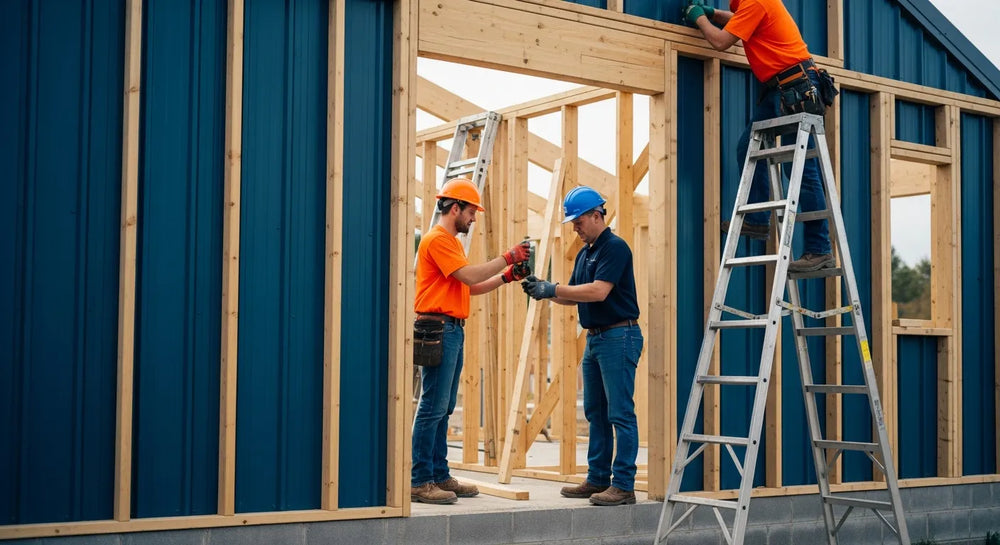
Cost to Build a Pole Barn House per Square Foot
Table of Contents
- Introduction
- Understanding the Pole Barn House Model
- The Raw Data: Average Cost per Square Foot
- Detailed Breakdown of Construction Components
- Solving the Liquidity Challenge in Construction
- CapEx Timing and 100% Bonus Depreciation
- Why Sourcing American-Made Matters
- Practical Procurement Scenario: Expanding a Machine Shop
- Factors That Can Influence Your Final Cost
- Maximizing Your Investment with Maden.co
- Maintenance and Long-Term Total Cost of Ownership (TCO)
- Step-by-Step Procurement Guide for Your Building Project
- Conclusion
- FAQ
Introduction
If you are managing a facility expansion or planning a new operations center, you have likely encountered the frustration of traditional construction timelines and the volatility of imported material costs. When a growing business needs additional square footage—whether for an integrated office-warehouse or a specialized workshop—waiting eighteen months for a conventional build can stifle market opportunities. This brings us to a pivotal question in modern industrial and residential construction: what is the actual cost to build a pole barn house per square foot, and how does it affect your bottom line?
At Maden.co, we recognize that the U.S. manufacturing revival is not just about the products made on the factory floor; it is about the infrastructure that houses those operations. The "shouse" (shop-house) and "barndominium" movements have transitioned from niche residential trends into viable solutions for small-to-medium enterprises (SMEs) looking for cost-effective, durable, and rapidly deployable structures. However, procurement managers often struggle with the "liquidity challenge"—the gap between needing a structure today and the slow, cumbersome process of traditional bank financing and supplier onboarding.
This article provides an exhaustive breakdown of the cost to build a pole barn house per square foot, covering everything from site preparation and raw materials to interior finishing and industrial-grade utilities. We will also explore how strategic financing through Maden Pay can eliminate "time-to-terms" friction, allowing you to secure American-made materials and begin construction without the bureaucratic delays of traditional credit applications. By the end of this guide, you will have a clear roadmap for your next capital expenditure project, ensuring high Total Cost of Ownership (TCO) efficiency and long-term structural integrity.
Understanding the Pole Barn House Model
Before diving into the specific dollar amounts, it is essential to define what makes a pole barn house (or post-frame building) unique. Unlike traditional "stick-frame" construction, which relies on a continuous concrete foundation and a network of closely spaced studs, post-frame construction utilizes large, pressure-treated poles or laminated columns buried in the ground or anchored to a slab. These posts provide the primary structural support, allowing for expansive interior spaces without the need for load-bearing interior walls.
For a business owner, this means unmatched flexibility. You can house a CNC machine shop on one side of the structure and a climate-controlled office suite on the other. Because the shell goes up significantly faster than traditional builds, you can move from groundbreaking to operation in a fraction of the time.
At Maden.co, our mission is to democratize access to American manufacturing. We believe that sourcing high-quality, U.S.-manufactured steel, timber, and fasteners is the foundation of a resilient supply chain. When you calculate the cost to build a pole barn house per square foot, you aren't just looking at a price tag; you are looking at an investment in American industrial excellence.
The Raw Data: Average Cost per Square Foot
Calculating the cost to build a pole barn house per square foot requires a distinction between the "shell" and the "finished" home or office.
The Shell Cost
For a basic, weather-tight shell—including the posts, trusses, metal siding, roof, and basic entry points—the cost typically ranges from $15 to $35 per square foot. This price fluctuates based on the quality of the steel (e.g., G-60 vs. G-90 galvanized coating) and the current market price of domestically sourced lumber.
The Fully Finished Cost
Once you transition from a simple storage building to a habitable or operational space with HVAC, plumbing, insulation, and interior walls, the price increases. A fully finished pole barn house generally costs between $80 and $150 per square foot. While this may seem comparable to traditional construction, the savings often manifest in reduced labor hours and the ability to utilize "bonus depreciation" on the structural components if used for business purposes.
Comparative Table: Construction Tiers
| Tier | Description | Est. Cost / Sq Ft |
|---|---|---|
| Basic Shell | Structural posts, roof, siding, gravel floor | $15 – $25 |
| Enclosed Shell | Windows, doors, concrete slab, basic vapor barrier | $30 – $45 |
| Industrial / MRO Build | High-load floors, 3-phase power, basic insulation | $50 – $75 |
| Full Residential / Office | Finished interior, plumbing, HVAC, high-end trim | $80 – $150+ |
Detailed Breakdown of Construction Components
To accurately estimate the cost to build a pole barn house per square foot, you must analyze the project across five primary phases. Each phase offers opportunities to source through Maden.co to ensure you are getting verified American-made quality.
1. Site Preparation and Foundation
The first major expense is preparing the land. Unlike a traditional home that requires a deep trench foundation, a pole barn can often be built on a simpler slab-on-grade or even with posts set into piers.
- Excavation and Clearing: Depending on the terrain, this can add $1,500 to $10,000 to the total project.
- Concrete Slab: A standard 4-inch reinforced concrete slab typically costs $6 to $10 per square foot. For industrial applications requiring heavy machinery, a 6-inch or 8-inch reinforced slab is necessary, which will increase the cost per square foot.
2. The Structural Kit
The "kit" is the heart of the project. We advocate for sourcing kits from manufacturers who prioritize supply chain transparency. A high-quality kit includes:
- Columns: Laminated columns are increasingly preferred over solid-sawn posts because they are straighter and less prone to warping.
- Trusses: Engineered wood or steel trusses designed to handle local snow and wind loads.
- Metal Siding and Roofing: 29-gauge or 26-gauge steel panels with high-quality paint systems (like Kynar 500) to prevent fading and corrosion.
3. Insulation and Climate Control
Because metal buildings are highly conductive, insulation is non-negotiable for comfort and energy efficiency.
- Closed-Cell Spray Foam: This is the gold standard for pole barns, providing both an R-value and a moisture barrier. It usually costs $2.50 to $5.00 per square foot of surface area.
- Batt and Blanket Insulation: A more budget-friendly option, though it requires a high-quality vapor barrier to prevent condensation against the metal skin.
4. Utilities and Industrial Systems
For B2B buyers, the "house" component often includes specialized utility needs.
- Electrical: Wiring a 2,000-square-foot pole barn house can range from $8,000 to $15,000 depending on whether you need 3-phase power for industrial equipment.
- Plumbing: Rough-in and fixture installation typically average $10,000 to $18,000.
5. Interior Finishing
This is where the cost to build a pole barn house per square foot varies most wildly. Using industrial-grade materials like metal interior liners can be more cost-effective and durable than traditional drywall for mixed-use buildings. You can find a wide range of these materials by choosing to browse all categories on our platform.
Solving the Liquidity Challenge in Construction
In the world of industrial procurement, cash flow is king. We understand that many U.S. manufacturers and contractors operate on net-30 to net-90 cycles. However, as traditional bank credit tightens, securing the capital for a new building project becomes a significant hurdle. This "liquidity challenge" often forces businesses to compromise on material quality or delay expansion.
Traditional procurement involves a painful "time-to-terms" friction. If you find a new supplier for your steel trusses or industrial fasteners, you might spend weeks filling out credit applications, providing tax returns, and waiting for an underwriter's approval. This delay can be catastrophic when you are trying to lock in pricing for a project.
At Maden.co, we have eliminated this bottleneck. By embedding credit directly into the transaction process through Maden Pay, we empower buyers to secure the terms they need instantly.
Why Maden Pay is a Strategic Operational Tool
Instead of viewing financing as a last resort, savvy procurement managers use it as a strategic tool to manage the cash conversion cycle.
- Speed: You can Check eligibility in under 60 seconds with a soft credit check that doesn't impact your score.
- Capacity: We offer credit lines typically ranging from $5,000 to over $250,000 for qualified businesses, providing the purchasing power needed for a full pole barn kit and interior materials.
- Efficiency: A single approval works across our entire marketplace. Whether you are buying the initial posts today or the HVAC components three months from now, your terms stay with you.
Disclaimer: Approvals, limits, and terms depend on business eligibility.
CapEx Timing and 100% Bonus Depreciation
For business owners and facility managers, the cost to build a pole barn house per square foot should always be viewed through the lens of tax strategy. Under current tax laws, certain "qualified improvement property" and equipment may be eligible for significant tax advantages.
100% Bonus Depreciation allows businesses to deduct a large percentage of the cost of eligible assets in the first year they are placed in service. If your pole barn house is primarily used for business operations—such as a manufacturing shop, warehouse, or office—you may be able to accelerate the depreciation of the structure or its components (like specialized flooring or HVAC systems).
This strategy can drastically lower your effective cost to build a pole barn house per square foot by providing immediate tax relief. However, tax laws are complex and subject to change. Always consult your tax professional to determine how bonus depreciation applies to your specific structural investment.
Why Sourcing American-Made Matters
When you are calculating the cost to build a pole barn house per square foot, it is tempting to look for the cheapest possible materials. However, in post-frame construction, "cheap" often translates to higher long-term costs due to structural failure, rust, or poor fitment during assembly.
By choosing American-made products, you are ensuring:
- Compliance with Industry Standards: U.S. manufacturers adhere to strict ASTM and AISI standards for steel and timber.
- Reduced Lead Times: Sourcing locally eliminates the months of waiting associated with ocean freight and customs delays.
- Support for the Manufacturing Revival: Every dollar spent on domestic materials strengthens the very supply chains your business relies on.
Our commitment to About us is simple: we want to make it easier for you to build a resilient, U.S.-based supply chain. We are not just a catalog; we are a strategic partner in your growth. If you are a manufacturer of high-quality construction components, we invite you to join our network through our Vendor registration page.
Practical Procurement Scenario: Expanding a Machine Shop
Consider a facility manager named Mark. Mark’s company just landed a major contract that requires three new CNC milling stations. His current facility is at maximum capacity. He decides to build a 2,400-square-foot pole barn house on an adjacent lot to serve as a high-precision milling center with a second-floor administrative office.
Mark estimates his cost to build a pole barn house per square foot will be roughly $95, given the need for reinforced concrete and climate control. He needs $228,000 in materials and labor.
If Mark goes the traditional route, he might spend a month talking to banks while the price of steel rises. Instead, Mark uses Maden.co. He selects a verified U.S. manufacturer for his post-frame kit and uses Maden Pay to secure net-60 terms. He gets an instant decision, allowing him to place the order the same day.
By the time Mark's first invoice is due, the building's shell is already up, and he has maintained his liquid cash to cover the down payments on the new CNC machines. This is the power of modern industrial procurement.
Factors That Can Influence Your Final Cost
To get a precise estimate of your cost to build a pole barn house per square foot, you must account for these often-overlooked variables:
Local Building Codes and Permits
Permit fees can range from a few hundred to several thousand dollars. Furthermore, if you are in a high-wind zone (like the Gulf Coast) or a heavy-snow zone (like the Upper Midwest), your kit will require additional bracing and heavier-gauge steel, which can add 10-15% to the shell cost.
Aesthetic Upgrades
If your pole barn house is in a visible location or needs to double as a showroom, you might opt for:
- Wainscoting: A two-tone metal exterior that adds visual interest.
- Cupolas and Awnings: These provide ventilation and curb appeal but increase the cost per square foot.
- Porches and Lean-tos: A popular way to add covered outdoor storage or entryways, typically costing $15-$25 per square foot of added space.
Labor Availability
While pole barns are faster to build, you still need skilled labor for the concrete work, electrical, and plumbing. In regions with a construction boom, labor rates can significantly drive up the total project cost. Some buyers choose to act as their own general contractor to save 10-20% on the project, but this requires significant time and oversight.
Maximizing Your Investment with Maden.co
Building a pole barn house is a significant capital investment. To ensure you receive the best value, you need a procurement partner that understands the nuances of the industrial market.
At Maden.co, we provide:
- Transparency: Know exactly where your materials are coming from.
- Innovation: A digital-first platform that simplifies complex B2B transactions.
- Excellence: Access to the best American manufacturers in one place.
Before you break ground, we encourage you to Check eligibility for financing. Having a pre-approved credit line allows you to negotiate with contractors from a position of strength, knowing that your material supply is already funded and secured.
Maintenance and Long-Term Total Cost of Ownership (TCO)
One of the greatest benefits of a pole barn house is the low maintenance requirement. Unlike wood-sided homes that require painting every 5-7 years, modern metal siding can last 40 years or more with minimal care.
Key Takeaway: When calculating the cost to build a pole barn house per square foot, don't forget to factor in the 30-year savings on maintenance. Metal roofs and siding are resistant to pests, fire, and rot, which can also lead to lower insurance premiums for your business.
To keep your facility running smoothly, you will eventually need MRO (Maintenance, Repair, and Operations) supplies. Whether it is replacement fasteners, industrial sealants, or lighting fixtures, you can Contact us for help sourcing specific American-made components.
Step-by-Step Procurement Guide for Your Building Project
- Define Your Use Case: Will this be 100% industrial, or a mixed-use residential/office space?
- Determine Square Footage: Create a floor plan that accounts for equipment clearance and future growth.
- Get a Quote for a Kit: Focus on U.S.-made steel and timber to ensure long-term structural integrity.
- Secure Financing: Use Maden Pay to establish your budget and lock in current pricing.
- Hire Your Crew: Search for contractors experienced in post-frame construction.
- Execute the Build: Monitor the installation of the vapor barrier and insulation closely, as these are critical for metal buildings.
Conclusion
Determining the cost to build a pole barn house per square foot is the first step toward a more efficient and resilient business infrastructure. While prices can range from $15 for a shell to over $150 for a finished office-home hybrid, the real value lies in the speed of construction and the flexibility of the design.
By leveraging American-made materials and modern financing solutions, you can bypass the traditional friction points of construction procurement. The U.S. manufacturing revival is here, and it is being built on a foundation of innovation, transparency, and strategic capital management.
We invite you to explore our marketplace, connect with verified vendors, and utilize the tools we have built to help your business thrive. Whether you are building a new workshop or a modern headquarters, we are here to ensure your project is a success.
Ready to start your project? Check eligibility for Maden Pay today and gain the purchasing power you need to bring your vision to life.
FAQ
1. What is the average cost to build a pole barn house per square foot for a basic shell?
A basic, weather-tight shell typically costs between $15 and $35 per square foot. This includes the primary structural members (posts and trusses) and the metal siding/roofing. It generally does not include a concrete slab, interior finishing, or utilities.
2. Can I use Maden Pay for the entire cost of my pole barn materials?
Yes, for qualified businesses, Maden Pay provides credit lines that can be used to purchase kits, individual materials, and MRO supplies across our marketplace. This allows you to consolidate your building material expenses into a single financing solution with terms (Net 30/60/90) that align with your business cash flow.
3. How does post-frame construction help with tax savings?
If the structure is used for business purposes, it may qualify for Section 179 expensing or 100% bonus depreciation. This allows you to deduct the cost of the asset more quickly than traditional depreciation schedules. Because pole barns are often classified differently than permanent real estate in some jurisdictions, there may be additional property tax advantages as well. Please consult your tax professional for specific advice.
4. Why should I choose U.S.-manufactured materials for my pole barn?
American-made steel and lumber are subject to rigorous quality control standards that ensure the safety and longevity of your building. Sourcing domestically also reduces the risk of supply chain disruptions and supports the American manufacturing revival. At Maden.co, we specialize in connecting you with these verified domestic suppliers.


