
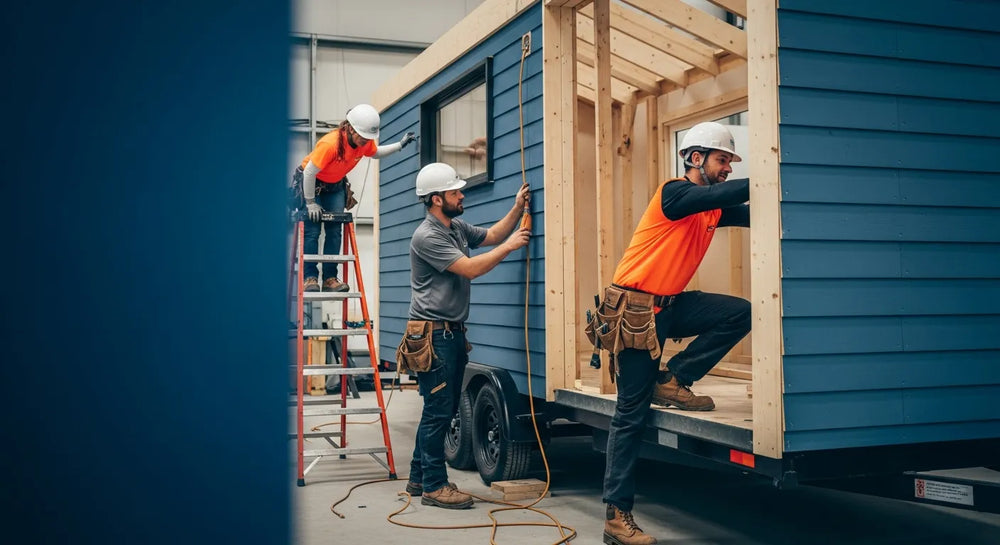
Cost to Build a Tiny House on a Trailer: A B2B Guide
Table of Contents
- Introduction
- The Strategic Importance of the U.S. Manufacturing Revival
- The Foundation: Selecting a Tiny House Trailer
- Structural Framing: Wood, Steel, and Material Procurement
- The External Envelope: Windows, Doors, and Roofing
- Internal Systems: Mechanical, Electrical, and Plumbing (MEP)
- The Liquidity Challenge: Navigating "Time-to-Terms"
- Accelerating Procurement with Maden Pay
- Strategic Tax Planning: 100% Bonus Depreciation
- Interior Finishes and MRO Needs
- Labor vs. DIY: The True Cost of Time
- Practical Procurement Scenario: The Workforce Housing Crisis
- Cost Summary Breakdown
- Navigating Regulatory and Compliance Standards
- Conclusion
- FAQ
Introduction
For a property developer looking to diversify into short-term rentals or an industrial facility manager tasked with providing onsite employee housing, the procurement timeline is often the difference between a high-yield project and a stalled asset. When considering the cost to build a tiny house on a trailer, the focus often shifts immediately to raw materials, but the true driver of project success lies in supply chain efficiency and liquidity management. We see many professional builders and enterprises struggle with the disconnect between high-speed construction needs and the sluggishness of traditional credit cycles.
The purpose of this guide is to provide a comprehensive analysis of the financial and logistical requirements involved in constructing a Tiny House on Wheels (THOW). We will move beyond surface-level estimates to explore the technical specifications of trailer chassis, the impact of fluctuating material costs, and the strategic advantages of sourcing through a verified U.S.-based marketplace. At Maden.co, we believe that the U.S. manufacturing revival is here, and it is built on a foundation of transparency and digital innovation.
By the conclusion of this article, you will understand how to optimize your Total Cost of Ownership (TCO), navigate the complexities of "time-to-terms" friction, and leverage embedded financing to maintain operational momentum. Building a tiny house on a trailer is not just a construction project; it is a strategic procurement exercise where financial speed and domestic quality determine the ultimate ROI.
The Strategic Importance of the U.S. Manufacturing Revival
Before diving into the line-item expenses, it is essential to frame the procurement process within the context of the current industrial landscape. At Maden.co, our mission is to democratize access to American manufacturing. For the B2B buyer, this means more than just supporting local jobs; it means reducing the risks inherent in long, opaque global supply chains. When you source the components for a tiny house—from the heavy-duty trailer to the HVAC units—from verified U.S. manufacturers, you are investing in industrial excellence and supply chain transparency.
The decision to build domestically often results in a more resilient supply chain. Traditional procurement models often leave buyers at the mercy of international shipping delays and fluctuating tariffs. By focusing on U.S.-made products, businesses can achieve tighter lead times and more reliable quality control. This is the core of what we do at Maden.co: we connect strategic buyers with the manufacturing power of the United States, ensuring that every bolt, beam, and bracket meets the rigorous standards required for mobile structural applications.
The Foundation: Selecting a Tiny House Trailer
The single most critical component of your build—and the one that dictates the entire engineering scope—is the trailer. Unlike a standard utility trailer, a tiny house trailer must be designed to support a distributed, permanent load that can reach up to 21,000 lbs or more.
Technical Specifications and Weight Ratings
The cost to build a tiny house on a trailer begins with the Gross Vehicle Weight Rating (GVWR). For a 20-foot to 30-foot tiny house, you typically look for trailers with dual or triple axles, each rated for 7,000 lbs.
- A36 Structural Steel: High-quality trailers utilize heavy-duty steel frames, often with integrated subflooring to lower the overall height of the unit.
- Electric Brakes and Breakaway Systems: Essential for safety and legal compliance during transport.
- Drop Axles vs. Straight Axles: Drop axles can provide an additional 4 inches of interior headroom, which is vital when staying within the standard 13.5-foot height limit.
On average, a purpose-built tiny house trailer costs between $6,000 and $12,000. While it may be tempting to source a cheaper, used flatbed, the modifications required to make a standard trailer "tiny house ready" often exceed the cost of a new, engineered chassis.
Structural Framing: Wood, Steel, and Material Procurement
Once the foundation is secure, the next major expenditure is the building envelope. This includes the framing, sheathing, and moisture barriers.
Traditional Wood Framing
Wood remains the most common choice due to its ease of use and insulating properties. However, weight is a constant concern. Builders often use 2x4 kiln-dried studs and advanced framing techniques (like OVE - Optimum Value Engineering) to reduce weight without sacrificing structural integrity.
- Cost Estimate: $2,500 – $5,500 depending on lumber market volatility.
Cold-Formed Steel (CFS) Framing
For industrial-grade builds and fleet applications, cold-formed steel framing is becoming the standard. CFS is lighter than wood, fire-resistant, and perfectly straight. It doesn't warp or rot, making it ideal for units that will be moved frequently.
- Cost Estimate: $4,000 – $8,500. While the upfront material cost is higher, the labor savings and weight reduction often improve the long-term TCO.
Sheathing and Barriers
High-performance builds utilize ZIP System sheathing or similar integrated R-value products that combine structural support with a built-in water-resistive barrier. This reduces procurement friction by combining two line items into one and speeds up the "dry-in" phase of the project. You can browse all categories on our platform to find the necessary structural adhesives and fasteners required for these advanced systems.
The External Envelope: Windows, Doors, and Roofing
A tiny house on a trailer is essentially a building subject to hurricane-force winds every time it travels down the highway. Therefore, the exterior components must be rated for high-impact and high-pressure scenarios.
Fenestration (Windows and Doors)
Standard residential windows often fail under the vibration and wind pressure of towing. Tempered glass and high-design-pressure (DP) rated units are necessary.
- Cost: $3,000 – $6,000 for a standard 24-foot build.
Roofing and Siding
Metal roofing is the preferred choice for its durability and light weight. For siding, LP SmartSide or cedar are popular, though fiber cement is often avoided due to its excessive weight.
- Cost: $4,000 – $7,500.
Internal Systems: Mechanical, Electrical, and Plumbing (MEP)
This is where the complexity of the "cost to build a tiny house on a trailer" truly escalates. You are essentially shrinking a full-sized home's infrastructure into a footprint the size of a parking space.
Electrical Systems
Most THOWs require a 30-amp or 50-amp RV-style hookup. However, for off-grid or high-tech applications, a robust solar array and lithium-ion battery bank can add significant cost.
- Standard Electrical: $1,500 – $3,000.
- Off-Grid Solar/Battery System: $5,000 – $15,000.
Plumbing and HVAC
PEX piping is the industry standard for THOWs due to its flexibility and resistance to freeze-cracking. For climate control, a mini-split heat pump system is the most efficient choice, providing both heating and cooling in a compact, quiet unit.
- Mini-Split System: $1,200 – $2,500.
- Plumbing Fixtures and Water Heaters: $2,000 – $4,500.
The Liquidity Challenge: Navigating "Time-to-Terms"
In traditional procurement, a facility manager or contractor might find the perfect U.S. manufacturer for their tiny house components but face a significant roadblock: the credit application. Traditional bank credit is tightening, and getting net terms from a new vendor can take weeks of paperwork, financial disclosures, and manual verification. This is the "time-to-terms" friction that stalls projects.
We recognize that U.S. manufacturing faces a structural liquidity challenge. Small to mid-sized manufacturers often operate on tight cash flow cycles, requiring payment upfront or within Net-30 windows. Conversely, buyers need the flexibility to align their purchasing with their own cash conversion cycles.
This is why we have integrated Maden Pay directly into the point of transaction. Instead of waiting weeks for a credit line, business buyers can receive instant eligibility decisions. This embedded financing is a strategic operational tool that allows you to secure the high-quality materials you need without depleting your working capital.
Approvals, limits, and terms depend on business eligibility.
Accelerating Procurement with Maden Pay
For a business building a fleet of tiny houses, the ability to access a credit line that works across the entire marketplace is a game-changer. Rather than renegotiating terms with a trailer manufacturer, a lumber yard, and an appliance wholesaler separately, a single approval on our platform covers your entire procurement list.
Why Maden Pay Outperforms Traditional Financing:
- Speed: Most businesses receive a decision in under 60 seconds via a soft credit check that does not impact their credit score.
- Capacity: We offer credit lines typically ranging from $5,000 to $250,000+ for qualified businesses, providing the scale necessary for large-scale tiny house production.
- Flexibility: With Net 30, 60, or 90-day options, you can check eligibility and align your payments with the completion and sale (or rental) of your tiny house units.
By reducing the administrative burden of traditional credit, Maden Pay allows you to focus on the engineering and construction phases of your project.
Strategic Tax Planning: 100% Bonus Depreciation
For B2B buyers and business owners, the cost to build a tiny house on a trailer can be mitigated through strategic tax planning. Under current tax laws, businesses may be able to take advantage of 100% bonus depreciation for assets like tiny houses when used for business purposes (such as short-term rentals, mobile offices, or employee housing).
This allows you to deduct the full cost of the asset in the first year it is placed in service, significantly improving your first-year cash flow. However, tax laws are complex and subject to change based on the year of purchase and specific asset classifications.
Disclaimer: You must consult your tax professional to determine how bonus depreciation applies to your specific business situation and to ensure compliance with current IRS regulations.
Interior Finishes and MRO Needs
The final 20% of the build often consumes 50% of the time and a significant portion of the budget. Interior finishes—cabinetry, flooring, and appliances—must be durable enough to withstand the "earthquake" conditions of highway travel.
Cabinetry and Storage
In a tiny house, every square inch must be functional. Custom-built cabinetry using lightweight plywood (like Baltic Birch) is often necessary to maximize storage while minimizing weight.
- Cost: $3,000 – $8,000.
Appliances
Compact, high-efficiency appliances are non-negotiable. Look for 24-inch ranges, apartment-sized refrigerators, and washer/dryer combos. Sourcing these through a platform like Maden.co ensures you are getting commercial-grade quality backed by U.S. warranties.
- Cost: $2,500 – $5,000.
For ongoing maintenance, repair, and operations (MRO), having a reliable supply chain partner is essential. If a specific fixture fails or a seal needs replacement, the ability to quickly contact us for sourcing support or browse our catalog for a domestic replacement minimizes downtime for your rental unit or mobile office.
Labor vs. DIY: The True Cost of Time
When calculating the cost to build a tiny house on a trailer, labor is the most significant variable.
- DIY Build: 800 to 1,500 hours of labor. While this "saves" money upfront, the opportunity cost for a business owner is high.
- Professional Build: Labor typically accounts for 30% to 50% of the total project cost. For a $70,000 build, labor might range from $20,000 to $35,000.
For businesses, the professional build is often more cost-effective when considering the speed to market. A unit built in 8 weeks by a professional team starts generating revenue months sooner than a DIY project. To facilitate this, we encourage domestic manufacturers to register as a vendor on our platform, connecting them with professional builders who require high volumes of American-made components.
Practical Procurement Scenario: The Workforce Housing Crisis
Consider a construction firm working on a remote pipeline project. They need 10 mobile housing units for their specialized engineers. Waiting for local bank approval for a $600,000 equipment loan could take two months—time the project doesn't have.
By utilizing the Maden.co marketplace, the procurement manager can source the trailers, framing kits, and interior finishes from verified U.S. manufacturers. By choosing to check eligibility for embedded financing, they secure the necessary capital to start the build immediately. The 10 units are completed and deployed within the same quarter, and the business utilizes Maden Pay to spread the payments over Net-90 terms, aligning with their project billing cycle. This is how digital innovation in the supply chain solves real-world liquidity challenges.
Approvals, limits, and terms depend on business eligibility.
Cost Summary Breakdown
To provide a clear picture of the investment required, here is a breakdown of the estimated costs for a professionally finished, 24-foot tiny house on a trailer:
| Component | Estimated Cost (Low) | Estimated Cost (High) |
|---|---|---|
| Trailer Chassis (7k Axles) | $6,500 | $10,000 |
| Framing (Steel or Wood) | $3,500 | $8,000 |
| Exterior (Roof, Siding, Windows) | $8,000 | $15,000 |
| MEP Systems (Plumbing, Elec, HVAC) | $6,000 | $12,000 |
| Insulation (Spray Foam) | $1,500 | $3,000 |
| Interior Finishes (Floors, Walls) | $4,000 | $9,000 |
| Cabinetry & Appliances | $6,000 | $12,000 |
| Labor (Professional) | $20,000 | $40,000 |
| Total Estimated Cost | $55,500 | $109,000 |
Note: These are estimates based on 2024 market data for U.S.-manufactured components. Prices will vary based on geographic location and specific material choices.
Navigating Regulatory and Compliance Standards
When building on a trailer, the unit often falls into a regulatory "gray area" between a vehicle and a structure. To ensure long-term value and safety, businesses should adhere to recognized standards:
- ANSI A119.5: The standard for park model recreational vehicles.
- NFPA 1192: The standard for recreational vehicles, covering fire and life safety.
- NOAH or Pacific West Certification: Third-party inspection services that verify the build meets residential building codes (IRC) despite being on a mobile chassis.
Sourcing certified components from the Maden.co catalog is the first step in ensuring your build meets these rigorous requirements. Compliance is not just about safety; it is about protecting your investment and ensuring the unit can be insured and financed in the future.
Conclusion
The cost to build a tiny house on a trailer is an investment in both physical materials and supply chain strategy. For the B2B buyer, success depends on more than just the price of lumber; it depends on the ability to source high-quality, American-made components quickly and the flexibility to manage cash flow effectively.
At Maden.co, we are proud to be your strategic partner in this journey. By connecting you with verified U.S. manufacturers, we help you build a more resilient and transparent supply chain. Whether you are expanding a rental fleet or providing industrial site housing, the tools for success are at your fingertips.
The U.S. manufacturing revival is here. We invite you to explore our comprehensive catalog, source the precision-engineered parts you need, and utilize our embedded financing to keep your projects on schedule and under budget.
Ready to streamline your procurement?
- Browse all categories to source U.S.-made components.
- Check eligibility for Maden Pay and secure your project's liquidity today.
Approvals, limits, and terms depend on business eligibility.
FAQ
1. What is the average total cost to build a tiny house on a trailer for a business?
While DIY builds can start as low as $30,000, most professional-grade, B2B tiny houses cost between $60,000 and $110,000. This includes high-quality U.S.-manufactured trailers, premium insulation, mini-split HVAC systems, and commercial-grade finishes that ensure a lower Total Cost of Ownership (TCO) and higher durability for rental or industrial use.
2. Why is the trailer chassis considered the most important cost factor?
The trailer is the structural foundation of the entire build. Unlike stationary homes, a THOW must withstand the stresses of transportation and constant vibration. A purpose-built tiny house trailer includes specific features like integrated flashing, reinforced wheel wells, and a GVWR rated for the heavy distributed load of a house. Investing in a high-quality, American-made trailer (typically $6k–$10k) prevents structural failure and ensures legal compliance on public roads.
3. Can businesses claim bonus depreciation on tiny houses built on trailers?
Yes, in many cases, tiny houses used for business purposes—such as employee housing, mobile offices, or short-term rentals—may qualify for 100% bonus depreciation. This allows the business to deduct the entire cost of the asset in the year it is placed in service. However, tax laws vary and are subject to change. Always consult your tax professional to understand the specific implications for your business.
4. How does Maden Pay help with the cost of materials?
Maden Pay addresses the "time-to-terms" friction in the industrial supply chain. Instead of waiting weeks for traditional bank credit or vendor-specific net terms, businesses can receive an instant eligibility decision for credit lines up to $250K+. This allows builders to purchase all necessary U.S.-made materials upfront while utilizing Net 30, 60, or 90-day payment options to align with their project's cash conversion cycle. Approvals, limits, and terms depend on business eligibility.


