
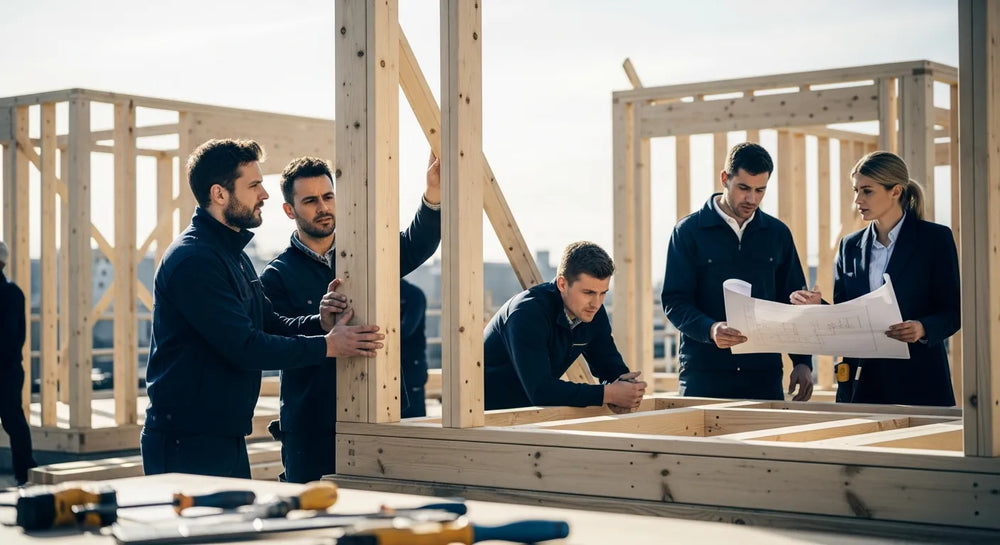
Factors Influencing the Cost to Build Frame House Units
Table of Contents
- Introduction
- The Foundation of Framework Costs
- Understanding the Material Breakdown
- The Liquidity Challenge in Modern Procurement
- Strategic Financing with Maden Pay
- Labor and Regional Cost Variations
- CapEx Timing and 100% Bonus Depreciation
- Eliminating Procurement Friction
- Technical Standards and Quality Assurance
- The Impact of Time-to-Terms on Project Velocity
- Sustainable Sourcing and the American Revival
- Detailed Breakdown: Wood vs. Steel Frame Costs
- Digital Innovation in the Supply Chain
- Navigating Market Volatility
- Practical Scenario: The Multi-Unit Developer
- Building for the Future
- Final Considerations on Total Cost of Ownership (TCO)
- Summary of Key Takeaways
- FAQ
Introduction
Imagine a project manager overseeing a 50-unit residential development who discovers that a critical shipment of structural connectors has been delayed by six weeks due to an overseas port disruption. For every day the site remains idle, the holding costs, labor retention fees, and lost opportunity costs mount, quickly ballooning the initial budget. In the high-stakes world of industrial construction and development, cash flow is the lifeblood of progress, yet traditional procurement methods often force buyers to choose between high-interest debt or crippling delays. At Maden.co, we believe that the American manufacturing revival is here, and it is built on the foundation of a resilient, transparent, and financially agile supply chain.
The purpose of this guide is to provide procurement managers, developers, and business owners with a comprehensive analysis of the cost to build frame house structures, with a specific focus on sourcing American-made materials. We will explore the technical nuances of wood versus steel framing, the impact of current market volatility on material pricing, and the strategic importance of supply chain transparency. Furthermore, we will address the structural liquidity challenges that plague the industry and demonstrate how modern financing solutions can bridge the gap between procurement needs and operational reality. By the end of this discussion, you will understand how leveraging a strategic partner like Maden.co can improve your Total Cost of Ownership (TCO) and accelerate your project timelines through digital innovation.
The Foundation of Framework Costs
When analyzing the cost to build frame house developments, the primary driver is the choice of material. Traditionally, wood framing has been the standard in North American residential construction due to its historical abundance and ease of use. However, the B2B sector is increasingly looking toward light-gauge or cold-formed steel (CFS) for multi-unit and commercial-adjacent frame structures.
The choice between wood and steel isn't just about the price per board-foot or ton; it’s about the total lifecycle cost and the speed of the supply chain. Wood prices are notoriously volatile, influenced by everything from seasonal harvesting restrictions to international trade tariffs. Conversely, steel offers a more predictable price point in certain industrial volumes and provides superior resistance to pests, rot, and fire, which can significantly lower long-term insurance premiums for developers.
At Maden.co, we emphasize that sourcing these materials domestically is not just a matter of pride; it is a strategic maneuver to mitigate risk. When you source through our marketplace, you are tapping into a network of verified U.S. manufacturers, ensuring that the components—from the base plates to the roof trusses—meet rigorous American standards such as ASTM and AISI.
Understanding the Material Breakdown
The cost to build frame house units is generally divided into several core categories: lumber or steel components, specialized fasteners, sheathing, and insulation.
Lumber and Engineered Wood
For a standard wood-frame house, dimensional lumber (2x4, 2x6, etc.) makes up the skeleton. However, modern industrial-scale projects often utilize engineered wood products like I-joists, Laminated Veneer Lumber (LVL), and Glulam beams. These products offer higher strength-to-weight ratios and allow for larger open spans, which can reduce the total volume of material needed. You can explore a wide variety of these essential construction materials through our Browse All Categories page.
Steel Framing Systems
Cold-formed steel is gaining traction in the "cost to build frame house" equation because of its precision. Steel studs are manufactured to exact specifications, reducing on-site waste. In a B2B environment, where labor costs are a significant percentage of the total budget, the ability to use pre-punched steel members for rapid electrical and plumbing installation can offset the slightly higher initial material cost compared to wood.
Fasteners and Hardware
The integrity of a frame house depends on its connections. Structural bolts, framing nails, and specialized ties must be sourced with transparency. Using sub-standard fasteners can lead to structural failures or failed inspections, both of which are catastrophic for project budgets. We connect industrial buyers with millions of verified American-made products, including high-quality fasteners that adhere to strict NPT and DIN standards where applicable.
The Liquidity Challenge in Modern Procurement
One of the most significant barriers to managing the cost to build frame house projects effectively is the structural liquidity challenge. In the U.S. manufacturing and construction landscape, many small-to-medium manufacturers and buyers operate on net-30 to net-90 cycles. However, as traditional bank credit continues to tighten, the "time-to-terms" friction becomes a major bottleneck.
Traditionally, if a procurement manager needs to onboard a new supplier for specialized framing components, they must go through a weeks-long process involving credit applications, financial disclosures, and manual negotiations. This delay can be the difference between hitting a project milestone or missing it. We solve this by embedding credit directly at the point of transaction. With Maden Pay, buyers can access net terms almost instantly, allowing them to secure materials without exhausting their immediate cash reserves.
Strategic Financing with Maden Pay
For a business owner looking to scale their operations, managing the cash conversion cycle is critical. When you are looking at the total cost to build frame house units, the ability to defer payment can significantly improve your ROI. Maden Pay is not just a payment method; it is a strategic operational tool designed for the industrial buyer.
The benefits of using Maden Pay include:
- Speed: Unlike traditional bank loans that take weeks, our platform provides instant eligibility decisions, often in under 60 seconds, via a soft credit check that does not impact your credit score.
- Capacity: We offer credit lines commonly ranging from $5,000 to over $250,000 for qualified businesses, providing the necessary leverage for large-scale material orders.
- Alignment: Our Net 30, 60, and 90-day options are specifically designed to align with B2B cash conversion cycles, giving you the breathing room to complete a phase of construction before the bill is due.
- Efficiency: A single approval works across our entire marketplace. You don't need to renegotiate terms with every new manufacturer you find on Maden.co.
Disclaimer: Approvals, limits, and terms depend on business eligibility. If you are ready to see how much purchasing power your business can unlock, you can Check eligibility today.
Labor and Regional Cost Variations
The "cost to build frame house" isn't a static number across the United States. Labor availability and regional building codes play a massive role. In the Pacific Northwest, wood might be more cost-effective due to proximity to timber mills. In the Southeast, steel or masonry might be preferred for hurricane resistance.
In the B2B sector, "soft costs" such as architectural design, engineering stamps, and permitting can account for 10% to 20% of the total project cost. By sourcing standardized, U.S.-made framing kits or components, engineers can reduce the time spent on custom calculations, thereby lowering these soft costs. At Maden.co, we are a strategic partner in building a resilient, U.S.-based supply chain, helping you find the right manufacturers who understand these regional nuances. Our About Us page details our commitment to this domestic manufacturing revival.
CapEx Timing and 100% Bonus Depreciation
For businesses investing in framing equipment, modular house-building machinery, or large-scale material inventories, tax strategy is a vital component of the cost equation. Under current tax laws, businesses may be able to take advantage of 100% bonus depreciation for certain qualified assets.
This allows a company to deduct the full cost of the asset in the first year it is placed in service, rather than depreciating it over several years. This can be a massive boon for companies looking to modernize their framing operations or invest in U.S.-made manufacturing equipment.
Note: Always consult your tax professional to understand how bonus depreciation applies to your specific business situation and to ensure compliance with the latest IRS regulations.
Eliminating Procurement Friction
Traditional procurement is often characterized by "friction"—the hidden costs associated with finding vendors, verifying their quality, and managing multiple invoices. When calculating the cost to build frame house developments, you must account for the administrative hours spent on these tasks.
Maden.co serves as a centralized hub that eliminates this friction. Instead of managing twenty different vendors for studs, trusses, fasteners, and sheathing, you can find them all in one place. This centralization improves Supply Chain Transparency, as every vendor on our platform is a verified American manufacturer. For manufacturers who want to join this movement and reach high-intent B2B buyers, we invite you to explore our Vendor Registration page.
Technical Standards and Quality Assurance
A major factor in the long-term cost to build frame house structures is the quality of the components. Inferior materials lead to "callback" costs—expensive repairs that occur after the structure is completed. For example, using non-standardized lumber can lead to excessive warping, which disrupts drywall installation and door framing.
By focusing on Industrial Excellence, we ensure that the products listed on Maden.co meet the technical specifications required for modern engineering. Whether it's ensuring the galvanization thickness on steel studs or the moisture content in kiln-dried lumber, sourcing from verified U.S. manufacturers provides a layer of quality assurance that "budget" international imports simply cannot match. This adherence to standards is part of what makes our marketplace a leader in the industrial space.
The Impact of Time-to-Terms on Project Velocity
Project velocity is the speed at which a project moves from inception to completion. Any delay in the supply chain directly impacts velocity. As we've discussed, the traditional "time-to-terms" process is a primary culprit for these delays.
For a facility manager whose expansion depends on a new framed structure, waiting weeks for a credit line to open with a lumber yard is unacceptable. By utilizing Maden Pay, that manager can Check eligibility in minutes and have the order processed the same day. This speed allows for "just-in-time" delivery models that reduce the need for expensive on-site storage and minimize the risk of material theft or weather damage.
Sustainable Sourcing and the American Revival
There is a growing demand for sustainable building practices in the construction of frame houses. Sourcing locally in the U.S. inherently reduces the carbon footprint associated with long-distance shipping. Furthermore, American manufacturers are subject to some of the world's most stringent environmental and labor regulations, ensuring that the "cost to build frame house" isn't being subsidized by unethical practices abroad.
We are proud to support the manufacturing revival by making it easier for buyers to choose domestic options. Every transaction on Maden.co supports American jobs and strengthens the domestic industrial base. If you have specific sourcing needs or need assistance finding a particular U.S.-made framing component, our team is ready to help through our Contact Us page.
Detailed Breakdown: Wood vs. Steel Frame Costs
To provide a clearer picture of the cost to build frame house units, let’s look at a comparative breakdown of material and labor considerations.
Wood Framing (The Traditional Approach)
- Material Cost: Generally lower than steel, though subject to high volatility.
- Labor Cost: Lower, as the labor pool for wood framing is vast.
- Pros: Carbon sequestration, renewable resource, excellent thermal properties.
- Cons: Susceptible to termites, mold, and fire; dimensional instability (warping).
Steel Framing (The Industrial Approach)
- Material Cost: Often higher or on par with premium wood, but more price-stable.
- Labor Cost: Can be higher due to the need for specialized tools (screw guns vs. nail guns) and techniques, though pre-fab options are narrowing this gap.
- Pros: 100% recyclable, non-combustible, termite-proof, perfectly straight members.
- Cons: Thermal bridging requires extra insulation; higher initial tool investment.
By analyzing these factors through the lens of Total Cost of Ownership, many B2B buyers find that the longevity and reduced maintenance of steel framing offer a better value proposition for commercial and multi-family projects.
Digital Innovation in the Supply Chain
The industrial sector has historically been slow to adopt digital tools, but Maden.co is changing that narrative. Digital innovation is one of our core values, and it manifests in how we simplify the procurement of framing materials. From robust search filters that allow you to find specific ASTM-rated products to a streamlined checkout process that integrates Maden Pay, we are bringing the convenience of B2C e-commerce to the complex world of B2B industrial supply.
This innovation extends to how we handle data. By providing transparent lead times and real-time inventory levels from American manufacturers, we allow procurement managers to plan their "cost to build frame house" budgets with unprecedented accuracy. No more "ghost" inventory or surprise lead times from overseas suppliers.
Navigating Market Volatility
In recent years, the construction industry has faced "black swan" events that caused lumber prices to quadruple overnight. While no one can predict the next market shift, a resilient supply chain is the best defense. A resilient supply chain is one that is short, transparent, and diverse.
By sourcing from multiple U.S.-based manufacturers on Maden.co, you avoid putting all your eggs in one basket. If one mill in Georgia is facing delays, you can quickly pivot to a manufacturer in Oregon or Pennsylvania. This flexibility is essential for maintaining your project's "cost to build frame house" estimates and avoiding the budget overruns that come with scarcity pricing.
Practical Scenario: The Multi-Unit Developer
Consider a developer planning a 20-unit framing project. Their traditional bank has capped their construction loan, leaving them with a gap in liquidity for the final phase of framing materials. Using traditional methods, they might have to halt work while they seek a bridge loan—a process that could take 30 days and come with heavy origination fees.
Instead, the developer turns to Maden.co. They find a U.S. manufacturer for the remaining roof trusses and wall panels. At checkout, they select Maden Pay and are approved for a $150,000 credit line with Net 60 terms. The materials are shipped, the project continues without a day of downtime, and the developer pays the invoice once the next draw from their primary lender is released. This is the power of embedded financing in action.
Building for the Future
The American manufacturing revival is not just a slogan; it is a practical necessity for a stable economy. As we look at the future of housing and industrial construction, the cost to build frame house units will continue to be influenced by global trends. However, by focusing on domestic production, we can insulate ourselves from much of this external pressure.
At Maden.co, our mission is to democratize access to these American-made solutions. We believe that every business, regardless of size, should have the tools they need to build, create, and grow. Whether you are a small contractor or a large-scale developer, we are here to provide the platform and the financing to make your project a success.
Final Considerations on Total Cost of Ownership (TCO)
When you calculate the cost to build frame house units, always look beyond the initial invoice. TCO includes:
- Purchase Price: The cost of the materials.
- Logistics: The cost of shipping and the risk of transit damage.
- Procurement Labor: The time spent by your staff managing the order.
- Financing Costs: The interest or opportunity cost of the capital used.
- Quality Costs: The cost of waste, rework, and long-term maintenance.
By sourcing through Maden.co, you are optimizing every one of these categories. You get competitive pricing on domestic goods, reduced logistical risks, a streamlined digital procurement process, strategic financing through Maden Pay, and the peace of mind that comes with Industrial Excellence.
Summary of Key Takeaways
The path to a successful and cost-effective framing project lies in three areas: Sourcing, Financing, and Transparency.
- Sourcing: Prioritize American-made materials to ensure quality and reduce logistical uncertainty.
- Financing: Use tools like Maden Pay to overcome the liquidity challenge and eliminate "time-to-terms" friction.
- Transparency: Leverage digital marketplaces to gain full visibility into your supply chain and material specifications.
As the U.S. manufacturing revival continues to gain momentum, Maden.co remains committed to being your strategic partner. We are more than just a marketplace; we are the engine driving a more resilient, efficient, and proudly American industrial landscape.
FAQ
1. How does sourcing American-made materials affect the overall cost to build frame house units? Sourcing American-made materials can initially seem more expensive than low-cost international imports, but it often results in a lower Total Cost of Ownership. Domestic sourcing reduces shipping lead times, lowers the risk of transit damage, and ensures compliance with strict U.S. building codes and technical standards (like ASTM). Furthermore, it provides greater supply chain transparency, reducing the administrative costs associated with managing complex international logistics and quality control issues.
2. What is "time-to-terms" friction, and how does Maden Pay solve it? "Time-to-terms" friction refers to the lengthy delay businesses face when trying to secure net terms or credit lines from traditional suppliers or banks. This process often involves weeks of paperwork and manual credit checks. Maden Pay eliminates this by embedding financing directly into the marketplace checkout. It provides instant eligibility decisions—often in under 60 seconds—allowing buyers to secure net 30/60/90 terms immediately and keep their projects moving without capital-induced delays.
3. Can I use bonus depreciation for my construction material purchases? Bonus depreciation (specifically under Section 168(k) of the tax code) typically applies to "qualified property," which often includes equipment, machinery, and certain structural improvements rather than raw inventory. However, for businesses investing in specialized framing machinery, modular building units, or significant capital improvements, 100% bonus depreciation can be a powerful tool to reduce tax liability. Always consult your tax professional to determine how current tax laws apply to your specific business and assets.
4. Is steel framing really more cost-effective than wood for a frame house? The cost-effectiveness of steel vs. wood depends on the project scope and long-term goals. While wood often has a lower upfront material cost, steel framing offers superior dimensional stability, fire resistance, and durability against pests. In a B2B or commercial context, the precision of steel can lead to faster on-site assembly and reduced waste, potentially lowering labor costs. Additionally, the long-term insurance premiums for steel-framed structures are often lower, improving the TCO over the life of the building.
The U.S. Manufacturing Revival Is Here. Whether you are ready to scale your operations or simply need a more reliable way to source essential framing components, we invite you to explore our catalog. Your next project deserves the quality, speed, and financial agility that only a dedicated American marketplace can provide.
Visit the Maden.co Homepage today to begin, or if you're ready to boost your purchasing power, Check eligibility for Maden Pay and experience the future of industrial procurement.


