
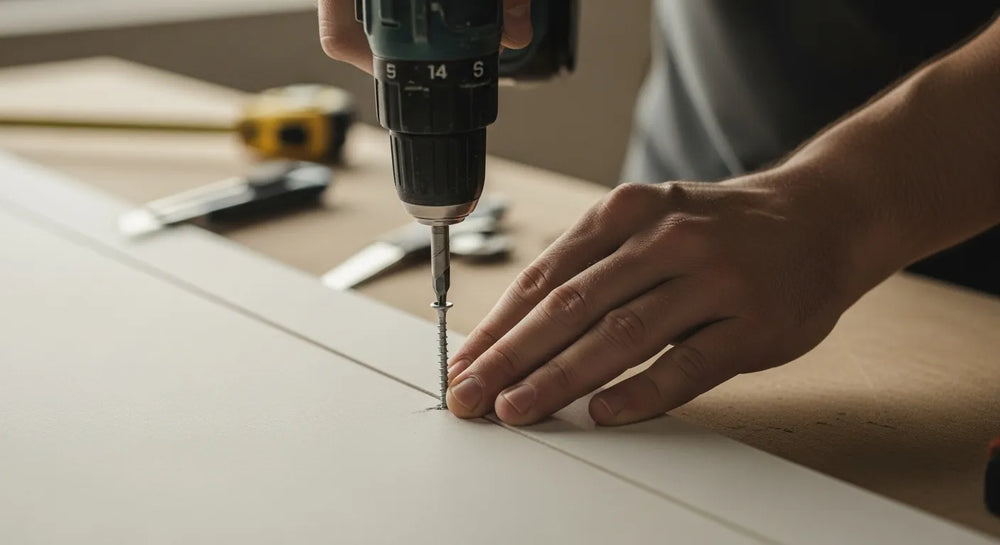
Can Drywall Anchors Be Removed? A Pro Guide
Table of Contents
- Introduction
- Understanding the "Why": Common Scenarios for Anchor Removal in a Professional Setting
- A Technical Breakdown: Types of Drywall Anchors and Their Removal Challenges
- Step-by-Step Removal Techniques: A Professional's Guide
- Prevention Over Cure: The Strategic Value of Sourcing Quality Components
- Streamlining Procurement for Large-Scale Projects
- Conclusion
- Frequently Asked Questions (FAQ)
Introduction
A maintenance manager faces the daunting task of reconfiguring an entire corporate office floor. Hundreds of wall-mounted shelves, whiteboards, and cable management systems must be relocated. Each fixture leaves behind a ghost: a small, unassuming plastic or metal drywall anchor. Multiplied by the hundreds, this seemingly minor issue becomes a significant operational challenge, impacting project timelines, labor costs, and the final aesthetic finish of the space. Can these anchors be removed cleanly? Or will each one become a time-consuming repair job, a blemish on an otherwise pristine wall? This is a question faced daily in maintenance, repair, and operations (MRO) across every industry.
The answer is a definitive yes, but the process is far more nuanced than simply pulling it out. The method, the tools required, and the resulting wall repair all depend entirely on the type of anchor used. An improper removal technique can turn a small hole into a significant drywall patch, escalating costs and extending project downtime. For professionals, efficiency and precision are paramount.
This article provides an authoritative, in-depth guide for MRO buyers, facility managers, and technicians on the proper techniques for removing various types of drywall anchors. We will move beyond simple DIY tips to explore the professional context, examining different anchor designs, providing step-by-step removal instructions, and detailing the correct procedures for wall repair. Furthermore, we will explore a critical, often-overlooked aspect of the process: how strategic upfront sourcing of high-quality, American-made components can drastically simplify future maintenance and reduce the Total Cost of Ownership (TCO). This is the core of our mission at Maden.co: to empower American businesses by providing direct access to a vast catalog of industrial products from verified U.S. manufacturers, ensuring quality and reliability from the very start.
Understanding the "Why": Common Scenarios for Anchor Removal in a Professional Setting
In commercial, industrial, and institutional environments, the need to remove drywall anchors is a frequent and necessary task. Unlike residential settings where an anchor might hold a picture frame for years, professional spaces are dynamic. Understanding these scenarios highlights the importance of mastering the removal and repair process.
Corporate and Office Environments
Office layouts are constantly evolving to accommodate changes in team size, workflow, and technology. This leads to common tasks like:
- Relocating Shelving and Cabinets: As departments expand or contract, storage solutions must move with them.
- Moving Whiteboards and AV Equipment: Conference rooms and collaborative spaces are often reconfigured, requiring the removal and re-installation of heavy presentation equipment.
- Updating Signage and Branding: Corporate branding updates or departmental moves necessitate the removal of old signs and logos.
- Re-routing Network and Power Cabling: Surface-mounted conduits and cable raceways are often secured with drywall anchors and may need to be moved to accommodate new workstations.
Retail and Hospitality Spaces
The retail and hospitality industries rely on creating specific customer experiences, which requires frequent updates to the physical environment.
- Changing Product Displays: Retail stores constantly update their merchandising, which involves moving shelving, display racks, and promotional fixtures.
- Hotel Room Refurbishments: During renovations, headboards, artwork, mirrors, and televisions are removed, leaving behind numerous anchors.
- Restaurant and Bar Redesigns: Changes in layout, decor, and thematic elements often involve relocating wall-mounted items.
Healthcare and Laboratory Facilities
In these highly controlled environments, precision and cleanliness are critical.
- Moving Medical Equipment: Wall-mounted diagnostic tools, glove dispensers, and monitors may need to be relocated as clinical needs change.
- Reconfiguring Laboratory Setups: Research and development labs are dynamic spaces where shelving for chemicals, equipment mounts, and utility hookups are frequently adjusted.
Industrial and MRO Applications
Even in workshops and manufacturing facilities, drywall is often used in offices, break rooms, and control centers.
- Relocating Safety Equipment: Fire extinguishers, first aid stations, and MSDS binders may need to be moved to comply with changing safety regulations or plant layouts.
- Mounting and Moving Tool Boards: Shadow boards and tool storage systems are often re-organized to improve workflow efficiency.
In every one of these professional scenarios, a failed removal attempt is not just an inconvenience; it represents lost time, added material cost, and a potential compromise to the professional appearance of the facility. This underscores the need for both proper technique and quality components from the outset.
A Technical Breakdown: Types of Drywall Anchors and Their Removal Challenges
The key to successful anchor removal lies in understanding the anchor’s design and how it interacts with the drywall. Each type employs a different mechanism to create its holding power, and that mechanism dictates the best removal strategy.
### Expansion Anchors
These are the most common type of light-to-medium-duty anchor. They are typically made of plastic and work by expanding behind the drywall as a screw is driven into them.
- Mechanism: The anchor is inserted into a pre-drilled hole. The screw’s threads bite into the plastic, forcing the anchor’s sides to flare out and press against the back of the drywall. A high-quality example, designed for reliable performance, is the U.S.-made Ribbed Plastic Anchor, whose ribs prevent it from spinning during installation.
- Removal Challenge: The expanded fins behind the drywall are wider than the entry hole, making a clean pull-out nearly impossible without causing significant damage. The plastic can also become brittle over time, breaking apart during removal attempts.
### Self-Drilling Anchors (Threaded Anchors)
These anchors are popular for their ease of installation, as they don’t require a pre-drilled hole. They have a sharp, threaded body that bores directly into the drywall.
- Mechanism: The anchor is screwed into the wall using a screwdriver or drill. Its wide threads cut into the gypsum, providing a secure hold for a subsequent screw. The Medium Duty Nylon Wall Anchor #6 Self-Drilling Drywall Zip-It® is a prime example of this design, valued for its rapid installation in MRO applications.
- Removal Challenge: While they are designed to be unscrewed, this isn't always straightforward. The drywall around the anchor can crumble, causing the anchor to spin in place rather than back out. Over-tightening during installation can also strip the drywall, making removal difficult.
### Sleeve-Type Anchors (Toggle Bolts & Strap Toggles)
These are heavy-duty anchors used for mounting significant loads like large monitors, heavy shelving, or grab bars.
- Mechanism: These anchors consist of a bolt and a spring-loaded or gravity-operated toggle (wings). A large hole is drilled, the toggle is folded and pushed through, and it springs open in the cavity behind the drywall. Tightening the bolt pulls the toggle tight against the back of the wall.
- Removal Challenge: The toggle mechanism is, by design, impossible to pull back through the installation hole. Attempting to do so will result in a large, torn section of drywall. The only viable removal method is to push the toggle into the wall cavity.
### Molly Bolts (Metal Expansion Anchors)
Molly bolts are another medium-to-heavy-duty option, offering more strength than plastic expansion anchors.
- Mechanism: A metal sleeve is inserted into a pre-drilled hole. As the bolt is tightened, the sleeve is compressed, causing it to deform and create several "legs" that brace against the back of the drywall.
- Removal Challenge: Similar to sleeve-type anchors, the expanded legs are much wider than the hole. They cannot be pulled out directly. The metal construction also means they are more rigid and can cause more damage if removed incorrectly.
Step-by-Step Removal Techniques: A Professional's Guide
Armed with an understanding of anchor mechanics, we can now outline the precise, professional methods for removing each type. Always begin by wearing appropriate personal protective equipment (PPE), including safety glasses, to protect from dust and debris.
### Method 1: Removing Plastic Expansion Anchors
There are two primary approaches: the push-through method and the pull-out method. The push-through is generally preferred as it causes the least surface damage.
Push-Through Method (Recommended)
- Remove the Screw: Completely back out the screw from the plastic anchor.
- Recess the Anchor: Use a nail set or a small Phillips head screwdriver and a hammer. Place the tip of the tool on the anchor's rim and give it a firm but controlled tap. The goal is to push the anchor head just below the surface of the drywall (about 1/8 inch).
- Apply Spackling Compound: Apply a small amount of spackling paste or drywall compound directly over the recessed anchor and the small hole.
- Finish the Surface: Once dry, lightly sand the area until it is smooth and flush with the surrounding wall. Prime and paint to match.
Pull-Out Method (Use with Caution)
- Grip the Rim: Use a pair of needle-nose pliers or a utility knife to carefully grip the outer rim of the anchor.
- Wiggle and Pull: Gently wiggle the anchor back and forth while pulling it straight out. If it resists, do not force it, as this will tear the paper and gypsum. You may need to use a utility knife to score around the anchor's flange to free it.
- Repair the Hole: This method will likely leave a larger, more jagged hole that will require more extensive patching with spackling compound.
### Method 2: Removing Self-Drilling Anchors
The goal here is to unscrew the anchor just as it was installed.
- Remove the Internal Screw: First, take out the screw that was holding the fixture.
- Engage the Anchor Head: Insert the appropriate screwdriver (usually a Phillips head) into the head of the anchor itself.
- Apply Firm, Steady Pressure: Press firmly inward while turning the screwdriver counter-clockwise. This inward pressure is critical to prevent the anchor from spinning in place and stripping the surrounding drywall.
- Back Out Slowly: Continue to turn slowly and steadily until the anchor is completely free from the wall.
- Address a Stripped Anchor: If the anchor spins without backing out, you will need to switch methods. Use pliers to grip the head and try to pull and turn simultaneously. If this fails, you may need to cut the head flush with a utility knife and use the push-through method described for expansion anchors.
### Method 3: Removing Toggle Bolts and Strap Toggles
As discussed, these cannot be pulled out. The only option is to abandon the toggle mechanism inside the wall.
- Unscrew the Bolt: Back the bolt out completely from the toggle wings. The wings will fall down into the wall cavity.
- Assess the Hole: You will be left with a relatively large hole (often 1/2 inch or more).
- Patch the Hole: This size of hole cannot be filled with spackling alone. You will need to use a self-adhesive mesh patch or California patch for a durable repair. Cover the patch with joint compound, feathering the edges. Multiple thin coats are better than one thick coat. Sand, prime, and paint.
### Method 4: Removing Molly Bolts
Molly bolts require a specific technique to either remove or recess them.
- Remove the Screw: Back the screw out of the sleeve, but do not remove it completely. Leave it threaded in by a few turns.
- Collapse the Legs: Gently tap the head of the screw with a hammer. This will push the sleeve inward and cause the expanded legs to flatten against the back of the drywall.
- Pull Straight Out: Once the legs are straightened, you should be able to pull the entire molly bolt assembly out of the wall using pliers or by pulling on the screw head.
- Alternative (Push-Through): If the bolt cannot be pulled out, fully remove the screw. Use a nail set to drive the entire sleeve through the drywall and into the wall cavity. This leaves a cleaner hole to patch than trying to force it out.
- Repair: Patch the remaining hole using spackling compound, sanding, and finishing as needed.
Prevention Over Cure: The Strategic Value of Sourcing Quality Components
While mastering removal techniques is a valuable skill for any MRO professional, a more profound, strategic approach focuses on the initial procurement process. The quality, material composition, and manufacturing consistency of the anchor itself play a significant role in its lifecycle, from installation performance to ease of removal. This is where the Total Cost of Ownership becomes a critical metric. A fraction-of-a-cent saved on an imported, low-quality anchor can translate into dollars of wasted labor and repair materials down the line.
This philosophy is the bedrock of our work at Maden.co. Our mission is to democratize access to American manufacturing, connecting industrial buyers with a network of over 800+ verified U.S. manufacturers. By championing American Manufacturing Pride and Industrial Excellence, we provide a platform where quality is not a variable but a constant.
When a design engineer specifies a fastener like the Medium Duty Nylon Wall Anchor #8 for Drywall sourced through our platform, they are choosing more than just a component. They are choosing predictable performance, consistent material integrity, and the supply chain resilience that comes from domestic manufacturing. This choice simplifies everything, from the initial installation to the inevitable day it needs to be removed.
Choosing a domestic supply chain partner provides tangible benefits that directly address the challenges discussed:
- Material Consistency: U.S. manufacturers adhere to stringent quality control standards, ensuring that the plastic or metal used in an anchor won't become prematurely brittle or deform unexpectedly.
- Manufacturing Precision: Tightly controlled tolerances mean the anchor will perform exactly as specified, reducing instances of spinning or stripping during installation and removal.
- Supply Chain Transparency: Knowing where your components come from eliminates the risks associated with counterfeit parts or materials that don't meet specifications, which is a core value we uphold through Digital Innovation.
You can learn more about our commitment to rebuilding and empowering America's industrial base by exploring our mission and values.
Streamlining Procurement for Large-Scale Projects
For a procurement manager outfitting a new facility or a business owner managing a large-scale renovation, sourcing thousands of small components like drywall anchors can be a significant logistical hurdle. The friction involved in vetting suppliers, confirming stock, and managing payments can lead to project delays. We've built our platform to solve these exact problems.
With access to over 2.5 million American-made products, buyers can quickly find the exact components they need, compare specifications, and purchase with confidence. For capital-intensive projects, managing cash flow is paramount. That's why we've integrated a powerful tool directly into our platform. When you're making a large-volume purchase to stock your MRO inventory or equip a new site, you can apply for Instant Financing at checkout to streamline your capital-intensive projects. This feature empowers businesses to acquire the necessary materials immediately without disrupting their operational budget, turning a large capital expenditure into a manageable operating expense.
Our goal is to make sourcing American-made products as accessible and convenient as any global alternative. If you are a U.S. manufacturer producing quality industrial components, we invite you to join our mission. Are you a U.S. manufacturer? Register as a vendor and join the American manufacturing revival.
If you have specific sourcing requirements or need assistance navigating our extensive catalog, our expert team is here to help. Please don't hesitate to contact us with your questions.
Conclusion
The question "Can drywall anchors be removed?" has a clear answer: yes, with the right knowledge and technique. For the MRO professional, mastering the removal and repair process for various anchor types is an essential skill that saves time, reduces cost, and maintains the integrity of the facility. The key is to identify the anchor type and apply the specific method—pushing, pulling, unscrewing, or collapsing—that works with its design, not against it.
However, the larger lesson lies in the strategic value of prevention. By prioritizing high-quality, reliably sourced components from the start, you minimize the likelihood of future maintenance headaches. A well-made anchor from a verified U.S. manufacturer installs cleanly, holds securely, and can be removed with predictable results, lowering the Total Cost of Ownership and contributing to a more efficient operation.
At Maden.co, we are your strategic partner in building a more resilient and reliable procurement process. We stand committed to the principle that "America's manufacturing revival is here," and we prove it by connecting you with the nation's best manufacturers. Explore our catalog today to discover the components you need for your next project, and remember to leverage our Instant Financing option at checkout to manage your purchasing power effectively.
Frequently Asked Questions (FAQ)
1. Is it better to push an anchor into the wall or pull it out? For most plastic expansion anchors and molly bolts, pushing the anchor into the wall cavity is the superior method. It leaves a smaller, cleaner hole that is easier to patch than the jagged, torn hole often created by forcefully pulling an anchor out. Pulling is only viable if the anchor comes out with minimal resistance.
2. What is the biggest mistake professionals make when removing drywall anchors? The most common mistake is using brute force. Trying to rip an anchor straight out of the wall without understanding its mechanism almost always leads to significant drywall damage. This escalates a simple task into a much more time-consuming and costly drywall repair job. Using the correct, nuanced technique for each anchor type is critical.
3. Can I reuse a drywall anchor after I've removed it? It is strongly advised not to reuse drywall anchors, especially plastic expansion types. The removal process, even when done carefully, can stress and deform the anchor, compromising its structural integrity. Its holding power will be significantly reduced upon re-installation, creating a safety hazard. Always use a new anchor for any new application.
4. How does sourcing American-made anchors impact project outcomes? Sourcing American-made anchors from a verified marketplace like Maden.co impacts projects positively by ensuring quality and consistency. U.S. manufacturers typically adhere to strict quality control standards, resulting in anchors made from superior materials with precise dimensions. This leads to fewer installation failures (like spinning or breaking), more predictable load-bearing capacity, and a more resilient supply chain, reducing the risk of project delays due to stockouts or low-quality parts.


