
Can You Use Drywall Anchors in Wood? A Pro's Take
Table of Contents
- Introduction
- Understanding the Fundamental Mismatch: Drywall vs. Wood
- The Direct Answer: Why Drywall Anchors Fail in Wood
- The High Cost of a "Simple" Shortcut: Risks for Your Business
- The Professional's Toolkit: Correct Fasteners for Wood Applications
- A Note on Plywood, MDF, and Particle Board
- The Maden.co Advantage: Sourcing with Confidence and Pride
- Conclusion
- Frequently Asked Questions (FAQ)
Introduction
Imagine this common scenario: an MRO technician is on-site, tasked with mounting a critical piece of equipment to a wooden stud. They reach into their kit, but the only fasteners they have on hand are drywall anchors. Facing a tight deadline, they make a judgment call and use what's available. It seems to hold, the job is marked complete, and they move on. But what is the real, downstream cost of this seemingly minor shortcut? This single decision, multiplied across thousands of job sites and facilities every day, raises a fundamental question of material science and professional integrity.
The purpose of this article is to provide a definitive, engineering-based answer to the question, "Can I use drywall anchors in wood?" We will explore the critical mechanical principles and material differences that make this a hazardous practice. We will break down the physics of fastener failure, outline the significant business risks involved—from rework costs to safety liabilities—and guide you toward the correct, reliable solutions for securing fixtures to wood.
Our thesis is clear: while it may be physically possible to force a drywall anchor into wood in some limited, non-structural situations, doing so is a fundamentally flawed practice that compromises holding strength, safety, and long-term reliability. Understanding why is the first step toward building more resilient, secure, and professionally executed projects.
Understanding the Fundamental Mismatch: Drywall vs. Wood
To grasp why a drywall anchor is the wrong tool for wood, we must first appreciate that fasteners are not universal commodities; they are precisely engineered components designed for a specific substrate. The properties of drywall and wood are polar opposites, and the anchors designed for each are, therefore, fundamentally different in their mechanical action.
How Drywall Anchors Are Engineered to Work
Drywall, or gypsum board, is essentially a brittle core of gypsum plaster sandwiched between two sheets of paper. It has very little compressive or tensile strength on its own. You cannot simply drive a screw into it and expect it to hold any significant weight; the screw will crumble the surrounding gypsum and pull out easily.
Drywall anchors are designed to solve this problem by distributing the load over a wider surface area of the fragile material. Their mechanics rely on the hollow or brittle nature of the substrate:
- Expansion Anchors: These are the most common type. A plastic or metal sleeve is inserted into a pre-drilled hole. As a screw is driven into the sleeve, the sleeve expands or splits apart behind the drywall, bracing against the inside of the wall. This creates a secure hold that relies on the anchor being larger than the hole on the backside.
- Self-Drilling Anchors: Often called "zip-it" or auger anchors, these feature very wide, coarse threads. They are designed to bore a large hole into the soft gypsum material, creating their own purchase. The holding power comes from the sheer volume of drywall engaged by these oversized threads.
- Toggle Bolts and Molly Bolts: For heavier loads, these anchors feature wings that spring open inside the wall cavity after being inserted through a hole. As the bolt is tightened, the wings pull tight against the back of the drywall, distributing the load over a very wide area.
The common thread is that all these designs presuppose a weak, brittle, or hollow material that requires the anchor to create its own support structure from behind or within.
The Unique Properties of Wood as a Fastening Substrate
Wood is an entirely different material. It is a natural composite of cellulose fibers held together by a lignin binder. This fibrous, dense structure gives it incredible tensile and compressive strength. Unlike drywall, which crumbles, wood holds a fastener through a combination of powerful forces:
- Friction: A screw driven into wood creates immense friction between the metal threads and the compressed wood fibers surrounding them.
- Fiber Compression and Displacement: The sharp threads of a wood screw are designed to cleanly cut through and displace the wood fibers. These displaced fibers then press back firmly against the screw shank and threads, creating a powerful mechanical bond along the entire length of the fastener.
Wood does not require an anchor to "spread the load" in the same way as drywall. It requires a fastener that can integrate with its fibrous matrix to create a powerful, unified connection. This fundamental difference is the root of the problem.
The Direct Answer: Why Drywall Anchors Fail in Wood
With a clear understanding of the materials, the answer becomes self-evident. Using a drywall anchor in solid wood is not just suboptimal; it is a direct contradiction of the fastener's engineering principles. Here is a technical breakdown of what happens when you attempt this mismatch.
The Physics of Failure: A Technical Breakdown
- Complete Lack of Expansion: An expansion-style plastic anchor inserted into a pre-drilled hole in solid wood has nowhere to expand. The dense wood fibers provide a solid, unyielding wall. The anchor will simply sit in the hole as a loose-fitting plastic sleeve, providing virtually no additional holding power. The screw will grip the plastic, but the plastic itself has no grip on the wood.
- Destructive Fiber Damage: A self-drilling drywall anchor with its wide, aggressive threads is catastrophic for wood's internal structure. It does not cleanly cut and displace fibers like a wood screw. Instead, it acts like a blunt auger, tearing, shredding, and pulverizing the wood fibers. This action creates a pocket of weakened, damaged wood around the fastener, severely compromising its pull-out strength. You are essentially destroying the very material you need for a secure connection.
- Negligible Pull-Out Strength: The ultimate measure of a fastener's performance is its pull-out strength. Because a drywall anchor cannot engage with wood fibers correctly, its resistance to being pulled straight out is dangerously low. A proper wood screw derives its strength from thousands of compressed fibers gripping its threads. A drywall anchor in wood has only minimal, incidental friction, making it susceptible to failure under even light loads.
- Vulnerability to Vibration and Loosening: The poor fit and lack of a solid mechanical bond mean that any vibration, torque, or load shifting will cause the anchor and screw assembly to quickly work its way loose. An application that seems secure upon initial installation can fail unexpectedly hours or days later.
Key Takeaway: The design features that make a drywall anchor effective in a hollow, brittle wall are the same features that make it ineffective and destructive in solid, fibrous wood.
The High Cost of a "Simple" Shortcut: Risks for Your Business
In the B2B world of manufacturing, construction, and MRO, a failed fastener is never just a minor inconvenience. It represents a cascade of costs and risks that can impact a company's bottom line, reputation, and legal standing.
Beyond the Failed Fixture: Liability and Safety Concerns
For design engineers and procurement managers, specifying and sourcing the correct component is not just about performance—it is about safety and liability. If a mounted piece of equipment, signage, or cabinetry fails and causes property damage or, worse, personal injury, the subsequent investigation will inevitably focus on the components used. Discovering that a drywall anchor was used in a wood application is a clear indication of improper procedure and could place significant liability on the installer and the company. At Maden.co, we connect businesses with a vast catalog of industrial components from verified U.S. manufacturers, ensuring that you can source the exact, specification-compliant fastener for your application, mitigating these risks.
The True Cost of Rework: Time, Labor, and Material Waste
The Total Cost of Ownership (TCO) of a component goes far beyond its initial purchase price. For an MRO buyer, a failed fastener means costly downtime for the equipment that has fallen, the labor cost of dispatching a technician for a second time, the cost of the replacement fastener, and the cost of repairing the damage to the wood substrate. A five-minute shortcut on the initial install can easily turn into a half-day of expensive rework.
This is why our mission at Maden.co is to democratize access to American manufacturing. By providing a seamless digital platform to source over 2.5 million U.S.-made products, we help businesses reduce procurement friction and ensure they get the right part, the first time. This focus on industrial excellence and supply chain transparency is how we support the idea that "America's manufacturing revival is here."
The Professional's Toolkit: Correct Fasteners for Wood Applications
Avoiding the risks associated with using the wrong fastener is simple: use the right one. The world of wood fasteners is vast, but for most applications, a few key types will provide a secure, reliable, and professional result.
The Workhorse: The Wood Screw
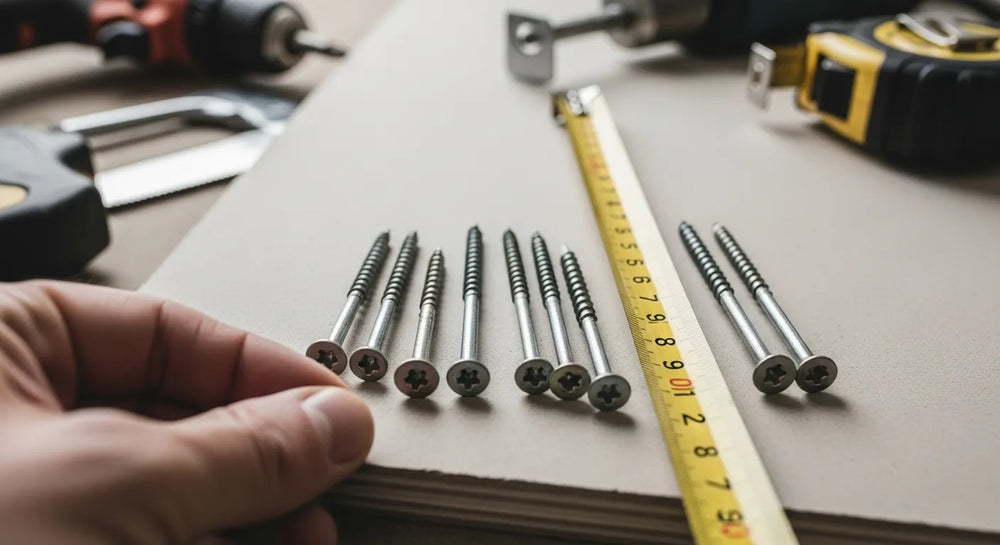
The simple wood screw is the undisputed champion of fastening to wood. Its design is a masterclass in material-specific engineering:
- Tapered Body and Sharp Threads: These are designed to gradually displace wood fibers, minimizing splitting while maximizing grip.
- Sharp Point: A sharp point allows the screw to be started easily and accurately.
- Variety of Heads and Drives: From flat heads that sit flush to pan heads for general-purpose mounting, and from traditional Phillips to high-torque Torx drives, there is a wood screw for every application.
For optimal results, especially in hardwoods, drilling a pilot hole is essential. A pilot hole should be slightly smaller than the screw's shank (the solid part without threads). This allows the threads to bite into fresh wood without the pressure that causes splitting.
For Heavier Loads: Lag Bolts and Lag Screws
When you need to mount heavy items like industrial shelving, machinery, or structural elements, a standard wood screw isn't enough. Lag bolts (or lag screws) are essentially heavy-duty wood screws. They are larger in diameter, have a hexagonal head for tightening with a wrench or socket, and provide immense shear and pull-out strength. They always require a pre-drilled pilot hole and are often used with washers to distribute the clamping force and prevent the bolt head from damaging the wood surface.
Specialized Solutions: Threaded Inserts for Wood
In applications where a component may need to be assembled and disassembled repeatedly, such as in jigs, fixtures, or high-end cabinetry, driving a wood screw in and out of the same hole will eventually wear out the wood fibers. The solution is a threaded insert. These are metal sleeves with external threads like a wood screw and internal machine threads. They are installed once into the wood, providing a durable, reusable metal thread for a standard bolt or machine screw.
A Note on Plywood, MDF, and Particle Board
It is important to recognize that not all "wood" is the same. Engineered wood products like plywood, Medium-Density Fiberboard (MDF), and particle board have different internal structures than solid wood. They are made from wood fibers, chips, or veneers bonded with resin.
While you should still never use a drywall anchor in these materials, they can also be challenging for standard wood screws, which may not hold as well in the less-dense composite material. For these applications, look for specialty fasteners designed for composite board, which often feature wider, deeper threads to get a better grip on the material. Checking detailed product specifications is crucial. Our platform empowers procurement managers to find the exact component for their specific substrate, ensuring project integrity from the start.
The Maden.co Advantage: Sourcing with Confidence and Pride
The choice to use the correct fastener is a microcosm of a larger business philosophy: a commitment to quality, reliability, and doing things the right way. This philosophy is at the heart of our mission.
Rebuilding Supply Chains with American Strength
At Maden.co, we believe that a resilient business starts with a resilient supply chain. Our entire model is built on the core value of American Manufacturing Pride. We provide an unparalleled digital gateway to over 800+ verified U.S. manufacturers, giving you the confidence that the components you order meet rigorous quality standards and are not subject to the volatility of overseas shipping. This commitment to domestic sourcing is not just about patriotism; it is a strategic business decision to build more robust and transparent operations. You can learn more about our mission to champion American manufacturing here.
From Specification to Installation: A Seamless Procurement Process
We understand the pressures facing today's industrial buyers. Whether you are an engineer finalizing a bill of materials or an MRO manager responding to an emergency line-down situation, speed and accuracy are critical. Our platform is designed to eliminate friction. You can easily search, filter, and compare millions of parts with detailed technical specifications.
Understanding different anchor types is key, even when they aren't meant for wood. For light-duty drywall jobs, a simple U.S.-made Ribbed Plastic Anchor is a reliable choice. For more demanding tasks, a Medium Duty Nylon Wall Anchor #8 for Drywall offers superior holding power. And for applications where installation speed is critical, a Medium Duty Nylon Wall Anchor #6 Self-Drilling Drywall Zip-It® can be a significant time-saver. By providing clear options for every job, we empower our customers to select the right tool every time. If you have specific sourcing questions about finding the right component, our team is ready to help.
Empowering Your Business with Financial Flexibility
We also recognize that managing cash flow is a constant challenge, especially when faced with large-volume orders or capital-intensive projects. To support your growth, we offer a powerful tool directly within our procurement process. This feature is a strategic asset for business owners and procurement managers, allowing you to acquire the necessary parts now while managing payments on a flexible schedule. You can apply for Instant Financing at checkout to streamline your capital-intensive projects.
Join the Revival: A Call for U.S. Manufacturers
Our platform is a partnership. We thrive because of the excellence of our American manufacturing partners. By connecting their products with buyers across the country, we are building a stronger, more self-reliant industrial ecosystem. Our network of industrial suppliers is the backbone of this movement. Are you a U.S. manufacturer? Register as a vendor and join the American manufacturing revival.
Conclusion
The answer to our initial question is an emphatic "no." Using a drywall anchor in wood is an incorrect application that willfully ignores the principles of material science and engineering. It creates a weak, unreliable, and potentially dangerous connection that can lead to costly rework, property damage, and serious safety liabilities.
The professional solution is always to use the correct fastener for the substrate. For wood, this means relying on the proven strength and reliability of wood screws, lag bolts, and other specialty wood fasteners. By taking the time to select and use the right component, you are investing in the quality, safety, and long-term integrity of your work.
At Maden.co, we are committed to making that investment easier than ever. We invite you to explore our extensive catalog of U.S.-made fasteners and industrial components. Build your next project with the confidence that comes from using the right parts, sourced from verified American manufacturers. And when you are ready to invest in the quality your projects deserve, remember you can apply for Instant Financing at checkout to make your procurement process as smooth and efficient as possible.
Frequently Asked Questions (FAQ)
1. What happens if I use a drywall anchor in wood by mistake?
If you mistakenly use a drywall anchor in wood, it will likely fail to create a secure hold, especially under any kind of load. The anchor can easily be pulled out, damaging the wood surface and causing whatever you have mounted to fall. For extremely lightweight, non-structural items like a small picture frame, it might hold temporarily, but it is fundamentally unreliable and not recommended under any circumstances.
2. Are there any types of drywall anchors that are better for wood than others?
No. The fundamental design principle of every drywall anchor—whether it's an expansion anchor, a self-drilling auger type, or a toggle bolt—is engineered specifically for the brittle, hollow nature of gypsum board. These designs are completely incompatible with the dense, fibrous structure of wood. It is always better to use a proper wood screw.
3. Can I use a plastic drywall anchor in a pilot hole in wood?
While you can physically place the plastic anchor into a pilot hole in wood, it serves no functional purpose. The anchor's sleeve will not expand as designed because the solid wood prevents it from flaring. It will simply act as a loose plastic liner, creating a weaker connection than if you had used the correct size wood screw directly in a properly sized pilot hole.
4. How do I choose the right size wood screw for my project?
Choosing the right wood screw involves considering both length and diameter (gauge). As a general rule, the screw's length should be sufficient to penetrate the base piece of wood by at least half of that piece's thickness, though two-thirds is ideal for stronger holds. The screw's diameter should be proportional to the load it will bear; a heavier item requires a thicker screw. Always check the manufacturer's recommendations for the object you are mounting, as they may specify precise fastener requirements.


