
How to Find the Right Size Drywall Anchor
Table of Contents
- Introduction
- The Overlooked Importance of Anchors in Professional Settings
- Decoding Anchor Specifications: A Technical Deep Dive
- A Buyer's Guide to Common Drywall Anchor Types
- The Strategic Advantage of Sourcing American-Made Anchors
- Conclusion: Building with Confidence from the Wall Out
- Frequently Asked Questions (FAQ)
Introduction
Imagine the final phase of a commercial fit-out. Custom-built shelving is ready to be installed, high-end fixtures are unboxed, and the project is on track for its deadline. Then, a shelf loaded with inventory crashes to the floor. The cause isn't a flaw in the shelving or an error in the building's structure, but a component that costs less than a dollar: the wrong drywall anchor. This seemingly minor oversight has now created a cascade of problems—damaged inventory, costly wall repairs, project delays, and a potential safety hazard. In the world of industrial maintenance, commercial construction, and procurement, the smallest parts often carry the heaviest responsibilities.
Selecting the correct drywall anchor is far more than a simple DIY task; it's a crucial decision that impacts structural integrity, operational safety, and the total cost of ownership. For procurement managers, MRO buyers, and design engineers, the challenge isn't just finding an anchor, but sourcing the right anchor with verified specifications from a reliable supplier who won't disrupt a finely tuned project timeline. This is where the complexity of global supply chains can turn a simple component into a significant bottleneck.
This article provides a definitive guide for professionals on how to select the right size and type of drywall anchor for any application. We will move beyond basic concepts to explore the technical specifications—load capacity, material science, and compatibility—that dictate performance. We will also examine the strategic importance of sourcing these critical components from verified American manufacturers to build more resilient, transparent, and efficient supply chains. Ultimately, this guide will demonstrate that choosing the right fastener is a foundational element of industrial excellence, ensuring every project is built on a bedrock of quality and reliability. At Maden.co, we believe that access to premier American-made industrial products is the key to unlocking this potential.
The Overlooked Importance of Anchors in Professional Settings
In residential settings, the consequences of a failed drywall anchor might be a broken picture frame. In commercial, industrial, and operational environments, the stakes are exponentially higher. These components are not merely holding decorations; they are integral to the safety and functionality of the entire workspace.
Beyond Light-Duty: Industrial and MRO Applications
Drywall anchors are workhorses in a vast range of professional applications, each with its own set of demands:
- Facility Maintenance (MRO): Securing fire extinguishers, safety signage, emergency lighting, and conduit for electrical or data lines. Anchor failure in these contexts can lead to compliance violations and serious safety risks.
- Commercial Construction: Installing restroom partitions, heavy mirrors, grab bars, cabinetry, and commercial-grade shelving in retail spaces, offices, and hospitality venues.
- IT Infrastructure: Mounting networking equipment, patch panels, and server racks to walls in data closets and offices.
- Manufacturing and Warehousing: Affixing tool boards, material safety data sheet (MSDS) stations, and lightweight monitoring equipment to drywall partitions within a plant or warehouse.
In each of these scenarios, the anchor must not only support the static weight of the object but also withstand potential dynamic loads, vibrations, and environmental factors. An anchor holding a simple sign near a high-traffic doorway experiences different stresses than one holding a cabinet that is frequently opened and closed.
The True Cost of Anchor Failure
The financial and operational fallout from using an improperly sized or low-quality anchor can be severe. The direct costs are obvious—replacing the damaged fixture and repairing the wall. However, the indirect costs are often far greater:
- Operational Downtime: A failed shelf in a retail stockroom or a broken fixture in a manufacturing facility can halt operations, leading to lost productivity and revenue.
- Safety Hazards and Liability: A falling object, whether it's a heavy mirror in a hotel lobby or a piece of equipment in a workshop, poses a direct threat to personnel and customers. The ensuing liability can be catastrophic for a business.
- Reputational Damage: Incidents caused by poor workmanship or substandard components can damage a company's reputation for quality and safety.
- Project Delays: Sourcing replacements and performing rework adds unplanned time to project schedules, potentially triggering penalty clauses in contracts and delaying a facility's opening.
This is why the principle of "Industrial Excellence" is one of our core values. It means recognizing that every component, no matter how small, contributes to the overall quality, safety, and longevity of a project. For a procurement manager under pressure to source a specific component, or an MRO buyer facing an unexpected equipment breakdown, the ability to quickly find and finance a verified, U.S.-made part is a game-changer.
Decoding Anchor Specifications: A Technical Deep Dive
Selecting the right drywall anchor requires a clear understanding of three critical variables: the load it must support, the wall it's going into, and the screw that completes the assembly. Getting any one of these wrong compromises the integrity of the entire installation.
1. Weight Capacity: Understanding Shear and Tensile Strength
The weight rating listed on an anchor's packaging is the single most important specification, but it's crucial to understand what it represents. There are two primary forces an anchor must resist:
- Shear Strength: This is the force that pulls downward, parallel to the wall surface. It represents the anchor's ability to resist the force of gravity on the object it's holding. Most weight ratings prominently feature the shear strength.
- Tensile Strength (or Pull-Out Strength): This is the force that pulls straight out, perpendicular to the wall. This is critical for objects that may be tugged on, such as grab bars, handrails, or even shelving that could be bumped from below.
Professional Best Practice: The 4:1 Safety Factor Never select an anchor rated for the exact weight of the object you are hanging. A widely accepted engineering and safety standard is to use a safety factor of at least four. This means if you are hanging a 25-pound object, you should select an anchor system rated to hold at least 100 pounds. This accounts for unforeseen dynamic loads, wall imperfections, and material degradation over time.
Technical data sheets, available on the product pages of a transparent marketplace like Maden.co, provide the detailed performance data that engineers and procurement specialists need to make informed decisions that go beyond a simple weight number on a box.
2. Drywall Thickness: The Unseen Variable
Not all drywall is created equal. The thickness of the wall panel directly impacts how an anchor performs. The two most common thicknesses in commercial construction are:
- 1/2-inch Drywall: Standard for most interior walls.
- 5/8-inch Type 'X' Drywall: Thicker and denser, used in areas requiring enhanced fire resistance, such as stairwells, corridors, and walls separating commercial units.
An anchor's grip, or "purchase," is dependent on its design interacting correctly with the drywall's thickness. A toggle bolt, for instance, requires a certain amount of empty space behind the wall for its wings to deploy. A short anchor designed for 1/2-inch drywall may not expand properly or grip effectively in a thicker 5/8-inch panel. Always verify the wall thickness before selecting your anchor.
3. Screw and Anchor Compatibility: A Crucial Partnership
A drywall anchor is only one half of a system; the screw is the other. The screw performs the vital function of expanding the anchor to create the friction or mechanical lock that holds it in place. Using the wrong screw is a common and critical installation error.
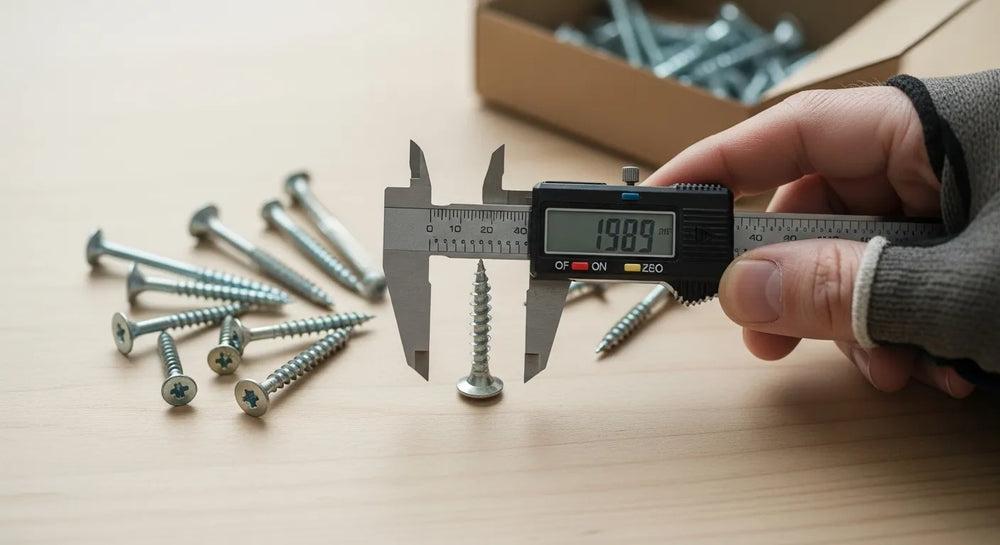
- Screw Diameter: A screw that is too thin will not expand the anchor sufficiently, resulting in a weak hold that can easily pull out. A screw that is too thick can split the anchor, destroying its structural integrity before it's even loaded.
- Screw Length: The screw must be long enough to pass through the fixture you are mounting, the drywall itself, and then fully engage the anchor mechanism.
Product specifications will always list a compatible range of screw sizes. For example, a reliable light-duty option like this U.S.-made Ribbed Plastic Anchor will have clear documentation indicating the precise screw and drill bit sizes needed for a secure installation. Sourcing from a marketplace that provides this level of detail is essential for procurement efficiency and installation success.
A Buyer's Guide to Common Drywall Anchor Types
With a firm grasp of the core specifications, we can now explore the most common types of drywall anchors used in professional applications. Each type is engineered for a specific range of loads and installation conditions.
Light-Duty Anchors
These are designed for objects that exert minimal force on the wall. They are typically made of nylon or plastic and are suitable for loads up to about 20-25 pounds, applying the 4:1 safety factor.
Expansion Anchors (Plastic/Nylon)
- How They Work: These are the most common style. After a pilot hole is drilled, the plastic sleeve is inserted into the wall. As a screw is driven into the sleeve, it expands, forcing the ribbed or finned sides of the anchor to press firmly against the inside of the drywall.
- Best For: Thermostats, smoke detectors, lightweight signage, small control panels, and other objects with negligible weight.
- Key Consideration: They offer the least holding power and should never be used for anything of significant weight or value, especially in a commercial setting.
Medium-Duty Anchors
This category represents a significant step up in holding power and is often the go-to choice for many MRO and commercial fit-out tasks. They are suitable for loads ranging from 25 to 75 pounds.
Self-Drilling/Threaded Anchors
- How They Work: These anchors, often made from high-strength nylon or a zinc alloy, feature aggressive threads and a sharp point that allow them to be screwed directly into drywall without a pilot hole. This makes installation incredibly fast and efficient. A screw is then driven into the center of the anchor to hang the fixture.
- Best For: Medium-weight shelving, large pictures or mirrors, wall-mounted dispensers, and heavier signage. Their speed makes them a favorite for MRO teams performing repetitive installations.
- Key Consideration: For an American-made solution that combines strength and efficiency, the Medium-Duty Nylon Wall Anchor #6 Self-Drilling Drywall Zip-It® is an excellent example. Its robust nylon construction prevents it from being as brittle as zinc versions, and the self-drilling design dramatically reduces labor time.
Sleeve-Type Anchors (Molly Bolts)
- How They Work: A sleeve-type anchor consists of a metal sleeve and a screw. When the screw is tightened, it pulls the back of the sleeve, causing it to collapse and expand like an umbrella behind the drywall panel. This creates a very strong mechanical lock that distributes the load over a wider area.
- Best For: Towel bars, small wall-mounted cabinets, and fixtures that may experience some pull-out force.
- Key Consideration: They provide excellent holding power but require a precisely drilled pilot hole. The screw can be removed and reinserted without the anchor losing its place, which is an advantage for maintenance.
Heavy-Duty Anchors
When the application demands the highest possible holding power in hollow walls, toggle bolts are the undisputed champions. They are suitable for loads exceeding 75 pounds and are the only acceptable choice for safety-critical items.
Toggle Bolts & Strap Toggles
- How They Work: A traditional toggle bolt consists of a screw and a pair of spring-loaded metal wings. A large hole is drilled, the wings are collapsed and pushed through the hole, and they spring open in the cavity behind the drywall. As the screw is tightened, it pulls the wings flush against the back of the wall, creating an extremely secure anchor point. Strap toggles are a modern evolution where a plastic strap helps position a metal channel, allowing for easier and more reliable installation.
- Best For: Wall-mounting televisions, heavy-duty commercial shelving, grab bars, and any application where failure is not an option.
- Key Consideration: They require the largest pilot hole, which may need to be patched if the fixture is ever removed. A standard toggle bolt's screw cannot be fully removed without the wings falling down inside the wall cavity.
For any of these categories, finding a reliable, high-quality version is paramount. Sourcing a component like a Medium-Duty Nylon Wall Anchor #8 for Drywall from a verified U.S. manufacturer provides the assurance of material quality and consistent performance that is often lacking in generic, unvetted alternatives.
The Strategic Advantage of Sourcing American-Made Anchors
In today's volatile global market, the decision of where to source components is as important as the decision of which components to source. For a seemingly simple item like a drywall anchor, a domestic supply chain offers profound strategic benefits that directly impact a project's bottom line and timeline.
Building a Resilient and Transparent Supply Chain
The last several years have exposed the fragility of long, complex supply chains. A single disruption at a foreign port or factory can delay an entire project for weeks, all for want of a basic fastener. This is a risk that modern procurement professionals can no longer afford to take.
By sourcing from Maden.co’s network of over 800 verified U.S. manufacturers, you are building a more resilient procurement process. Shorter lead times, reduced shipping complexities, and clearer communication channels mean you get the parts you need, when you need them. This embodies our core value of Supply Chain Transparency. Our mission is to democratize access to American manufacturing, making it as easy to source a U.S.-made component as any global alternative. This fundamental belief drives everything we do; you can learn more about our mission to champion American manufacturing here.
Ensuring Material Integrity and Quality Compliance
When you source an anchor from an unverified overseas supplier, you introduce uncertainty. Is the nylon of a high-grade composition that won't become brittle over time? Is the steel in a toggle bolt properly plated to resist corrosion? Inconsistent quality control can lead to a high rate of product failure, compromising safety and performance.
Our commitment to American Manufacturing Pride means we partner exclusively with U.S. manufacturers who adhere to rigorous quality standards. This ensures that the technical specifications listed are accurate and that the materials used are of the highest integrity. For engineers specifying components for critical applications, this verification is not just a preference; it is a necessity.
Are you a U.S. manufacturer producing high-quality fasteners and industrial components? Register as a vendor and join the American manufacturing revival. We are actively seeking partners who share our commitment to quality and innovation.
Empowering Your Procurement Process
We understand the pressures facing procurement and MRO teams. You need to reduce procurement friction, manage budgets effectively, and ensure operational continuity. Our platform is designed to be a strategic tool to help you achieve these goals.
Instead of spending hours vetting unknown suppliers, you have immediate access to millions of products from hundreds of trusted sources. For capital-intensive projects or the need to stock up on MRO inventory, managing cash flow is critical. That's why we offer a powerful tool to empower your purchasing decisions. You can apply for Instant Financing at checkout to streamline your capital-intensive projects, allowing you to acquire the necessary materials without disrupting your budget. If you have specific sourcing questions or need help navigating large orders, our team is ready to help.
Conclusion: Building with Confidence from the Wall Out
The process of finding the right size and type of drywall anchor is a microcosm of the larger challenges in modern industrial procurement. It requires technical diligence, an unwavering focus on safety, and a strategic approach to sourcing. As we've seen, success hinges on a clear understanding of load requirements, wall conditions, and component compatibility. Choosing an anchor based on these factors isn't just good practice—it's a professional responsibility.
However, the "what" is only half the equation. The "where" is equally critical. By prioritizing verified, U.S.-made components, businesses can mitigate supply chain risks, guarantee material quality, and support the domestic industrial base. This is the future of procurement—a future that is more resilient, transparent, and efficient.
At Maden.co, we are committed to leading this charge. Our platform is more than just a marketplace; it is the engine for the American manufacturing revival. We provide the tools, access, and support that empower businesses to build with confidence, knowing that every component, down to the last drywall anchor, is backed by the highest standards of quality and reliability.
Stop searching and start sourcing with certainty. Explore our extensive catalog of American-made fasteners and discover how our platform can transform your procurement process. And when you’re ready to equip your team for their next major project, remember to leverage the power of Instant Financing at checkout.
Frequently Asked Questions (FAQ)
1. What is the most common mistake when choosing a drywall anchor? The most common and dangerous mistake is underestimating the total load weight or failing to account for dynamic forces, such as the pull on a grab bar. Professionals must always apply a safety factor of at least four to the static weight of the object. For a 20-pound fixture, select an anchor system rated for 80 pounds or more.
2. Can I reuse a drywall anchor? For professional, commercial, and industrial applications, you should never reuse a drywall anchor. Plastic expansion anchors are designed to deform upon installation, and their holding power is significantly compromised on second use. Given the low cost of a new anchor versus the high cost of failure, always use a new anchor for every installation.
3. How do I know what size screw to use with my anchor? The anchor manufacturer will provide a technical data sheet (TDS) that specifies the exact range of compatible screw diameters and the required length. This information is crucial and is typically available on detailed product pages on a B2B marketplace like Maden.co. Using an incorrect screw size is a primary cause of anchor failure.
4. Why should my business prioritize sourcing U.S.-made anchors? Prioritizing U.S.-made anchors from a verified marketplace offers significant strategic advantages. It builds supply chain resilience by protecting your projects from international shipping delays and geopolitical instability. It also guarantees adherence to stringent U.S. quality control and material standards, which is essential for ensuring safety, performance, and compliance in any professional environment. Our entire business model is built on this principle; you can learn more about our mission to champion American manufacturing here.


