
How to Screw Into Concrete Board for Pro Results
Table of Contents
- Introduction
- Understanding the Material: Why Concrete Board Is Not Just Heavy Drywall
- Selecting the Right Fastener: The Core of Your Success
- Essential Tools and Safety Preparations
- Step-by-Step Installation Guide for Professionals
- Beyond Installation: The Strategic View for Procurement
- Join the American Manufacturing Revival
- Conclusion
- Frequently Asked Questions
Introduction
A single failed fastener. It seems like a minor detail, but for a project manager overseeing a commercial bathroom remodel, it can mean a catastrophic delay. Imagine tiles cracking and pulling away from the wall weeks after installation, all because the wrong screw was used to secure the concrete backer board. The resulting rework doesn't just cost money; it erodes client confidence and damages a reputation built on quality. This scenario isn't hypothetical; it's a common and costly consequence of overlooking the critical science behind fastening into cementitious materials. Securing items to concrete board is fundamentally different from working with drywall or wood, and treating it the same is a direct path to failure.
This article moves beyond basic DIY tips to provide a professional-grade understanding of how to properly screw into concrete board. We will delve into the material science of concrete board, explore the critical criteria for selecting the right American-made fasteners, and provide a detailed, step-by-step guide to ensure a secure and durable installation every time. For procurement managers, MRO buyers, and design engineers, this guide will serve as a definitive resource for specifying and sourcing components that guarantee project integrity and enhance the total cost of ownership. The core message is simple: professional results demand professional-grade materials and techniques, a principle that underpins everything we do at Maden.co.
Understanding the Material: Why Concrete Board Is Not Just Heavy Drywall
Before a single screw is driven, it's essential to understand the unique properties of the material you're working with. Concrete backer board—often known by brand names like Durock®, HardieBacker®, or WonderBoard®—is a composite panel engineered for durability and moisture resistance, making it the standard substrate for tile in wet areas like bathrooms, kitchens, and industrial facilities.
The Anatomy of Concrete Board
Unlike gypsum-based drywall, concrete board is composed of a core of Portland cement, sand, and other aggregates, all reinforced with a fiberglass mesh on its surfaces. This composition gives it distinct characteristics:
- High Compressive Strength: It can withstand significant pressure without crushing, providing a solid foundation for tile and other finishes.
- Abrasive Nature: The cement and aggregate content will quickly dull standard tool bits and can be abrasive to fastener coatings if not chosen correctly.
- Inherent Brittleness: While strong under compression, concrete board can be brittle. Improper fastening techniques, especially over-driving screws, can easily cause it to crack or fracture around the fastener head.
- Moisture Impermeability: Its primary advantage is that it will not swell, soften, or degrade when exposed to water, unlike drywall or green board.
Why Standard Screws Are Destined to Fail
Using a standard drywall or wood screw in concrete board is a critical error for several reasons. A procurement manager trying to cut costs with a bulk order of generic fasteners may inadvertently be specifying a project's future failure point.
- Corrosion: Standard screws, typically coated with black phosphate or a thin layer of zinc, offer minimal protection against moisture. In a wet environment, these screws will rust and corrode. This corrosion not only weakens the screw itself but can also bleed through grout or thin-set, causing unsightly stains and eventual structural failure.
- Lack of Holding Power: The threads on a standard screw are not designed to bite effectively into the dense, cementitious core of the backer board. They can strip out easily, providing inadequate pull-out strength.
- Mechanical Failure: The heads of drywall screws are designed to dimple paper and gypsum, not embed into hard cement. The force required can easily snap the head off the screw, leaving a useless shank embedded in the board.
Understanding these material properties is the first step toward appreciating why specialized concrete board screws are not just a recommendation but a requirement for any job where longevity and performance are priorities. This commitment to using the right component for the job is a core tenet of Industrial Excellence, one of our guiding values.
Selecting the Right Fastener: The Core of Your Success
The integrity of an entire wall system rests on the small, often overlooked fastener. Choosing the correct screw involves a careful evaluation of its material, coating, head style, and thread design, all tailored to the specific application and substrate. Here at Maden.co, we are committed to democratizing access to American manufacturing, ensuring that buyers can easily source the precise, high-quality components needed for mission-critical applications.
Material and Coating: The First Line of Defense Against Corrosion
Given that concrete board is predominantly used in moisture-prone areas, corrosion resistance is the single most important factor in fastener selection.
- Standard Protection: Hot-dip galvanized screws offer a baseline level of protection suitable for some applications. However, the thick, sometimes uneven coating can interfere with thread engagement.
- Superior Protection with Ceramic Coatings: For maximum durability, especially in commercial kitchens, industrial wash-down stations, or coastal environments, a ceramic-coated screw is the superior choice. These multi-layer coatings provide a robust barrier against moisture and alkaline corrosion from the cement itself.
A prime example is the Steel Blue Ruspert Ceramic Coating Flat Phillips® Drive Concrete Screw available on our platform. The Ruspert coating offers exceptional corrosion resistance, often exceeding 1,000 hours in salt spray tests. Sourcing a specialized, U.S.-made fastener like this through our marketplace removes the guesswork and provides verifiable quality assurance for your project.
Head Type and Drive Style: Optimizing for Strength and Finish
The head of the screw determines how it sits on the board's surface and how efficiently torque is transferred during installation.
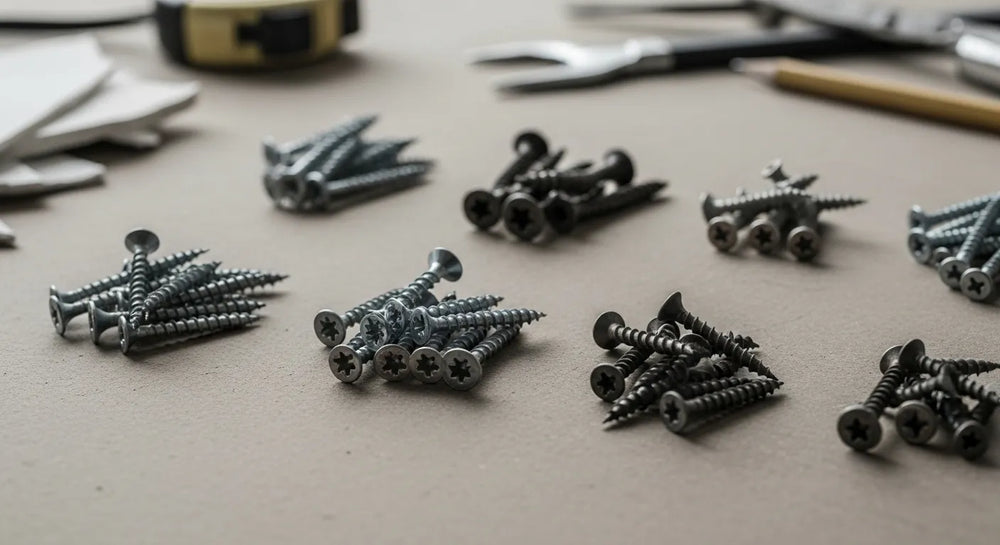
- Flat/Bugle Head: These are the most common types for attaching backer board to studs. The shape is engineered to self-countersink, allowing the head to sit perfectly flush with or slightly below the board's surface. This creates a smooth, even plane for applying thin-set and tile, preventing high spots that can lead to cracked tiles.
- Hex Washer Head: When the goal is not to attach the board itself, but to mount a heavy fixture to a concrete board-covered wall (e.g., grab bars, shelving brackets, machinery mounts), a hex washer head screw is the ideal solution. The integrated washer provides a large bearing surface, distributing the clamping force and maximizing pull-out strength. For applications demanding high shear strength, the Hex Head Concrete Screws 3/16 x 2.75 from our network of verified U.S. manufacturers provide the robust holding power necessary for these demanding tasks.
- Drive Style (Phillips vs. Star/Torx): While Phillips is common, a star or Torx drive offers significantly better engagement with the driver bit. This reduces the risk of "cam-out"—where the bit slips out of the screw head at high torque—preventing damage to the screw, the bit, and the board surface. For large-scale installations, the efficiency gained from using a star drive screw can translate into significant labor savings.
Thread Design and Dimensions: The Key to a Secure Bite
The threads do the real work of holding the board in place.
- High-Low Threads: Many concrete board screws feature a "high-low" thread pattern. The high, sharp thread is designed to cut cleanly into the concrete board, while the lower thread provides stability and increases pull-out resistance in the underlying wood or metal stud.
- Self-Tapping Point: A sharp, self-tapping or self-drilling point allows the screw to penetrate the dense board and the underlying stud without the need for pre-drilling, dramatically speeding up the installation process.
- Length and Diameter: Choosing the correct size is non-negotiable. The fastener must be long enough to pass through the concrete board (typically 1/4" or 1/2" thick) and penetrate the underlying stud by a minimum of 1 inch for wood and at least three full threads for metal. For a standard 1/2" backer board on a wood stud, a screw length of 1-5/8" is common. When securing heavier items or thicker boards, a more substantial option like the 1/4 x 2-3/4 Flat Head Concrete Screws may be required to achieve the necessary embedment depth and holding power.
Essential Tools and Safety Preparations
With the correct fasteners selected, gathering the right tools and implementing proper safety protocols is the next step toward a professional installation. Efficiency and safety go hand-in-hand in any industrial or commercial setting.
Recommended Tooling
- Impact Driver or Low-Speed Drill with Clutch: An impact driver is often preferred for its ability to drive screws with high torque without stripping the head. If using a drill, a model with an adjustable clutch is crucial to prevent over-driving the screws.
- Correct Driver Bits: Use a new, high-quality bit that perfectly matches the screw's drive style (e.g., #2 Phillips, T-25 Star). A worn bit is a primary cause of cam-out.
- Tape Measure and Pencil/Marker: For accurate layout.
- Utility Knife with Carbide Blades: For scoring and snapping the concrete board to size.
- Level and/or Laser Level: To ensure boards and fixtures are installed perfectly plumb and level.
Critical Safety Measures
Cutting and drilling concrete board releases crystalline silica dust, a known respiratory hazard. Always prioritize safety.
Safety Protocol:
- Eye Protection: Wear safety glasses or goggles at all times.
- Respiratory Protection: A NIOSH-approved respirator (N95 or better) is mandatory when cutting or drilling concrete board.
- Hand Protection: Wear gloves to protect against the abrasive surface of the board.
- Ventilation: Work in a well-ventilated area. If indoors, use a dust extractor connected to your cutting tools to capture dust at the source.
Step-by-Step Installation Guide for Professionals
This section provides a clear, repeatable process for attaching concrete backer board to wood or metal studs, ensuring a secure and flat substrate.
Step 1: Board Preparation and Layout
Before installing the first screw, ensure the framing is clean, flat, and structurally sound. The concrete boards should be installed with a 1/8-inch gap between adjoining sheets and a 1/4-inch gap along the floor or tub flange to allow for expansion and movement. Stagger the joints between rows in a running bond pattern, similar to brickwork, to increase the wall's overall rigidity. Mark the location of all studs on the ceiling and floor, then snap chalk lines onto the face of the board as a guide for screw placement.
Step 2: Screw Placement and Spacing
Proper spacing is critical for preventing the board from flexing or cracking under load. Follow the manufacturer's specific guidelines, but a general industry standard is:
- Field Screws: Place screws every 8 inches in the "field" (the center) of the board, ensuring each screw hits a stud.
- Edge Screws: Place screws every 6 inches along all edges and seams of the board.
- Perimeter Distance: Keep all screws between 3/8-inch and 3/4-inch from the edge of the board to prevent fracturing.
Step 3: Driving the Screw—The Technique
This is where precision matters most. The goal is to set the screw head flush with the surface of the board without breaking the surface paper or fiberglass mesh.
- Start Slow: Position the screw on your marked stud line and begin driving at a low speed to ensure the point engages cleanly without "walking."
- Apply Firm, Straight Pressure: Keep the driver perfectly perpendicular to the board surface to prevent the screw from being driven at an angle.
- Use the Clutch or Feel: As the screw head nears the board surface, slow down. If using a drill, the clutch should disengage once the screw is seated. With an impact driver, you will need to develop a feel for when the head is perfectly flush. A slight dimple is acceptable, but if you break the mesh, the screw's holding power is compromised.
- Check for Flushness: Run a putty knife over the screw head. If it catches, the screw is either too high or too low. A proud screw head will create a high spot under the tile, while an over-driven screw has lost its structural integrity.
Step 4: Finishing the Joints
Once all boards are securely fastened, the joints must be treated. Apply a layer of polymer-modified thin-set mortar over the seams and embed alkali-resistant fiberglass mesh tape into the wet mortar. This process, along with the correct fastening pattern, creates a monolithic, waterproof, and dimensionally stable substrate ready for tile.
Beyond Installation: The Strategic View for Procurement
For a procurement manager, design engineer, or MRO buyer, the choice of a fastener extends far beyond a single installation. It's a decision that impacts project timelines, budgets, and long-term asset performance. This is where partnering with a platform like Maden.co becomes a strategic advantage.
Our mission is to prove that American-made components are as accessible and convenient as any global alternative. We provide a direct line to over 2.5 million products from a network of 800+ verified U.S. manufacturers. For a manager under pressure to source a specific ceramic-coated concrete board screw with material certifications, our platform eliminates hours of frustrating searches and supplier vetting. You can learn more about our mission to champion American manufacturing and build resilient domestic supply chains by visiting our About Us page.
Optimizing Total Cost of Ownership (TCO)
The sticker price of an imported fastener is deceptive. The true cost includes the risk of quality variance, potential for customs delays, and the significant expense of rework if the component fails. By sourcing high-quality, U.S.-made screws, you are investing in reliability and performance, directly lowering your TCO by minimizing project delays and eliminating costly callbacks.
Customer Empowerment and Streamlined Procurement
We believe in Customer Empowerment. Our platform is designed to reduce procurement friction. Detailed product specifications, clear sourcing information, and a powerful search function mean you can find the exact component you need in minutes, not days. For large-scale projects or capital-intensive equipment purchases, managing cash flow is paramount. That's why we offer a unique strategic tool: you can apply for Instant Financing at checkout to streamline your capital-intensive projects, breaking down large orders into manageable payments without delaying your project timeline. If you have specific sourcing requirements or questions about our financing options, our expert team is ready to assist. Please contact us for personalized support.
Join the American Manufacturing Revival
The strength of our industrial base is a direct reflection of the manufacturers who form its backbone. We are actively building the most comprehensive B2B marketplace for U.S.-made products, and our success is shared with our partners. If you are a U.S. manufacturer producing high-quality fasteners, components, or any other industrial product, we invite you to join our mission. By becoming a vendor on our platform, you gain access to a nationwide audience of professional buyers actively seeking American-made quality. Are you a U.S. manufacturer? Register as a vendor and join the American manufacturing revival.
Conclusion
Mastering how to screw into concrete board is a testament to professional craftsmanship. It requires a deep understanding of the material, a disciplined approach to fastener selection, and a precise installation technique. The difference between a job that lasts for decades and one that fails in months often comes down to these fundamental details. By choosing the correct, corrosion-resistant, American-made screw, you are not just fastening a board to a wall; you are ensuring the structural integrity, safety, and long-term value of the entire project.
At Maden.co, we are your strategic partner in achieving this standard of excellence. We empower you to build with confidence by providing unparalleled access to the best of American manufacturing. Explore our extensive catalog to find the exact fasteners and components your projects demand, and leverage powerful tools like Instant Financing at checkout to manage your procurement process more effectively than ever before. America's manufacturing revival is here, and it’s built to last.
Frequently Asked Questions
1. Can I use regular drywall screws for concrete board as a temporary solution? No, you should never use drywall screws for concrete board, even temporarily. Drywall screws lack the necessary corrosion resistance and will rust quickly in the damp environments where concrete board is used. Furthermore, their thread design and head shape are not engineered for the dense, brittle nature of concrete board, leading to poor holding power and a high risk of screw failure or board fracture.
2. Do I always need to pre-drill when screwing into concrete board? Generally, no. High-quality concrete board screws are designed with self-tapping points that can penetrate both the board and the underlying wood or light-gauge metal studs without pre-drilling. However, if you are fastening into very hard wood studs or heavier gauge steel, a small pilot hole can make driving the screw easier and reduce the risk of it snapping.
3. What is the absolute best type of screw to use in a shower or other very wet area? For maximum longevity in a high-moisture environment like a shower, the best choice is a screw with a high-performance ceramic coating. These multi-layer coatings provide a superior barrier against both moisture and the alkaline environment of the cement, preventing rust and corrosion for the life of the installation. The Steel Blue Ruspert Ceramic Coating Flat Phillips® Drive Concrete Screw is an excellent example of a fastener engineered for these demanding conditions.
4. How far apart should screws be spaced when installing concrete board? While you should always consult the specific board manufacturer's guidelines, a reliable industry standard is to place screws every 8 inches on-center for all studs in the "field" (main area) of the board, and every 6 inches along the perimeter or edges of each board. Screws should be kept approximately 1/2 inch from the edges and corners to prevent cracking.


