
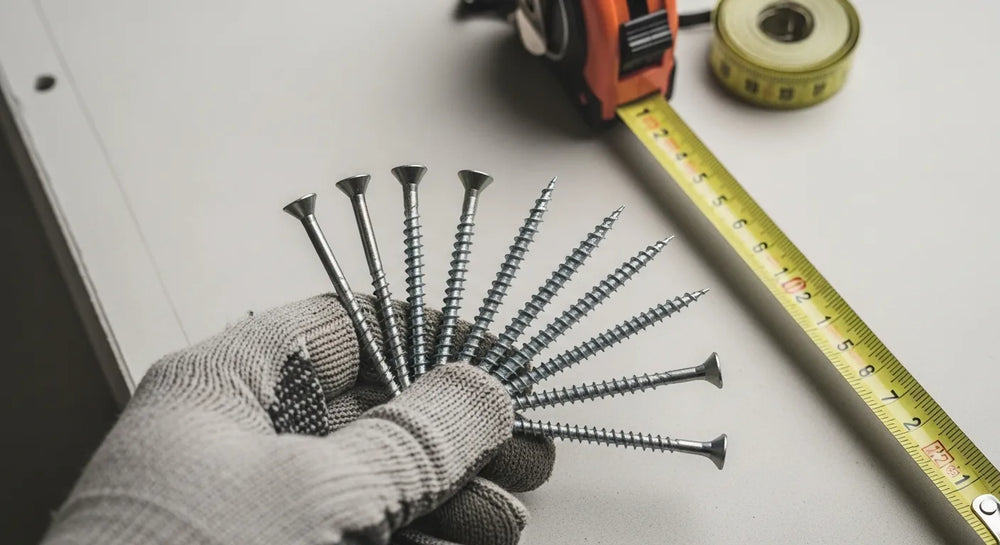
How to Use Drywall Anchors for Secure Mounting
Table of Contents
- Introduction
- The Critical Role of Drywall Anchors in Commercial Settings
- Understanding Drywall Anchor Types and Their Mechanics
- Step-by-Step Installation Guide: From Procurement to Project Completion
- Common Mistakes to Avoid for a Professional Finish
- Strategic Procurement: Managing Cash Flow and Supply Chain Resilience
- Conclusion
- Frequently Asked Questions (FAQ)
Introduction
Imagine this scenario: a critical piece of equipment—a control panel for a new automation line or a vital network switch for an office—needs to be wall-mounted. The installation seems straightforward, a final checkbox on a long project list. But hours later, the unit has pulled free from the wall, damaging the equipment and the drywall, causing costly delays and safety concerns. This frustrating and expensive setback often stems from a fundamental misunderstanding of one of the most common but misused components in any facility: the drywall anchor. The integrity of an entire installation can hinge on a component that costs mere cents, yet the consequences of its failure can run into thousands of dollars in damages and downtime.
Drywall, by its nature, is not a structural material. It is a panel made of gypsum plaster pressed between two thick sheets of paper. While excellent for creating interior walls, it has minimal holding power on its own. A simple screw driven into drywall can only support a few pounds before it rips out, taking a chunk of the wall with it. This is where drywall anchors become indispensable. They are engineered to create a secure mounting point by expanding behind or gripping the drywall, distributing the load over a wider surface area.
This article moves beyond simple DIY instructions. We will provide a professional framework for understanding, selecting, and correctly installing drywall anchors for commercial, industrial, and MRO (Maintenance, Repair, and Operations) applications. We will explore the different types of anchors and their mechanics, detail a step-by-step installation process that ensures safety and longevity, and discuss common pitfalls to avoid. Most importantly, we will frame this seemingly simple task as a critical component of a resilient and efficient procurement strategy. At Maden.co, we believe that sourcing high-quality, reliable components is the cornerstone of industrial excellence. Properly selecting and installing a U.S.-made drywall anchor isn't just about hanging an object; it's about safeguarding assets, ensuring workplace safety, and contributing to a project's long-term success.
The Critical Role of Drywall Anchors in Commercial Settings
In a residential setting, a failed drywall anchor might mean a fallen picture frame. In a commercial or industrial environment, the stakes are significantly higher. The proper use of drywall anchors is a matter of operational integrity, safety compliance, and financial prudence. Procurement managers and MRO teams are not just buying fasteners; they are investing in the stability and safety of their facilities.
Applications Beyond the Basics
While the principle is the same, the applications in a professional setting are far more demanding and diverse. Consider the range of items that rely on secure wall mounting in a typical business environment:
- Safety and Compliance: Fire extinguishers, first aid kits, emergency signage, and OSHA-mandated information boards.
- Operational Equipment: Wall-mounted control panels, sensor arrays, small monitors, and IT networking hardware like routers and switches.
- Facility Amenities: Commercial paper towel and soap dispensers, hand sanitizer stations, and lightweight shelving for storing supplies.
- Aesthetics and Branding: Corporate signage, whiteboards in conference rooms, and decorative fixtures in client-facing areas.
In each of these cases, a failure is not a minor inconvenience. A falling fire extinguisher is a serious safety hazard. A detached control panel can halt a production line. A broken dispenser can lead to hygiene issues and a negative perception of the facility.
The True Cost of Failure: Risk, Liability, and TCO
The initial cost of a drywall anchor is negligible. The Total Cost of Ownership (TCO), however, can skyrocket if the wrong anchor is chosen or an inferior product is used. The risks associated with anchor failure include:
- Direct Costs: The cost to repair the damaged wall, replace the broken fixture or equipment, and the labor involved in re-installation.
- Indirect Costs: Operational downtime, project delays, and the administrative burden of addressing the failure.
- Safety and Liability: The most significant risk is physical injury to employees or customers, which can lead to workers' compensation claims, legal liability, and irreparable damage to a company's reputation.
This is why supply chain transparency is one of our core values. When you source fasteners from an unverified overseas supplier, you risk inconsistencies in material composition, load ratings, and overall quality. A batch of anchors that looks identical to the last may have vastly different performance characteristics, introducing a dangerous variable into your operations. By connecting industrial buyers with over 800+ verified U.S. manufacturers, we help eliminate that uncertainty. You get the assurance that the components you install meet rigorous quality standards, protecting your investments and your people.
Understanding Drywall Anchor Types and Their Mechanics
Selecting the right anchor is the first and most critical step. The choice depends entirely on the weight of the object you are mounting, the thickness of the drywall, and the nature of the load (is it static, like a sign, or subject to vibration, like a piece of machinery?). Here is a breakdown of the most common types used in professional applications.
Expansion Anchors (Sleeve-Type)
These are among the most common types of anchors for light-duty applications. They consist of a plastic or nylon sleeve that is inserted into a pre-drilled hole. As a screw is driven into the sleeve, the sleeve expands, pressing firmly against the inside of the drywall.
- How They Work: The primary mechanism is friction. The expansion forces the sleeve's outer surface against the gypsum core of the drywall. Many designs include "fins" or "ribs" along the body of the anchor.
- Advantages: They are inexpensive, easy to install, and suitable for a wide range of light-duty tasks.
- Considerations: The quality of the plastic or nylon is paramount. A low-quality anchor can become brittle and crack during installation or over time, especially in environments with temperature fluctuations. The ribbed design is a crucial feature for professional use, as it prevents the entire anchor from spinning in the hole when the screw is tightened—a common and frustrating failure point. A well-designed, American-made option like this Ribbed Plastic Anchor provides superior grip and prevents rotation, ensuring a secure and efficient installation every time.
- Best For: Mounting lightweight signage, thermostats, smoke detectors, and other items typically under 15-20 pounds.
Self-Drilling Anchors (Threaded)
For MRO teams focused on efficiency, self-drilling anchors are a game-changer. These anchors, often made of durable nylon or a zinc alloy, feature aggressive, oversized threads and a sharp point that allows them to be driven directly into the drywall with a screwdriver or drill, eliminating the need to pre-drill a pilot hole.
- How They Work: The deep threads cut into the drywall paper and gypsum, creating a strong mechanical bond. The screw is then driven into the center of the anchor, which may cause a slight expansion for added holding power.
- Advantages: Speed of installation. By removing the pre-drilling step, they can significantly reduce labor time, especially on projects requiring dozens or hundreds of mounting points.
- Considerations: They create a larger hole than expansion anchors, which can be a factor if the item might be moved later. They work best in standard 1/2" or 5/8" drywall and are not suitable for plaster or lath walls. The nylon variants offer excellent performance without the risk of corrosion. For projects where speed and reliability are key, a product like our U.S.-manufactured Medium-Duty Nylon Wall Anchor #6 Self-Drilling is an ideal choice, embodying the digital innovation and efficiency we champion.
- Best For: Medium-duty applications like mounting small shelves, whiteboards, and wall-mounted dispensers, with typical load ratings from 30 to 50 pounds.
Hollow-Wall Anchors (Toggle Bolts & Molly Bolts)
When you need to support heavier loads and cannot locate a wall stud, hollow-wall anchors are the professional standard. They provide significantly more holding power than expansion or self-drilling types.
-
Toggle Bolts: This classic design consists of a spring-loaded "wing" mechanism attached to a machine bolt. You drill a hole large enough for the collapsed wings to pass through. Once inside the wall cavity, the wings spring open. Tightening the bolt clamps the wings against the back of the drywall.
- Advantage: Excellent holding power, as they distribute the load over a very large surface area.
- Disadvantage: They require a large pilot hole and the bolt must be inserted through the object you are mounting before the toggle is inserted into the wall. If you remove the bolt, the wing mechanism falls down inside the wall cavity.
-
Molly Bolts (Sleeve-Type Hollow-Wall Anchors): These are a more modern evolution. A metal sleeve with pre-split sides is inserted into a pilot hole. As you tighten the screw, the sleeve's sides collapse and flare out behind the drywall, acting like a toggle.
- Advantage: Unlike a toggle bolt, the anchor body remains in the wall if you remove the screw, allowing you to take down and remount the object easily.
- Disadvantage: They can be more difficult to set correctly than a simple toggle bolt and are sensitive to over-tightening, which can damage the drywall.
A Critical Note on Heavy Loads
It is essential to recognize the limits of drywall itself. No anchor, no matter how robust, can make drywall a structural element. For truly heavy items like large cabinets, televisions in public spaces, or heavy industrial equipment, you must anchor directly to a wall stud. Always use a stud finder as your first tool. If studs are not conveniently located, the proper solution is to attach a horizontal piece of plywood or blocking to the wall, screwing it securely into multiple studs, and then mount your object to that solid backer board.
Step-by-Step Installation Guide: From Procurement to Project Completion
A successful installation is a process, not just a single action. It starts with careful planning and sourcing and ends with verification. Following these steps ensures a secure, professional-grade result.
Step 1: Load Assessment and Anchor Selection
Before you even think about drilling, you must analyze the requirements.
- Determine the Load Weight: Know the exact weight of the object. Don't guess.
- Consider Load Type: Is it a static load (dead weight that doesn't move, like a sign) or a dynamic load (subject to vibration, pulling, or movement, like a handrail or dispenser)? Dynamic loads exert far more stress and require a much stronger anchor or mounting to a stud.
- Apply a Safety Factor: Never use an anchor rated for exactly the weight of your object. A professional standard is a 4:1 safety factor. This means if your object weighs 20 pounds, you should use an anchor or system of anchors rated to hold at least 80 pounds. This accounts for material imperfections, unseen wall conditions, and dynamic forces.
- Check Wall Thickness: Most commercial interior walls use 1/2" drywall, but 5/8" fire-rated drywall (Type X) is also common. Ensure your chosen anchor is compatible with the wall's thickness.
For a design engineer specifying components for a new build-out, our platform offers a distinct advantage. They can filter through millions of products with detailed spec sheets to find the precise anchor that meets their calculated load requirements, ensuring both safety and compliance from the earliest stages of the project.
Step 2: Sourcing High-Quality, Verifiable Components
This step is often overlooked but is fundamental to a successful outcome. The anchor you choose is only as reliable as its manufacturer. At Maden.co, our mission is to democratize access to the incredible depth and quality of American manufacturing. By providing a direct connection to a vast catalog of components, we empower businesses to build with confidence. You can learn more about our mission to champion American manufacturing here.
For a procurement manager tasked with outfitting an entire facility, consistency is key. Sourcing a large quantity of a U.S.-made anchor like the Medium-Duty Nylon Wall Anchor #8 for Drywall from our marketplace ensures that every single anchor in the box meets the same high standard. This eliminates the "batch lottery" common with anonymous global supply chains and underpins a more resilient and predictable MRO strategy.
Step 3: Gathering the Right Tools
Having the right tools on hand prevents mistakes and ensures a clean installation.
- Stud finder
- Power drill with variable speed control
- Correctly sized drill bits (check the anchor's packaging for the exact size needed)
- Screwdriver (manual or a drill on a low-torque setting)
- Level
- Tape measure and pencil
- Safety glasses
Step 4: The Installation Process - Best Practices
- Locate Studs First: Always begin by using a stud finder to see if a wall stud is available at or near your desired mounting location. Mounting to a stud is always the superior option.
- Mark Your Location: Use a tape measure and level to mark the precise spot for your anchor. Double-check your measurements.
- Drill the Pilot Hole (If Required): For expansion or molly anchors, drill a pilot hole. The drill bit size must match the manufacturer's specification exactly. A hole that is too large will prevent the anchor from gripping; one that is too small will damage the anchor or the drywall upon insertion. Drill straight into the wall with steady pressure.
-
Install the Anchor:
- For Expansion Anchors: Gently tap the anchor into the hole with a hammer until its flange is flush with the wall surface. It should be a snug fit.
- For Self-Drilling Anchors: Use a drill on a low-speed setting or a screwdriver to drive the anchor into the drywall until the head is flush. Do not overdrive, as this can strip the drywall.
- For Toggle Bolts: After drilling the large hole, pass the bolt through your fixture, thread on the spring-loaded toggle, pinch the toggle flat, and push it through the hole. You will hear a "snap" as the wings open inside the wall.
-
Set the Screw:
- Position your item over the anchor and insert the screw.
- Drive the screw slowly and steadily. You will feel the resistance increase as the anchor expands or the toggle tightens.
- Stop as soon as the screw is snug. The most common cause of anchor failure is over-tightening. This can strip the drywall, break a plastic anchor, or pull the entire anchor through the front of the wall.
Step 5: Post-Installation Verification
Before placing the full weight of the object on the anchor, give it a gentle but firm tug to ensure it is securely set in the wall. This simple test can prevent a catastrophic failure later. For critical applications, documented pull tests on sample installations may be required to meet project specifications.
Common Mistakes to Avoid for a Professional Finish
Knowing what not to do is as important as knowing the correct procedure. Avoiding these common errors will distinguish a professional installation from an amateur one.
- Reusing an Old Hole: Never try to install a new anchor in an old, abandoned hole. The surrounding drywall is already compromised and will not provide adequate holding power. The old hole must be properly patched and a new hole drilled at least a few inches away.
- Ignoring Wall Condition: Do not install anchors into drywall that is soft, crumbly, or shows any signs of water damage. The integrity of the entire wall panel is compromised, and it cannot be trusted to support any load.
- Choosing the Wrong Anchor for the Job: Using a light-duty expansion anchor to hang a medium-weight shelf is a recipe for disaster. Always err on the side of a stronger anchor and a higher safety factor.
- "Guesstimating" the Drill Bit Size: Using a bit that is "close enough" is a critical error. A 1/16th of an inch can be the difference between a secure fit and a complete failure. Always use the exact size specified.
- Applying Immediate Full Load: For installations using adhesives or epoxies in conjunction with anchors (a rare but sometimes necessary technique), always respect the manufacturer's specified cure time before applying any weight.
Strategic Procurement: Managing Cash Flow and Supply Chain Resilience
For business owners and procurement managers, the process doesn't end with the installation. A strategic approach to sourcing components like drywall anchors can have a significant impact on the bottom line and operational stability. This is about building a procurement process that is as robust as the installations it enables.
The concept of Total Cost of Ownership extends beyond the risk of failure. It also includes the soft costs of sourcing: the time spent searching for reliable suppliers, the delays caused by backorders, and the administrative effort of managing multiple vendors. Our platform is designed to reduce this procurement friction. We provide a single, streamlined source for millions of American-made parts, allowing your team to find, purchase, and receive the components they need with unparalleled efficiency. This is a core part of our commitment to Customer Empowerment.
We also understand that managing cash flow is critical for businesses of all sizes. MRO needs don't always align perfectly with budget cycles. A large-scale office renovation or an unexpected need to install new equipment can require a significant upfront purchase of components. To support this, we offer a powerful tool for financial flexibility. You can apply for Instant Financing at checkout to streamline your capital-intensive projects. This feature allows you to acquire the necessary materials immediately to keep projects on schedule while managing payments in a way that suits your company's cash flow.
Finally, by choosing to source from our network of verified U.S. manufacturers, you are building a more resilient supply chain. The disruptions of recent years have proven the strategic vulnerability of long, complex global supply chains. Sourcing domestically insulates your operations from international port delays, tariffs, and geopolitical instability, ensuring you can get the parts you need when you need them. If you have specific sourcing requirements or can't find a particular component, our team is ready to help.
Are you a U.S. manufacturer producing high-quality fasteners or other industrial components? Register as a vendor and join the American manufacturing revival.
Conclusion
A drywall anchor is more than just a piece of plastic or metal; it is a critical enabler of safety, efficiency, and operational readiness in any professional environment. Understanding the mechanics of how these components work, committing to a precise and methodical installation process, and recognizing the profound difference between a commodity product and a high-quality, verified component are essential. A secure mounting is the result of a chain of good decisions, starting with a strategic choice in the procurement process.
At Maden.co, we are dedicated to strengthening that chain. We are proving every day that American-made components are not only superior in quality and reliability but are also as accessible and convenient as any global alternative. By connecting you with the best of American manufacturing, we empower you to complete your projects with confidence, enhance your supply chain's resilience, and reduce the total cost of ownership.
Explore our extensive catalog of U.S.-made fasteners and industrial supplies today. Equip your team with the reliable components they need to do the job right the first time, and consider using our Instant Financing option at checkout to make even large-scale procurements simple and manageable.
Frequently Asked Questions (FAQ)
1. What is the strongest type of drywall anchor? While hollow-wall anchors like toggle bolts and molly bolts generally offer the highest load capacity in drywall alone by distributing weight over a large area behind the wall, the "strongest" anchor is always the one that is correctly matched to the specific load and application. For a majority of medium-duty commercial and MRO tasks, high-quality nylon expansion or self-drilling anchors provide more than sufficient strength and are significantly faster and easier to install.
2. Can I use a drywall anchor to hang a TV? We strongly advise against using any type of drywall-only anchor to mount a television, especially in a commercial or public setting. A TV represents a significant and valuable asset, and more importantly, a potential safety hazard if it falls. Televisions should always be mounted directly to wall studs using appropriate lag bolts. If stud placement is not ideal, the professional standard is to first mount a large piece of plywood as a backer board, securing it into multiple studs, and then attach the TV mount to the solid plywood.
3. How do I remove a drywall anchor? The removal process depends on the anchor type. For standard plastic expansion anchors, you can often back the screw out about halfway, then use pliers to grip the screw head and pull the entire anchor straight out. Self-drilling anchors can simply be unscrewed from the wall. For molly bolts, you must fully unscrew the bolt, then you can either tap the anchor head into the wall or attempt to pull it out. With toggle bolts, the wing mechanism will fall into the wall cavity once the bolt is completely removed. In all scenarios, the remaining hole will need to be patched with spackle or joint compound for a clean finish.
4. Why is sourcing U.S.-made fasteners like drywall anchors important? Sourcing U.S.-made fasteners from a verified marketplace like Maden.co provides critical assurances that are often absent from global supply chains. It guarantees material traceability, meaning you know what your anchor is made of; consistent quality control, ensuring reliable performance from one batch to the next; and adherence to stated specifications, which is vital for safety and compliance. This focus on industrial excellence reduces the risk of premature failure, enhances project safety, and supports a resilient domestic supply chain—a core tenet of our mission.


