
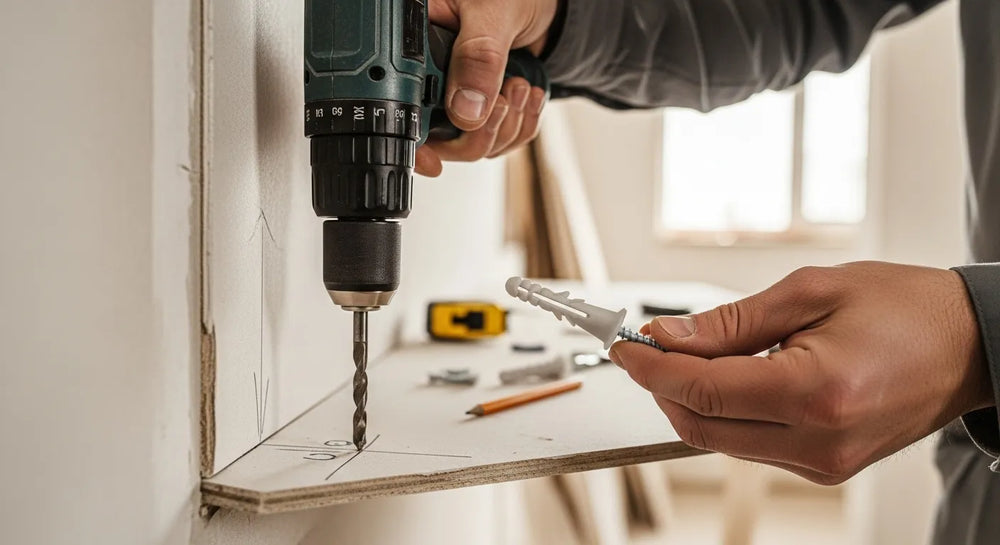
When to Use Drywall Anchors: Securing Your Project
Table of Contents
- Introduction
- The Problem with Drywall: Why Anchors are Non-Negotiable
- Identifying the "When": Scenarios Demanding a Drywall Anchor
- A Deeper Dive into Anchor Types: Matching the Component to the Application
- The Maden.co Advantage: Sourcing with Confidence and Resilience
- Conclusion
- Frequently Asked Questions
Introduction
It’s a sound every facility manager, engineer, and maintenance professional dreads: the sharp crack followed by the crash of a fixture pulling free from a wall. What was once a securely mounted shelf, display, or piece of equipment is now a liability. This common failure often stems from a fundamental misunderstanding of the material we rely on most in modern construction: drywall. While ubiquitous, drywall is not a structural material. Its core of compressed gypsum powder is simply not designed to hold the concentrated force of a threaded screw. This is where the drywall anchor ceases to be an optional accessory and becomes a non-negotiable component for safety, stability, and professional integrity.
For procurement managers and MRO (Maintenance, Repair, and Operations) buyers, sourcing the right fastener is as critical as sourcing a high-tolerance bearing or a specific NPT fitting. A failed anchor can lead to damaged assets, operational downtime, and even safety incidents. The challenge isn't just knowing that you need an anchor, but understanding precisely when and which anchor is appropriate for the application. This guide moves beyond simple DIY advice to provide an industrial-grade understanding of drywall anchor selection and usage. We will explore the physics behind why anchors are essential, break down the specific scenarios demanding their use, and detail how sourcing high-quality, American-made components from a trusted marketplace like Maden.co can fortify your supply chain and ensure your projects are built to last. The correct anchor is not just a piece of plastic or metal; it is the critical link ensuring a successful and secure installation.
The Problem with Drywall: Why Anchors are Non-Negotiable
To understand when to use a drywall anchor, one must first appreciate the inherent limitations of drywall itself. Standard drywall, also known as gypsum board or wallboard, consists of a core of hydrated calcium sulfate (gypsum) pressed between two thick sheets of paper. This composition makes it an excellent material for creating smooth, fire-resistant interior walls, but it offers very little in terms of structural strength.
The Physics of Failure
When you drive a standard screw directly into a sheet of drywall, its threads have very little solid material to grip. The gypsum core is soft and brittle. Under a load—even a seemingly light one—the following happens:
- Concentrated Stress: The entire weight of the mounted object is concentrated on the thin, weak threads of the screw cutting into the soft gypsum.
- Material Crushing: The gypsum around the screw threads begins to pulverize and crumble under the pressure.
- Hole Widening: The hole enlarges as the gypsum deteriorates, offering less and less friction and holding power.
- Catastrophic Failure: The screw, now sitting in a widened, crumbling hole, pulls out completely, often taking a chunk of the drywall paper face with it.
A drywall anchor fundamentally changes this dynamic. Instead of relying on the weak shear strength of gypsum, an anchor works by distributing the load over a much larger surface area. It either expands behind the drywall, bites into it with aggressive threads, or uses wings to brace against the back of the board. This distribution of force is the key principle that allows us to securely mount objects to an otherwise non-structural surface.
The Stud: The Gold Standard of Mounting
The ideal scenario for mounting any object to a wall is to locate a wall stud. These vertical framing members, typically made of wood or steel, are the structural backbone of the wall. Driving a screw directly into a stud provides a secure connection capable of holding significant weight. However, studs are typically spaced 16 or 24 inches apart on center, meaning vast sections of a wall are hollow.
For an MRO buyer needing to install safety signage, a design engineer specifying the location of a wall-mounted control panel, or a contractor installing shelving, the required mounting point will not always align with a stud. In these countless situations, a properly selected and installed drywall anchor is the only professionally acceptable solution. Choosing to forego an anchor is not a calculated risk; it is a guarantee of eventual failure.
Identifying the "When": Scenarios Demanding a Drywall Anchor
The decision to use a drywall anchor is determined by two factors: the substrate (drywall) and the weight of the object being mounted. If you are not fastening into a solid stud, you need an anchor. The next step is to match the anchor to the load it will be supporting.
Light-Duty Applications (Loads up to 15 lbs)
These are the most common applications where a simple, reliable anchor is required. The forces involved are primarily static, meaning the weight is constant and does not involve motion or vibration. For these scenarios, the goal is to provide a stable mounting point that prevents the screw from pulling out over time.
Common Industrial and Commercial Scenarios:
- Mounting smoke detectors and carbon monoxide alarms.
- Hanging lightweight signage, clocks, or small whiteboards in an office.
- Securing thermostats and small electronic control panels.
- Installing lightweight cable management clips or conduits.
For these tasks, a simple expansion anchor is often the most efficient and effective solution. The Ribbed Plastic Anchor is a prime example of a U.S.-made component designed for this purpose. After drilling a small pilot hole, the anchor is tapped into place. As a screw is driven in, the anchor's split ends expand and press firmly against the inside of the drywall, creating a secure, friction-based hold. This type of anchor is a staple in any MRO toolkit due to its simplicity and reliability for countless light-duty fastening needs.
Medium-Duty Applications (Loads from 15 to 50 lbs)
As the weight of the object increases, so does the need for a more robust anchoring solution. Medium-duty applications often involve objects that are handled regularly or hold other items, introducing dynamic forces. The anchor must not only support the static weight but also resist pulling out from incidental contact or vibration.
Common Industrial and Commercial Scenarios:
- Installing shelves for storing parts, tools, or office supplies.
- Mounting fire extinguishers and their brackets.
- Securing towel dispensers and soap dispensers in restrooms.
- Hanging heavy mirrors, framed certificates, or large bulletin boards.
- Wall-mounting smaller monitors or display screens.
For these applications, you need an anchor that provides a more substantial grip than a simple ribbed plug. A sleeve-type anchor, such as the Medium-Duty Nylon Wall Anchor for #8 Drywall, offers superior holding power. These anchors are engineered to expand more aggressively behind the wall, creating a larger footprint that distributes the load more effectively. The use of high-quality nylon, as found in American-made products, ensures the anchor is durable and not brittle, preventing it from cracking under stress during installation or over time.
Another excellent choice for this category, particularly when speed is a factor, are self-drilling anchors. The Medium-Duty Nylon Self-Drilling Drywall Zip-It® Anchor is a game-changer for maintenance crews. Its aggressive threads allow it to be driven directly into the drywall with a screwdriver, eliminating the need for pre-drilling. This saves valuable time on large projects, such as outfitting an entire office or facility with new fixtures.
Heavy-Duty Applications (Loads over 50 lbs)
When you need to mount items exceeding 50 pounds, the stakes are significantly higher. This is the point where you must exercise extreme caution. While heavy-duty drywall anchors exist, the primary goal should always be to locate a stud. If a stud is absolutely not an option, you must use an anchor specifically designed for high loads, like a toggle bolt or a molly bolt.
Common Industrial and Commercial Scenarios:
- Installing heavy-duty shelving for storing inventory or equipment.
- Mounting wall cabinets in a breakroom or workshop.
- Securing grab bars in ADA-compliant restrooms (which absolutely should be anchored to blocking or studs whenever possible).
- Hanging large, heavy displays or industrial control boxes.
Even with the strongest drywall anchors, the drywall panel itself becomes the point of failure. A heavy, dynamic load can cause the entire section of drywall to break away. For any critical or liability-sensitive application, consulting a structural engineer or using an alternative mounting solution (like floor-supported shelving) is the most responsible course of action.
A Deeper Dive into Anchor Types: Matching the Component to the Application
Understanding the mechanics of different anchor types empowers procurement managers and engineers to make informed decisions that go beyond simple weight ratings. The right choice depends on the load, the base material, and the installation requirements.
Expansion Anchors
- Mechanism: These are the most common type. A plastic or nylon sleeve is inserted into a pre-drilled hole. When a screw is driven into the sleeve, it forces the sides of the anchor to expand, pressing against the interior of the drywall.
- Pros: Easy to install, inexpensive, ideal for light-duty static loads.
- Cons: Limited holding power compared to other types, not suitable for ceilings or heavy loads.
- Best Application: A procurement manager needing to source a cost-effective, bulk solution for installing lightweight fixtures throughout a new commercial building would specify a reliable product like the American-made Ribbed Plastic Anchor.
Self-Drilling / Threaded Anchors
- Mechanism: These anchors feature a sharp, self-tapping point and aggressive threads that carve their way directly into the drywall. They essentially create their own perfectly sized hole.
- Pros: Extremely fast installation, no pre-drilling required, excellent holding power for their size.
- Cons: Can be more difficult to remove, may cause more damage to the drywall if improperly installed.
- Best Application: An MRO team tasked with a rapid-response repair or a large-scale installation under a tight deadline would benefit immensely from the efficiency of a part like the Medium-Duty Nylon Self-Drilling Drywall Zip-It® Anchor.
Sleeve-Type Anchors (Hollow Wall Anchors)
- Mechanism: Also known as Molly bolts, these consist of a screw pre-assembled into a metal sleeve. When inserted into a pre-drilled hole, tightening the screw causes the sleeve to collapse and flare out behind the drywall, creating a very strong, load-bearing foot.
- Pros: Excellent holding power for medium-to-heavy loads, screw can be removed and reinserted.
- Cons: Requires a specific size hole, can be more difficult to install correctly than simpler anchors.
- Best Application: A design engineer specifying the mounting for a wall-mounted piece of equipment that may require occasional servicing would choose this type, as the fixture can be removed without the anchor falling into the wall cavity.
Toggle Bolts
- Mechanism: This design offers the highest holding power in hollow walls. It consists of a bolt and a spring-loaded "wing" or toggle. The toggle is collapsed, pushed through a pre-drilled hole, and springs open behind the drywall. As the bolt is tightened, it pulls the toggle tight against the back of the wall, distributing the load over the widest possible area.
- Pros: The strongest type of drywall anchor available.
- Cons: Requires a relatively large hole for installation, the toggle falls into the wall if the bolt is ever fully removed.
- Best Application: Hanging the heaviest possible loads, such as large overhead fixtures (in drywall ceilings) or heavy industrial components where locating a stud is impossible.
The Maden.co Advantage: Sourcing with Confidence and Resilience
In an industrial context, the quality of a simple component like a drywall anchor can have significant repercussions. A cheap, poorly manufactured anchor can lead to project delays, rework, and potential safety issues. This is why a strategic approach to sourcing is paramount.
The Importance of Material and Manufacturing Quality
Sourcing fasteners from unverifiable overseas suppliers introduces significant risk. Issues like brittle plastic that cracks upon installation, inconsistent dimensions that lead to poor fit, or weak metals that deform under load are all too common. These are not just inconveniences; they are supply chain vulnerabilities.
At Maden.co, our entire mission is built on combating this uncertainty. We are dedicated to democratizing access to the American manufacturing base, connecting industrial buyers with a vast network of over 800+ verified U.S. manufacturers. By choosing a U.S.-made product like the Medium-Duty Nylon Wall Anchor for #8 Drywall, you are investing in quality control, material traceability, and consistent performance. This commitment to industrial excellence and American manufacturing pride is at the core of everything we do. You can learn more about our mission to champion domestic production and build a more resilient industrial supply chain.
Streamlining Procurement for Industrial Needs
For a procurement manager under pressure to source a wide range of components for a project, navigating multiple vendors, verifying specifications, and managing lead times can be a logistical nightmare. Our platform is designed to eliminate this friction. With over 2.5 million American-made products in one place, you can quickly find, compare, and procure everything from specialized fasteners to complex machinery components, all with the assurance of supply chain transparency.
Strategic Financial Management with Instant Financing
We understand that large projects and urgent repairs require significant capital outlay. To empower businesses and facilitate seamless procurement, we offer a powerful tool directly within our platform. Instead of navigating complex credit applications or delaying critical purchases, you can apply for Instant Financing at checkout to streamline your capital-intensive projects. This feature allows businesses to manage cash flow effectively, enabling larger volume purchases or immediate acquisition of necessary MRO parts without disrupting their budget. It's a strategic advantage that helps keep your operations running smoothly.
A Call to American Manufacturers
Our platform is a testament to the strength and innovation of domestic industry. We are constantly expanding our network to better serve our customers and strengthen the American manufacturing ecosystem. If you are a U.S.-based manufacturer producing high-quality industrial components, we invite you to join our cause. Are you a U.S. manufacturer? Register as a vendor and join the American manufacturing revival.
Conclusion
Knowing when to use a drywall anchor is a foundational skill in any industrial, commercial, or maintenance setting. It is the professional standard for any application where a load-bearing fastener must be secured to a wall without the benefit of a structural stud. The decision-making process is simple: if you are drilling into hollow drywall to hang an object, you must use an anchor.
The true challenge lies in selecting the right anchor for the job and sourcing it from a reliable partner. By understanding the different types of anchors and their load-bearing capabilities, and by prioritizing high-quality, verifiably American-made components, you transform a potential point of failure into a source of strength and stability. This commitment to quality not only ensures the integrity of your work but also contributes to a more resilient and reliable domestic supply chain.
Solve your procurement challenges and build with confidence. Explore the extensive Maden.co catalog to find the precise, U.S.-made anchors and fasteners your projects demand. And remember to leverage the power of Instant Financing at checkout to make your procurement process as efficient and strategic as possible.
Frequently Asked Questions
1. Can I use a drywall anchor to hang a TV? It is strongly recommended that you do not. A TV is not only heavy but also expensive and represents a significant safety risk if it falls. The dynamic forces, especially on an articulating mount, can easily overwhelm even heavy-duty drywall anchors. The industry best practice is to always locate wall studs and use lag bolts to secure the TV mount directly to the wall's structural frame.
2. What's the difference between a nylon and a plastic (polyethylene) anchor? While they may look similar, nylon is a superior material for most anchor applications. Nylon is stronger, less brittle, and more resistant to temperature fluctuations and aging than common polyethylene plastic. For a medium-duty application where reliability is key, a nylon anchor provides a more durable and dependable hold over the long term.
3. How do I remove a drywall anchor? For plastic expansion anchors, you can often back the screw out partially and use pliers to pull the screw and anchor out together. For self-drilling anchors, you can simply unscrew them from the wall. Sleeve-type anchors (Molly bolts) are more difficult; it's often best to tap them flush with the wall or drive them into the wall cavity before patching the hole. For toggle bolts, once the bolt is removed, the toggle wing will fall harmlessly inside the wall cavity.
4. Why is sourcing U.S.-made anchors important for my business? Sourcing U.S.-made anchors from a platform like Maden.co offers several strategic business advantages. It ensures a higher level of quality control and material consistency, reducing the risk of component failure. It provides supply chain transparency and resilience, minimizing delays associated with overseas shipping. Finally, it supports the domestic economy and strengthens the American industrial base, ensuring these critical manufacturing capabilities remain robust. If you ever have questions about sourcing a specific component, our expert team is here to assist; feel free to contact us for support.


