
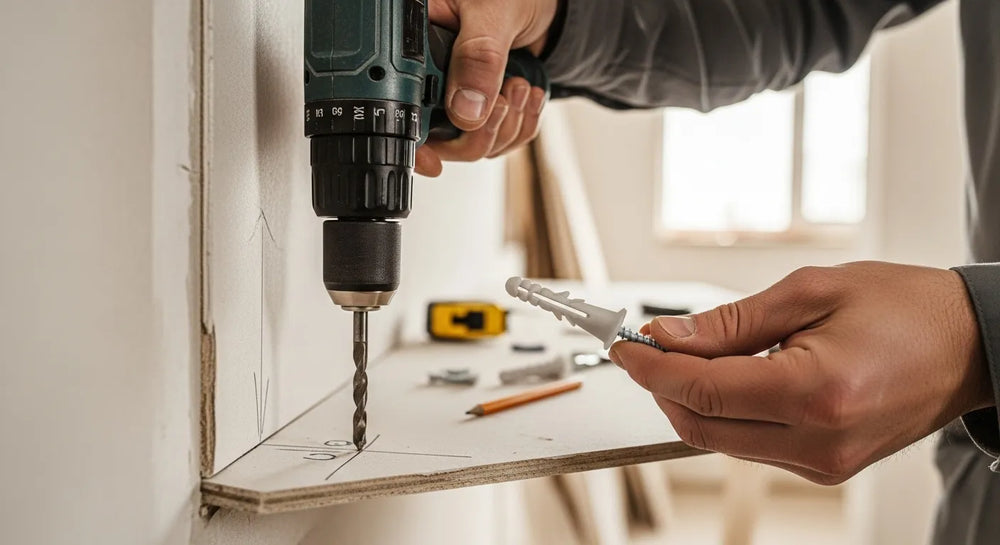
Which Drywall Anchors Are Best? A Buyer’s Guide
Table of Contents
- Introduction
- Understanding the Fundamentals: Why Drywall Anchor Selection Matters
- Deconstructing the Drywall: The Foundation of Your Fastening Strategy
- A Taxonomy of Drywall Anchors for Professional Applications
- Matching the Anchor to the Load: A Critical Calculation
- The Strategic Advantage of Sourcing American-Made Anchors
- Streamlining Procurement: Beyond the Component Itself
- Conclusion
- Frequently Asked Questions
Introduction
A project manager for a large commercial build-out stands in a newly framed office, tablet in hand, reviewing the day’s schedule. The task is simple: mount hundreds of fixtures, from heavy-duty shelving in the breakrooms to essential safety equipment in the hallways. But a call from the site foreman brings bad news. The shipment of specified drywall anchors is delayed, stuck in a port halfway across the world. Suddenly, a component worth pennies is threatening to derail a six-figure project, causing a cascade of scheduling conflicts for electricians, painters, and finishers. This scenario, all too common in today's fragile global supply chain, highlights a critical truth: the smallest parts can have the biggest impact on a project's success.
Choosing the right drywall anchor is more than a simple hardware store decision; it's a calculated procurement strategy that impacts safety, efficiency, and your bottom line. For procurement managers, MRO (Maintenance, Repair, and Operations) buyers, and design engineers, the selection process requires a deeper level of analysis than a typical DIY guide can offer. This article provides that professional perspective. We will deconstruct the different types of drywall anchors, analyze their load-bearing capabilities, and discuss the critical factors that should inform your selection for commercial, industrial, and high-volume applications.
Ultimately, we'll demonstrate that the "best" drywall anchor is not a single product, but the one that perfectly aligns with your project's specific material, load, and performance requirements. It's a component chosen to optimize the Total Cost of Ownership (TCO) by ensuring reliability, minimizing rework, and contributing to a resilient, American-based supply chain.
Understanding the Fundamentals: Why Drywall Anchor Selection Matters
In a professional context, a fastener is never just a fastener; it's a critical point of structural integrity. While a homeowner might worry about a picture frame falling, an MRO manager is concerned with OSHA compliance for mounted equipment, and a commercial builder is liable for the safety of hundreds of fixtures in a public space. The stakes are exponentially higher, and so is the need for precision.
The true cost of an anchor failure extends far beyond the price of the component itself. Consider the business implications:
- Safety Hazards: A dislodged shelf in a warehouse or a failed grab bar in a commercial restroom can lead to serious injury and significant liability.
- Rework Costs: The labor and material costs to repair a damaged wall and properly reinstall a fixture can be hundreds of times the cost of the original anchor.
- Reputational Damage: For contractors and installers, failures reflect poorly on the quality of their work, potentially costing future business.
- Project Delays: As in our opening scenario, a single failed component can halt progress, leading to costly overruns and contractual penalties.
This is why we champion the principle of Industrial Excellence. It's a commitment to understanding that every component, no matter how small, contributes to the overall quality and safety of the final project. This begins with sourcing parts from manufacturers who demonstrate consistent quality control and material integrity—a hallmark of American manufacturing. By focusing on the Total Cost of Ownership, procurement professionals can justify sourcing higher-quality, reliable components by quantifying the immense costs they help avoid.
Deconstructing the Drywall: The Foundation of Your Fastening Strategy
Before you can select an anchor, you must understand the substrate it will be installed in. Drywall, or gypsum board, is not a uniform material. Its composition and thickness directly dictate which anchors are viable and how much load they can safely support. Specifying an anchor without considering these variables is a recipe for failure.
Not All Drywall is Created Equal
For industrial and commercial applications, you will encounter several types of drywall, each with unique properties:
- Standard Drywall: The most common type, consisting of a gypsum core pressed between two sheets of paper.
- Moisture-Resistant Drywall ("Green Board"): Features a water-resistant core and paper facing, typically used in bathrooms, kitchens, and laundry rooms. It is not waterproof but resists humidity better than standard board.
- Fire-Resistant Drywall ("Type X"): Contains glass fibers mixed into the gypsum core, which increases its fire rating. It's often required by building codes in commercial buildings, garages, and multi-family housing.
- Impact-Resistant and Abuse-Resistant Drywall: Features a denser core and a fiberglass mesh to withstand higher levels of surface impact and abrasion, common in high-traffic areas like school hallways, hospitals, and manufacturing facilities.
Thickness Matters
The thickness of the drywall panel is arguably the most critical factor for an anchor's holding power. The most common thicknesses you will encounter are:
- 1/4 inch: Primarily used for covering existing surfaces or for creating curved walls. It offers very little structural support.
- 3/8 inch: A lighter-weight option often used in repair work or in some mobile homes.
- 1/2 inch: The most common thickness for interior walls in residential and light commercial construction.
- 5/8 inch: A thicker, more rigid panel, often a Type X fire-rated board. It provides superior sound dampening and structural rigidity, making it standard for most commercial applications.
For a procurement manager, obtaining the correct drywall specification is non-negotiable. Ordering thousands of anchors designed for 1/2-inch drywall when the project uses 5/8-inch Type X will result in installation failures, wasted material, and significant procurement friction. Accurate specification is the first step to a successful installation.
A Taxonomy of Drywall Anchors for Professional Applications
With a clear understanding of the substrate, we can now explore the primary categories of drywall anchors. Each type operates on a different mechanical principle and is engineered for specific load ranges and applications.
Expansion Anchors: The Workhorse of Light-Duty Fastening
Expansion anchors are the most common type and function by expanding within or behind the drywall as a screw is driven into them. They are best suited for light-duty static loads.
The most recognizable example is the ribbed plastic anchor. These simple, tapered plastic sleeves are inserted into a pre-drilled hole. The ribs prevent the anchor from spinning during screw insertion, and the anchor expands to press against the gypsum, creating a friction-based hold.
- Best For: Very light loads such as small signage, thermostats, smoke detectors, and lightweight decor.
- Scenario: A facilities manager for a corporate campus needs to mount 200 lightweight wayfinding signs. Speed, cost-effectiveness, and reliability are paramount. They cannot afford for signs to come loose, but the load is minimal.
- Sourcing Solution: For these high-volume, low-load applications, consistency is key. A U.S.-made Ribbed Plastic Anchor from a verified supplier ensures that the material composition and dimensions are uniform from the first anchor to the last, preventing installation issues.
- Professional Considerations: While excellent for light duty, they have very low pull-out strength and should never be used for anything of significant weight or value, especially on ceilings where the primary force is tensile.
Self-Drilling Anchors: Prioritizing Speed and Efficiency
For contractors and installers, time is money. Self-drilling anchors are designed to maximize installation speed by eliminating the need for a pilot hole. They feature a sharp, auger-like tip that bores directly through the drywall. Once flush with the wall, the screw is inserted, causing the anchor to expand and hold.
These anchors typically come in two materials: nylon and a zinc alloy (often referred to by brand names like Zip-It®). Nylon offers excellent, reliable holding power for medium-duty applications and is non-corrosive. The metal versions can handle slightly heavier loads but can be more brittle if over-torqued.
- Best For: Medium-duty applications like installing brackets for shelving, mounting conduit clamps, securing junction boxes, and hanging heavy pictures or mirrors.
- Scenario: An electrical contractor is on a tight schedule to install lighting and conduit throughout a new retail space. Every minute saved on each of the hundreds of mounting points translates directly to improved labor efficiency and project profitability.
- Sourcing Solution: MRO buyers and contractors looking to optimize on-site efficiency should specify a reliable, self-drilling anchor. A high-quality component like the Medium Duty Nylon Self-Drilling Drywall Zip-It® Anchor from a domestic source guarantees performance and reduces the risk of inferior foreign-made products failing under load.
- Professional Considerations: The primary risk is over-torquing, which can strip the drywall and cause the anchor to lose all its grip. Using a drill with a clutch setting or careful hand-tightening is essential for a secure installation.
Sleeve-Type Anchors: Balancing Strength and Versatility
Sleeve-type anchors represent a step up in holding power from basic expansion and self-drilling types. These anchors consist of a metal or nylon sleeve that deforms or expands behind the drywall as a screw is tightened, creating a much larger and more secure contact area.
Examples include Molly bolts and certain nylon sleeve anchors. A classic Molly bolt has a cylindrical metal sleeve that is designed to crumple and expand in a controlled way behind the wall. Their all-metal construction makes them a durable choice for medium-to-heavy loads. Another effective design utilizes a nylon sleeve that splits and braces itself against the back of the drywall.
- Best For: Heavier applications like towel bars, curtain rods, small cabinets, and commercial-grade shelving units.
- Scenario: A design engineer is specifying fasteners for a custom shelving unit in a new office prototype. The load is significant, and failure is not an option, but drilling massive holes for toggle bolts is aesthetically undesirable.
- Sourcing Solution: When engineering requirements demand specific performance characteristics, access to clear technical data is vital. The product page for a U.S.-made Medium Duty Nylon Wall Anchor #8 for Drywall provides the necessary specifications for an engineer to make an informed decision and ensure the fastener meets the project's safety and performance standards.
- Professional Considerations: Installation requires a pre-drilled hole of the correct size. One advantage of some sleeve types, like Molly bolts, is that the screw can be removed and reinserted without the anchor falling into the wall cavity—a useful feature for items that may need occasional removal for maintenance.
Toggle Bolts: The Gold Standard for Heavy-Duty Applications
When the load is heavy or dynamic, and failure is absolutely not an option, the toggle bolt is the go-to solution. This anchor consists of a machine bolt and a pair of spring-loaded "wings." A large hole is drilled, the wings are collapsed and pushed through, and they spring open inside the wall cavity. As the bolt is tightened, the wings are drawn tight against the back of the drywall, distributing the load over a very wide area.
- Best For: Heavy-duty and safety-critical applications like mounting televisions, grab bars, large mirrors, heavy shelving, and overhead fixtures like projectors (on ceilings).
- Scenario: A contractor is installing ADA-compliant grab bars in the restrooms of a new hospital. The anchors must support significant dynamic loads and meet stringent building codes. There is no room for error.
- Professional Considerations: Toggle bolts provide the highest load capacity of any drywall anchor. However, they require a relatively large installation hole. The primary drawback is that if the bolt is fully removed from the fixture, the winged toggle will fall down into the wall cavity, lost forever. Newer "strap toggle" designs have mitigated this issue, but the traditional toggle bolt remains a reliable, high-strength choice.
Matching the Anchor to the Load: A Critical Calculation
Selecting an anchor is an engineering decision that requires an understanding of the forces at play. All reputable manufacturers provide load ratings for their products, but it's crucial to know what these numbers mean.
Understanding Load Types
- Shear Strength: This is the force pulling downward, parallel to the surface of the wall. Think of a picture hook holding a heavy frame. The anchor is being "sheared."
- Tensile Strength (or Pull-Out Strength): This is the force pulling straight out from the wall, perpendicular to the surface. Think of someone pulling on a grab bar or an anchor holding a fixture on a ceiling.
An anchor's capacity will be different for each type of load. Tensile loads are generally more challenging for drywall anchors to resist.
Safe Working Load (SWL) vs. Ultimate Load
Product packaging often advertises an "ultimate load" rating. This is the absolute maximum weight the anchor held in a laboratory setting before catastrophic failure. You should never design an installation based on this number.
Professionals must use the Safe Working Load (SWL), which is the ultimate load divided by a safety factor. The industry-standard safety factor is typically 4:1 or 5:1. This means if an anchor has an ultimate tensile load of 200 lbs, its SWL is only 40-50 lbs. This margin of safety accounts for variations in drywall quality, installation imperfections, and dynamic forces (e.g., someone bumping into a shelf).
The Strategic Advantage of Sourcing American-Made Anchors
In a globalized market, it may be tempting to source common components like fasteners from the lowest-cost overseas provider. However, for a professional organization, this is a short-sighted strategy that ignores the significant risks and hidden costs. Embracing a domestic sourcing strategy is a core tenet of building a resilient and profitable business.
At Maden.co, our entire model is built on proving the value of this approach. Our mission is to democratize access to American manufacturing, making it just as convenient to source from a verified factory in Ohio as it is from an unknown overseas supplier.
Supply Chain Resilience: The past few years have proven that international supply chains are brittle. A port closure, a trade dispute, or a pandemic can halt the flow of critical components, bringing multi-million dollar projects to a standstill over parts worth less than a dollar. Sourcing domestically from our network of over 800 U.S. manufacturers drastically shortens lead times and insulates your projects from global volatility. This is the essence of building a robust supply chain.
Material Quality and Compliance: American manufacturers operate under some of the world's most stringent quality and safety standards (e.g., ASTM, ANSI). When you source a U.S.-made anchor, you are getting a product made with verifiable material grades and consistent manufacturing processes. This translates to predictable performance and eliminates the risk of using counterfeit or substandard materials that can lead to catastrophic failures. You can learn more about our foundational commitment to championing American manufacturing on our about us page.
Streamlining Procurement: Beyond the Component Itself
A modern procurement strategy isn't just about what you buy; it's about how you buy it. The process itself can be a major source of cost and inefficiency. Our platform is designed to directly address these challenges, embodying our values of Digital Innovation and Customer Empowerment.
Reducing Procurement Friction: Think of the hours your procurement team spends vetting new suppliers, chasing down technical specification sheets, negotiating terms, and managing logistics for dozens of small orders. We eliminate this friction by providing a single, trusted platform. All our manufacturers are verified, and detailed product data is standardized and readily available, allowing your team to source with confidence and speed.
Managing Cash Flow with Strategic Financing: We understand that business growth requires capital. A large project or an unexpected MRO need can put a strain on cash flow when materials must be purchased upfront. This is why we've integrated powerful financial tools directly into our platform. To help businesses manage capital and execute on large-scale projects, we offer Instant Financing options at checkout. This isn't just a payment method; it's a strategic tool that allows you to procure the necessary volume of components now and align your payments with your project's revenue cycle.
A Call to U.S. Manufacturers: The American manufacturing revival is a collaborative effort. Our growing B2B marketplace is a testament to the strength and innovation of domestic producers. If your company manufactures high-quality industrial products and shares our commitment to excellence, we invite you to join our network. Register as a vendor and connect with thousands of industrial buyers who are actively seeking to build their supply chains here at home.
Conclusion
The question "which drywall anchors are best?" has no single answer. The best anchor is the one that is correctly specified for the drywall type, engineered to handle the specific shear and tensile loads of the application, and sourced from a reliable manufacturer that guarantees quality and consistency. It’s a decision that moves beyond unit price to consider the Total Cost of Ownership—factoring in safety, reliability, and the high cost of failure and project delays.
Choosing the right anchor is a reflection of a professional commitment to quality. It demonstrates an understanding that even the smallest components are critical to the integrity of the whole.
Stop the endless search for reliable components and the uncertainty of fragile supply chains. Explore our catalog of over 2.5 million U.S.-made products and find the exact drywall anchors and industrial supplies your project demands. Build a more resilient business and experience a streamlined procurement process designed for the modern industrial buyer. And remember, you can apply for Instant Financing at checkout to make your capital-intensive projects more manageable. If you have specific sourcing questions or can't find a particular component, our team is ready to help.
Frequently Asked Questions
1. Can I use a plastic anchor for a heavy item like a TV? It is strongly advised not to. Simple plastic expansion anchors are designed for very light static loads and have minimal pull-out strength. A television is not only heavy, but its mounting bracket also places a significant tensile and shear load on the fasteners. For an application this critical, you should always locate a wall stud and fasten directly to it. If a stud is not available, a heavy-duty toggle bolt or strap toggle is the minimum acceptable alternative.
2. What's the biggest mistake people make when installing drywall anchors? The most common and damaging mistake is over-torquing the screw, especially with a power drill. For self-drilling and expansion anchors, over-tightening can strip the surrounding gypsum, causing the anchor to spin freely and lose all its holding power. For toggle bolts, it can deform the drywall. It is crucial to tighten the screw until it is snug and the fixture is secure, but no further.
3. Do I always need to pre-drill a hole for a drywall anchor? No, it depends entirely on the type of anchor. Self-drilling anchors, as their name implies, are designed to bore their own hole. For all other types, such as ribbed plastic anchors, sleeve-type anchors, and toggle bolts, a pre-drilled pilot hole is mandatory. Using the exact drill bit size specified by the anchor manufacturer is critical for ensuring a snug fit and achieving the anchor's rated load capacity. A hole that is too large will prevent the anchor from engaging properly.
4. How does sourcing U.S.-made anchors benefit my business's bottom line? The benefit is calculated through Total Cost of Ownership (TCO), not just the unit price. Sourcing American-made anchors from a platform like Maden.co contributes to your bottom line by: 1) Reducing the risk of costly project delays caused by international shipping disruptions. 2) Lowering rework and liability costs by ensuring material quality and performance consistency, thus avoiding failures. 3) Improving procurement efficiency by reducing the time your team spends vetting suppliers and chasing data. These factors protect your project margins and enhance overall profitability.


