
Why Your Drywall Anchor Won't Go In: Pro Solutions
Table of Contents
- Introduction
- Understanding the Anatomy of Your Wall
- Common Culprits: Diagnosing the Installation Failure
- A Strategic Approach to Flawless Anchor Installation
- Beyond the Basics: Advanced Scenarios and Solutions
- The Maden.co Advantage: Building Resilient Operations with U.S. Manufacturing
- Conclusion
- Frequently Asked Questions (FAQ)
Introduction
A facilities manager is two hours into what was supposed to be a 30-minute job: installing heavy-duty shelving in a new office wing. The project is stalled, not by a complex assembly, but by a tiny component that refuses to cooperate. The drywall anchor—a simple, ubiquitous piece of hardware—will not go into the wall. It either crumples, spins uselessly, or stops dead, threatening the project timeline and causing mounting frustration. This scenario is all too common in maintenance, repair, and operations (MRO), where even the smallest component failure can have a significant ripple effect on productivity and costs.
This isn't just about a hole in the wall; it's about operational efficiency, safety, and the integrity of your work. A failed anchor means wasted time, materials, and potentially unsafe installations. In a professional setting, the consequences extend to project delays and a diminished perception of quality. At Maden.co, we understand that industrial excellence is built on the reliability of every single component, no matter how small. Our mission is to democratize access to American manufacturing, ensuring that professionals have the high-quality, dependable hardware they need to get the job done right the first time.
This comprehensive guide will move beyond simple DIY tips to provide a professional-grade diagnostic and solutions framework for why your drywall anchor is not going in. We will explore the hidden anatomy of your walls, dissect the common points of failure—from tool selection to installation technique—and provide a strategic methodology for ensuring flawless anchor installation every time. The core message is clear: success hinges on a combination of accurate problem identification, correct procedure, and the uncompromising quality of your materials, a standard upheld by the verified U.S. manufacturers in our network.
Understanding the Anatomy of Your Wall
Before you can solve the problem, you must understand the environment. A drywall panel is not a uniform, empty plane; it's the facade of a complex system of structural, electrical, and plumbing components. Assuming every spot is clear for drilling is the first and most common mistake.
Beyond the Gypsum: What's Hiding Behind Your Drywall?
The hollow sound between studs is the ideal target for most drywall anchors, but many installation failures occur because the drill bit or anchor tip hits an unexpected obstruction. Here's what you might encounter:
- Wood Studs: These vertical framing members are typically pine or fir and are placed 16 or 24 inches on center. If you hit a stud, a standard drywall anchor is not needed and will not work. You should instead use a wood screw driven directly into the stud for a far superior hold.
- Metal Studs: Increasingly common in commercial construction, metal studs will stop a standard drill bit and crumple a plastic anchor. Drilling into them requires a specific self-tapping screw designed for metal.
- Plumbing: Copper, PEX, or PVC pipes can run vertically and horizontally through walls, especially in kitchens, bathrooms, and laundry areas. Puncturing a water pipe is a catastrophic failure that can lead to extensive water damage.
- Electrical Wiring: Romex (non-metallic sheathed cable) is often run through holes drilled in studs. Drilling into a live wire is extremely dangerous and can cause electrocution or a fire. Electrical boxes for outlets and switches are also mounted to studs.
- Fireblocks: These are horizontal pieces of wood installed between studs to slow the spread of fire within the wall cavity. They are often found at mid-wall height and can be easily mistaken for an unknown, impenetrable obstruction.
- HVAC Ducting: In some walls, you may encounter metal ductwork for your heating, ventilation, and air conditioning system.
The Difference Between Drywall and Plaster
What you perceive as drywall might actually be plaster, especially in older buildings. The two materials behave very differently.
- Drywall (Gypsum Board): This consists of a layer of gypsum plaster pressed between two thick sheets of paper. It's relatively soft and easy to drill through. However, it's also brittle and can crumble if the wrong anchor or technique is used.
- Plaster and Lath: This older construction method involves applying wet plaster over a framework of thin wooden strips called lath. Plaster is much harder and more brittle than drywall. Attempting to hammer in a plastic anchor can easily crack a large area. Drilling requires a masonry bit, and anchor selection often trends towards toggle bolts that can span the lath behind the plaster.
The Critical Role of Wall Thickness and Condition
Not all drywall is the same. The thickness directly impacts the type of anchor you can use and its holding power.
- Standard Thickness: 1/2-inch drywall is the most common for interior walls.
- Thicker Walls: 5/8-inch drywall (Type X) is used for fire-rated walls and ceilings. It provides a more substantial base for anchors.
- Thin or Damaged Walls: In some cases, you may find 1/4-inch or 3/8-inch drywall, which offers very little holding strength. Drywall that has been subjected to moisture or has been previously damaged will be soft and crumbly, making it nearly impossible for a standard expansion anchor to get a grip.
Understanding these variables is the first step in diagnosing your installation issue. The problem often isn't the anchor itself, but a misunderstanding of the substrate you're working with.
Common Culprits: Diagnosing the Installation Failure
When an anchor fails to install correctly, it's typically due to one of four main reasons: hitting an obstruction, using the wrong tools, selecting an inappropriate anchor, or improper installation technique.
Obstruction Encountered: Hitting a Stud or Something Else
This is the most frequent cause of an anchor stopping dead in its tracks. You push, and it goes in about half an inch, then refuses to budge.
Diagnostic Test: Use a high-quality electronic stud finder to scan the area before you even think about drilling. These devices can detect wood and metal studs, and some advanced models can even alert you to the presence of live AC wiring. If you don't have a stud finder, you can try the "tap test." Tap along the wall with your knuckle; the sound will be hollow between studs and change to a dull, solid thud when you're over one.
Solution: If you've hit a wood stud, rejoice! This is the most secure place to mount anything. Abandon the anchor and use a long wood screw. If you've hit metal, you must determine if it's a stud, a pipe, or a protective plate. If you suspect plumbing or electrical, stop immediately and choose a new location at least a few inches away. Safety is paramount.
The Wrong Tools for the Job: Pilot Holes and Drill Bits
Many anchor failures are caused by an incorrectly sized pilot hole. The relationship between the drill bit and the anchor is precise and unforgiving.
- Hole Too Small: This is a common reason an anchor won't go in. You try to hammer it, and the plastic fins shear off, the head mushrooms, or the anchor body bends and crumples. You cannot force a 1/4-inch anchor into a 3/16-inch hole.
- Hole Too Big: This leads to a different failure. The anchor goes in far too easily and then spins in place when you try to drive the screw. The anchor's fins or ribs have nothing to bite into, rendering it completely useless for load-bearing.
Solution: Read the anchor's packaging. The manufacturer specifies the exact drill bit size required for a reason. For example, a common plastic anchor might require a 3/16" or 1/4" bit. Don't guess. Using a precisely manufactured anchor, like a U.S.-made Ribbed Plastic Anchor, ensures that the specified dimensions are accurate, allowing for a perfect fit when paired with the correct drill bit. This is a prime example of how Industrial Excellence, one of our core values, translates to tangible results on the job site.
Anchor and Wall Mismatch: Not All Anchors Are Created Equal
Using an anchor that isn't designed for your specific application or wall type is a recipe for frustration. A procurement manager ordering in bulk or an MRO buyer stocking the supply closet must understand these distinctions to avoid costly and time-consuming errors.
- Light-Duty Plastic Expansion Anchors: These are the most common type, often used for hanging pictures or lightweight decor. They work by expanding as a screw is driven into them, pressing against the sides of the drywall. They are unsuitable for heavy loads or for use in crumbly plaster.
- Self-Drilling Anchors: These are a fantastic innovation for efficiency. They feature a sharp, drill-like tip that bores its own hole into the drywall, eliminating the need for pre-drilling. They offer better holding power than basic plastic anchors and are ideal for medium-duty applications like installing smoke detectors or small shelves. A high-quality, American-made option like the Medium-Duty Nylon Wall Anchor #6 Self-Drilling Drywall Zip-It® can significantly speed up commercial installation projects. However, they can fail if they hit a stud or if the drywall is too soft, causing the hole to become oversized.
- Heavy-Duty Anchors (Toggle Bolts, Molly Bolts): For significant loads like cabinets, handrails, or televisions, you need an anchor that distributes the weight over a larger area behind the drywall. Toggle bolts have spring-loaded "wings" that pop open after being inserted through the wall. Molly bolts have a sleeve that expands and clamps onto the back of the drywall. These require a much larger hole but provide superior strength.
Technique and Execution Errors
Sometimes, the wall is fine, the tools are correct, and the anchor is appropriate, but the installation technique is flawed.
- Excessive Force: Drywall is fragile. Trying to hammer an anchor in with brute force will likely damage the anchor and the wall surface, creating a weak point. The anchor should be tapped in gently with a rubber mallet or the handle of a screwdriver.
- Drilling at an Angle: The pilot hole must be drilled perpendicular to the wall surface. An angled hole will cause the anchor to sit improperly and may prevent it from expanding correctly, compromising its holding power.
- Over-tightening the Screw: With plastic anchors, it's possible to apply too much torque when driving the screw. This can strip the inside of the anchor, causing the screw to spin endlessly without tightening. It can also cause the anchor head to pull through the face of the drywall.
A Strategic Approach to Flawless Anchor Installation
Avoiding failure requires shifting from a reactive "fix-it" mindset to a proactive, strategic process. For professionals, this process ensures repeatability, safety, and efficiency.
Step 1: Pre-Installation Inspection and Planning
Before a single hole is drilled, a thorough assessment is necessary. Use a stud finder to map out the framing, electrical, and potential plumbing in the work area. Mark the stud locations lightly with a pencil. Plan your layout to either hit the studs directly (preferred) or to be safely centered in the hollow bays between them. Finally, confirm the weight of the object you plan to hang to ensure you select an anchor with an adequate load rating.
Step 2: Selecting the Right American-Made Anchor
The quality of your fastener is not the place to cut corners. A low-quality, imported anchor with inconsistent material density or dimensional inaccuracies can fail unpredictably, damaging property or even causing injury. This is why our entire business model is built on Supply Chain Transparency. At Maden.co, we connect you with a vast catalog of over 2.5 million products from more than 800 verified U.S. manufacturers. This provides the assurance that the component you order meets rigorous quality standards. You can learn more about our mission to champion American manufacturing here.
For a versatile, reliable choice for many common MRO tasks, consider a product like the Medium-Duty Nylon Wall Anchor #8 for Drywall. Made in the USA from high-grade nylon, it provides consistent expansion and a secure grip for medium-duty applications. Choosing a domestically produced component improves your Total Cost of Ownership (TCO) by reducing the risk of failure, rework, and project delays.
Step 3: Precise Execution and Best Practices
With the right location and the right anchor, execution becomes the final critical variable.
- Mark Your Spot: Use a pencil to make a clear, precise mark for your hole.
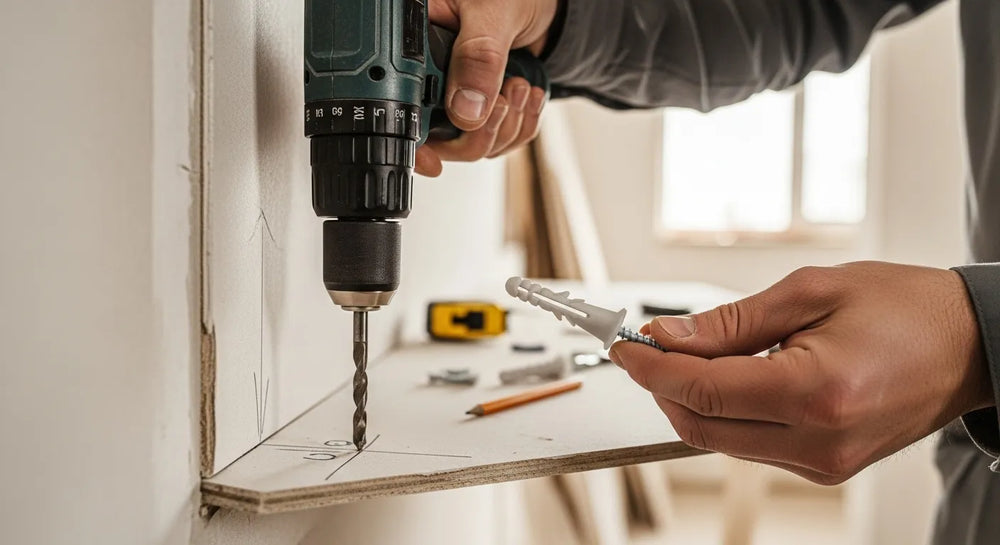
- Drill the Pilot Hole: Use the exact bit size specified for your anchor. Drill straight into the wall, applying steady, even pressure. Let the drill do the work. Once you're through the drywall, you'll feel a sudden lack of resistance. Stop there; don't drill deeper into the empty wall cavity.
- Clear the Hole: Gently blow or vacuum the dust out of the hole to ensure a clean surface for the anchor to grip.
- Insert the Anchor: Press the anchor into the hole with your thumb. It should be snug. If it requires force, your hole is too small. If it's loose, your hole is too big. Gently tap it with a mallet until the head is flush with the wall surface.
- Drive the Screw: Place your item over the anchor, insert the screw, and drive it in with a screwdriver or a drill on a low-torque setting. You should feel the resistance increase as the anchor expands. Stop when the screw is snug. Do not over-tighten.
Beyond the Basics: Advanced Scenarios and Solutions
Professional environments often present unique challenges that go beyond standard drywall installations.
Dealing with Old or Crumbly Drywall
If the drywall is soft, damaged, or chalky, a standard anchor will likely fail. The material around the hole simply won't be strong enough to support the expanded anchor. In these cases, you may need to use a snap toggle bolt, which clamps a solid metal channel against the back of the drywall, distributing the load over a much wider, more stable area. Alternatively, you may need to first repair the damaged section of the wall with a patch kit before attempting to install an anchor.
Anchoring into Ceilings
Mounting items to a ceiling requires extra caution, as you are fighting gravity directly. The load rating for an anchor is often significantly lower for ceiling applications than for wall applications. For anything of significant weight, such as light fixtures or projectors, it is always best to locate a ceiling joist and secure the item directly to it. If a joist is not available, a heavy-duty toggle bolt is the minimum requirement. Never use simple plastic expansion anchors for ceiling applications.
Removing a Failed or Unwanted Anchor
If an installation goes wrong, you're left with a useless anchor in your wall. For plastic expansion anchors, the easiest solution is often to tap it slightly deeper into the wall cavity with a nail set and then patch over the small hole with spackle. For a self-drilling anchor, you can typically just unscrew it. If the head has broken off, you may need to push the body through into the wall cavity.
The Maden.co Advantage: Building Resilient Operations with U.S. Manufacturing
For a procurement manager under pressure to source components for a facility-wide upgrade, a design engineer needing fasteners with specific material certifications, or an MRO buyer facing an unexpected equipment breakdown, the ability to quickly find and finance a verified, U.S.-made part is a game-changer. The frustration of a failed drywall anchor is a microcosm of larger supply chain challenges: a lack of quality control, uncertain material origins, and delays caused by unreliable components.
At Maden.co, we are solving this problem. Our platform is a testament to our core value of Customer Empowerment. We provide the digital tools to make sourcing American-made products as accessible and convenient as any global alternative. This focus on Digital Innovation reduces procurement friction, saving your team valuable time and resources that can be better spent on core operations.
For large-scale renovation or outfitting projects, managing cash flow is critical. We understand that securing high-quality components in volume is a significant investment. That’s why you can apply for Instant Financing at checkout to streamline your capital-intensive projects and acquire the quality parts you need without delay.
Our commitment extends to the backbone of our nation's industry. We believe America's manufacturing revival is here, and we are proud to be a part of it. Are you a U.S. manufacturer producing top-tier fasteners and hardware? Register as a vendor and join a network dedicated to industrial excellence.
If you have specific sourcing questions about finding the right anchor, fastener, or any other industrial component for your unique application, our expert team is ready to help. Contact Us for personalized assistance.
Conclusion
A drywall anchor that won't go in is more than a minor annoyance; it's a diagnostic puzzle. By systematically evaluating the wall's structure, the tools for the job, the type of anchor selected, and the technique used for installation, you can turn repeated frustration into consistent success. The solution is rarely brute force, but rather a methodical approach rooted in understanding the mechanics of the system.
Ultimately, the integrity of your work and the efficiency of your operations depend on the reliability of your components. By choosing to source high-quality, American-made anchors and fasteners, you are not just buying a piece of hardware; you are investing in safety, durability, and a more resilient domestic supply chain.
Explore the extensive catalog on Maden.co to find the verified, U.S.-made components your projects demand. From specialty fasteners to MRO essentials, build with the confidence that comes from American quality and take control of your procurement process with powerful tools like Instant Financing available right at checkout.
Frequently Asked Questions (FAQ)
1. Can I reuse a drywall anchor? Generally, it is not recommended to reuse drywall anchors, especially plastic expansion anchors. Once they have been expanded and removed, their structural integrity is compromised, and they will not provide the same holding power. It is always safer and more effective to use a new anchor for each installation.
2. What's the best anchor for hanging something heavy like a TV? For heavy items, you should always try to mount directly into a wall stud using lag bolts. If a stud is not available, you must use a heavy-duty anchor designed to distribute weight behind the drywall. Snap toggle bolts are an excellent choice, as they provide a large clamping surface and have very high load ratings suitable for televisions, cabinets, and shelving.
3. My self-drilling anchor just spins when I try to install it. What's wrong? This usually indicates one of two problems. First, you may have inadvertently created an oversized hole, either by wiggling the drill or because the drywall itself is too soft or has been previously damaged. Second, the anchor may have bored through the drywall and hit a stud or other obstruction just behind it, preventing it from threading in further and causing it to spin.
4. Why is it important to source U.S.-made fasteners for professional use? Sourcing U.S.-made fasteners provides several critical advantages for businesses. It ensures adherence to stringent quality control standards and material traceability, reducing the risk of component failure. It also strengthens supply chain resilience by shortening lead times and reducing dependency on overseas logistics. Finally, it supports the domestic economy and aligns with a commitment to American Manufacturing Pride, a value that often translates to superior product performance and reliability.


