
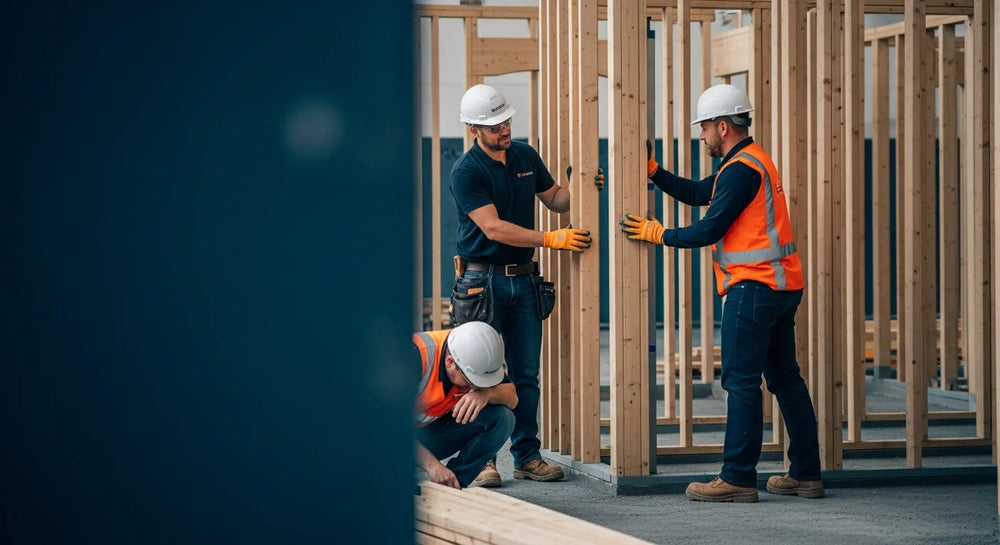
Does It Cost More to Build a 2 Story House?
Table of Contents
- Introduction
- The Fundamental Economics of Footprint vs. Verticality
- Foundation and Excavation: The High Cost of the Ground Floor
- Roofing and Exterior Shell: Savings Through Reduction
- The Verticality Tax: Labor, Safety, and Equipment
- Mechanical, Electrical, and Plumbing (MEP) Considerations
- The Liquidity Challenge and Time-to-Terms Friction
- Financing as an Operational Tool
- CapEx Strategy and 100% Bonus Depreciation
- The Interior Factor: Stairs and "Wasted" Space
- Sourcing American-Made: Quality and Reliability
- Energy Efficiency and Long-Term TCO
- Practical Scenario: The Facility Manager's Dilemma
- The Role of Digital Innovation in Construction Procurement
- Why "Cheaper" Isn't Always Better
- Summary of Cost Factors
- Building the Future with Maden.co
- Conclusion
- Frequently Asked Questions
Introduction
Imagine a project manager at a growing regional distribution center who is tasked with overseeing the construction of a new on-site administrative wing and employee housing complex. The budget is tight, and the board of directors is demanding a breakdown of every cent. The primary question on the table is one that has plagued developers and procurement professionals for decades: does it cost more to build a 2 story house or facility than a single-story equivalent? In an era where industrial land prices are skyrocketing and the cost of raw materials fluctuates weekly, the answer is rarely a simple "yes" or "no." It is a complex calculation involving foundation footprints, roofing square footage, and the efficiency of vertical mechanical systems.
At Maden.co, we recognize that every square foot of a new build represents a significant capital investment. Our mission is to democratize access to American manufacturing, ensuring that whether you are building up or out, you have access to the highest-quality, U.S.-made components to complete your project. The U.S. Manufacturing Revival Is Here, and it is being built on the back of smart, data-driven construction decisions.
This article will provide a comprehensive analysis of the cost structures associated with multi-story construction. We will examine the trade-offs between foundation and roofing expenses, the hidden costs of vertical labor, and the long-term operational efficiencies of different building profiles. Furthermore, we will explore how strategic procurement and modern financing solutions can alleviate the cash flow bottlenecks that often stall ambitious building projects. Ultimately, we will demonstrate that the most cost-effective path is not just about the number of floors, but about how you leverage supply chain transparency and embedded financing to optimize your Total Cost of Ownership (TCO).
The Fundamental Economics of Footprint vs. Verticality
When a business owner or facility manager asks, "does it cost more to build a 2 story house?" they are usually looking at the bottom-line price per square foot. To understand this, we must first break down the "envelope" of the building.
A single-story structure with 2,000 square feet of living or working space requires a 2,000-square-foot foundation and a 2,000-square-foot roof (not accounting for pitch). In contrast, a two-story structure with the same total square footage only requires a 1,000-square-foot foundation and a 1,000-square-foot roof. Because the foundation and the roof are two of the most expensive components of any building, the two-story option often appears cheaper on paper.
However, construction is rarely that linear. Moving vertically introduces new costs that do not exist in single-story structures. These include the structural requirements of a floor joist system capable of supporting a second level, the installation of staircases (which consume "dead" square footage), and the increased labor costs associated with working at height. For a procurement manager sourcing materials for these projects, the choice between a sprawling footprint and a vertical rise changes the entire bill of materials.
Foundation and Excavation: The High Cost of the Ground Floor
The foundation is the literal and financial base of any project. For a single-story building, the costs of excavation, grading, and concrete pouring are doubled compared to a two-story building of the same total square footage. This is particularly relevant in regions with difficult soil conditions or high water tables, where specialized piers or reinforced slabs are required.
When you browse all categories on our marketplace, you will find that the specialized hardware and structural components required for heavy-duty foundations are a significant investment. By building upward, you effectively halve the quantity of concrete, rebar, and vapor barriers needed for the ground level.
Furthermore, the site preparation costs—clearing trees, leveling the land, and managing drainage—scale with the footprint. A smaller footprint for a two-story building may allow a company to utilize a smaller, less expensive lot, or to preserve more of their existing land for future expansion or parking. This land-use efficiency is a critical factor in the TCO of any commercial or residential project.
Roofing and Exterior Shell: Savings Through Reduction
Similar to the foundation, the roof is a massive cost driver. A two-story building significantly reduces the total roof area. Whether you are using traditional asphalt shingles, standing-seam metal roofing, or industrial TPO membranes, cutting the required surface area by 50% leads to substantial savings in both materials and labor.
However, these savings are partially offset by the increased cost of the exterior walls. A two-story house has more wall surface area than a one-story house of the same square footage. More wall area means more siding, more insulation, and more windows. In the B2B world, where we prioritize industrial excellence and energy efficiency, the cost of high-performance insulation and American-made windows can add up quickly.
The Verticality Tax: Labor, Safety, and Equipment
One of the most overlooked aspects of the "does it cost more to build a 2 story house" debate is the "verticality tax." This refers to the increased complexity and risk of building upward.
- Scaffolding and Lifting: For a single-story build, most work can be done from the ground or short ladders. Once you add a second story, you require extensive scaffolding, telehandlers, or even cranes to move materials like trusses and exterior panels into place.
- Safety Compliance: OSHA regulations for fall protection become much more stringent (and expensive to implement) once workers are off the ground.
- Labor Efficiency: It simply takes longer for a crew to move tools, materials, and themselves up and down a second story. This reduction in man-hour efficiency can eat into the savings gained from a smaller roof and foundation.
For a facility manager whose conveyor belt motor failed or who is rushing to finish a plant expansion, these delays are more than just an inconvenience; they are a threat to operational continuity. This is why we focus on Supply Chain Transparency, ensuring that the materials you need are delivered on time to minimize the duration of expensive on-site labor.
Mechanical, Electrical, and Plumbing (MEP) Considerations
The efficiency of MEP systems is where the two-story house often shines. Plumbing is a prime example. In a two-story structure, bathrooms and kitchenettes can be "stacked" vertically. This allows for shorter runs of copper or PEX piping and a more efficient drainage and venting system.
In a sprawling single-story facility, plumbing runs can be incredibly long, requiring larger pipe diameters to maintain pressure and more complex venting solutions. Similarly, electrical distribution is often more efficient in a vertical layout, as the main panel can be centrally located with shorter branch circuits reaching both floors.
HVAC systems, however, can go either way. While vertical duct runs are often shorter, a two-story building may require a more complex multi-zone system to account for the fact that heat rises, often leaving the second floor significantly warmer than the first. Sourcing high-efficiency, American-made HVAC components through a strategic partner like Maden.co ensures that these long-term operational costs remain manageable.
The Liquidity Challenge and Time-to-Terms Friction
In the world of industrial construction and MRO, the physical building is only half the battle. The other half is the financial architecture that supports it. We recognize that U.S. manufacturing faces a structural liquidity challenge. Many contractors, builders, and manufacturers operate on net-30 to net-90 cycles. However, traditional bank credit is tightening, and the "time-to-terms" friction is real.
In traditional procurement, if a builder needs to secure $100,000 worth of American-made steel studs or electrical components, they often have to go through a grueling onboarding process. This involves weeks of credit applications, financial disclosures, and manual negotiations with multiple vendors. This delay can stall a project just as surely as a shortage of concrete.
We have eliminated this friction by embedding credit directly at the point of transaction. With Maden Pay, businesses can bypass the traditional gatekeepers. Our system provides instant eligibility decisions—often in under 60 seconds—via a soft credit check that doesn't impact your score. This allows you to check eligibility and secure the funding you need to keep your two-story project moving forward without the "time-to-terms" bottleneck. Please note: Approvals, limits, and terms depend on business eligibility.
Financing as an Operational Tool
When we discuss Maden Pay, we aren't just talking about loans; we are talking about a strategic operational tool. For a construction firm or a business owner building a new facility, cash flow is everything.
- Capacity: We offer credit lines that commonly range from $5,000 to over $250,000 for qualified businesses. This capacity allows you to bulk-buy materials when prices are favorable, rather than piecemealing the project.
- Alignment: Our net 30, 60, and 90-day options are specifically designed to align with B2B cash conversion cycles. You can order your materials, finish the second-story framing, and potentially receive your next draw or payment before the bill is due.
- Efficiency: Once you are approved, that single approval works across our entire marketplace. Whether you are buying lighting fixtures from one vendor or HVAC units from another, you don't have to renegotiate terms.
This level of financial agility is essential when answering "does it cost more to build a 2 story house." If the two-story option allows for a faster build time due to concentrated MEP systems, and you have the financing to back it up, the total project cost may actually be lower than a single-story build that drags on due to land prep and funding delays. You can apply for Maden Pay today to see how it can transform your procurement process. Approvals, limits, and terms depend on business eligibility.
CapEx Strategy and 100% Bonus Depreciation
For business owners, the decision to build a two-story facility is often a Capital Expenditure (CapEx) decision. One of the most powerful tools in the U.S. tax code for incentivizing investment is bonus depreciation.
Currently, 100% bonus depreciation allows businesses to deduct the full cost of certain qualifying assets in the first year they are placed in service, rather than depreciating them over several years. While this typically applies to equipment, machinery, and certain "qualified improvement property" (QIP), it is a vital strategy for asset acquisition during a building project.
For example, if you are outfitting your new two-story office with American-made furniture, specialized IT infrastructure, or heavy machinery, these investments may qualify for significant immediate tax relief. This can drastically improve your first-year cash flow and lower the "real" cost of the project. Always consult your tax professional to understand how current tax laws apply to your specific building project and asset acquisitions.
The Interior Factor: Stairs and "Wasted" Space
One of the definitive reasons why a two-story house might cost more in terms of "usable" square footage is the staircase. A standard staircase occupies approximately 30 to 50 square feet per floor. In a two-story building, you are essentially losing about 80 to 100 square feet of living or working space just to facilitate vertical movement.
In a commercial setting, this may also necessitate the installation of an elevator to comply with the Americans with Disabilities Act (ADA). The cost of a commercial-grade elevator, its shaft construction, and its ongoing maintenance is a massive line item that does not exist in a single-story facility. For small-to-mid-sized businesses, the "elevator threshold" is often the deciding factor that makes a single-story building more cost-effective.
Sourcing American-Made: Quality and Reliability
Regardless of the building's height, the origin of the materials matters. At Maden.co, we are dedicated to providing a resilient, U.S.-based supply chain. When you choose American-made products, you are not just supporting the manufacturing revival; you are ensuring that your building is constructed to rigorous industry standards such as NPT (National Pipe Thread) for plumbing and various DIN standards where applicable.
Sourcing domestically also reduces the risks associated with international shipping—port delays, tariffs, and fluctuating exchange rates. A "cheap" imported component can become incredibly expensive if it fails or arrives six weeks late, holding up a crew of expensive contractors. By partnering with us, you gain access to millions of verified American-made products that meet the highest benchmarks of industrial excellence. If you are a manufacturer of such products, we invite you to explore our vendor registration to join our growing ecosystem.
Energy Efficiency and Long-Term TCO
The shape of a building—its "compactness"—directly impacts its energy efficiency. A two-story building is generally more energy-efficient than a single-story building of the same square footage. Because it has less roof and foundation surface area relative to its interior volume, there is less "envelope" through which heat can escape in the winter or enter in the summer.
This leads to a lower Total Cost of Ownership over the life of the building. While the upfront cost to build a 2 story house might be slightly higher in some scenarios due to stairs or structural reinforcement, the monthly utility savings can eventually tip the scales in favor of verticality. When you factor in the availability of Maden Pay to finance high-efficiency upgrades, the argument for a modern, multi-story facility becomes even more compelling.
Practical Scenario: The Facility Manager's Dilemma
Consider a facility manager named Sarah who needs to add 5,000 square feet of office space to an existing manufacturing plant. She has two choices:
- Extend the current single-story building into the existing parking lot.
- Build a second story over the existing loading dock area.
If she chooses the single-story extension, she faces massive costs in tearing up asphalt, rerouting underground utilities, and pouring a massive new slab. She also loses 15 parking spots, which might force her to buy adjacent land.
If she chooses the two-story route, she has to reinforce the existing structure to hold the weight and deal with the "verticality tax" of cranes and scaffolding. However, she preserves the parking lot and keeps the administrative team closer to the production floor.
By using Maden.co, Sarah can quickly source the American-made structural steel and HVAC systems needed for the vertical expansion. Instead of waiting weeks for a bank to approve a construction loan, she can check eligibility for embedded financing and get the project started immediately. This speed-to-market is often the most valuable "saving" of all.
The Role of Digital Innovation in Construction Procurement
The construction industry has traditionally been slow to adopt digital tools, but that is changing. We are at the forefront of this digital innovation. Our marketplace provides a streamlined, user-friendly interface that allows procurement managers to find exactly what they need—from NPT fittings to industrial lighting—without sifting through outdated paper catalogs.
This digital-first approach extends to our financial products. The "liquidity challenge" we mentioned earlier is often exacerbated by poor data. Our embedded financing uses modern data points to make faster, fairer credit decisions, allowing businesses to grow at the speed of their ambition rather than the speed of a bank's bureaucracy.
Why "Cheaper" Isn't Always Better
In the question of "does it cost more to build a 2 story house," it is vital to distinguish between price and value. A single-story house might have a lower initial price tag if land is cheap and labor is plentiful. But if that building is harder to heat, requires a new roof twice as large in twenty years, and forced you to compromise on your facility's layout, was it actually "cheaper"?
We believe in building for the long term. This means using quality American-made materials that won't require frequent MRO interventions. It means designing facilities that are efficient, both in terms of their physical footprint and their operational costs. And it means choosing a strategic partner who understands the unique challenges of the U.S. manufacturing and construction sectors.
Summary of Cost Factors
To provide a clear answer to our primary question, let's summarize the factors that influence the cost of a two-story versus a one-story build:
Factors that make a 2-story house cheaper:
- Foundation: Roughly half the size, leading to significant savings in excavation and concrete.
- Roofing: Half the surface area, reducing material and labor costs.
- Land Use: Requires a smaller lot, which can be a massive saving in high-value areas.
- MEP Systems: More efficient plumbing and electrical "stacking."
- Energy Efficiency: A more compact thermal envelope leads to lower utility bills.
Factors that make a 2-story house more expensive:
- Structural Requirements: The first floor must be engineered to support the weight of the second, requiring sturdier joists and potentially more load-bearing walls.
- Vertical Labor: Costs more to move people and materials upward; requires specialized equipment like scaffolding.
- Staircases: Occupy valuable square footage and add to the carpentry and flooring bill.
- Exterior Walls: More wall surface area means more siding and insulation.
- Accessibility: The potential need for an elevator in commercial or ADA-compliant builds.
Building the Future with Maden.co
Whether you decide that a single-story sprawl or a two-story rise is right for your business, the key to success lies in your supply chain. The U.S. manufacturing revival is not just a slogan; it is a commitment to quality, transparency, and industrial excellence.
By sourcing through Maden.co, you are ensuring that your project is built with the best products America has to offer. We are here to help you navigate the complexities of procurement, from finding the right technical specifications to securing the financing that keeps your cash flow healthy.
If you have questions about specific products or need help navigating our catalog, please do not hesitate to contact us. Our team of experts is dedicated to supporting your mission and helping you build a more resilient, U.S.-based supply chain.
Conclusion
So, does it cost more to build a 2 story house? The answer is that while the cost per square foot of a two-story building is often lower due to savings in foundation and roofing, the total project cost can be influenced by the "verticality tax," structural requirements, and accessibility needs. For many businesses, the two-story model offers superior land-use efficiency and long-term energy savings, making it the smarter investment in the long run.
The most important factor in your construction project isn't just the number of floors; it's the strategy you use to build them. By focusing on Total Cost of Ownership, leveraging 100% bonus depreciation where applicable, and utilizing modern financing like Maden Pay, you can overcome the liquidity challenges that hold so many businesses back.
We invite you to explore our marketplace, connect with verified American manufacturers, and take advantage of the digital innovation that is transforming industrial procurement. The U.S. Manufacturing Revival Is Here—let’s build it together.
Frequently Asked Questions
1. Is the price per square foot always lower for a two-story building?
Generally, yes. Because two of the most expensive parts of a building—the foundation and the roof—are significantly smaller in a two-story design, the cost per square foot is usually lower than a single-story building of the same size. However, this can be offset if you require expensive additions like an elevator or specialized structural framing.
2. How does Maden Pay help with construction material costs?
Maden Pay provides embedded financing at the point of purchase, offering net 30/60/90 terms. This helps businesses manage their cash flow during a long construction project by allowing them to acquire materials immediately while spreading out the payments to align with their revenue or project draws. You can check eligibility in seconds. Approvals, limits, and terms depend on business eligibility.
3. Does a two-story building take longer to construct?
Typically, a two-story building takes slightly longer than a single-story building. This is due to the complexity of framing a second floor, the time required to move materials vertically, and the additional safety measures needed when working at height. Efficient procurement of American-made materials can help mitigate these delays.
4. Are two-story buildings more energy-efficient?
Yes, in most cases. Two-story buildings are more "compact," meaning they have a smaller exterior surface area relative to their interior volume. This results in less heat loss in the winter and less heat gain in the summer, which can lead to significant long-term savings on energy bills compared to a sprawling single-story structure.


