
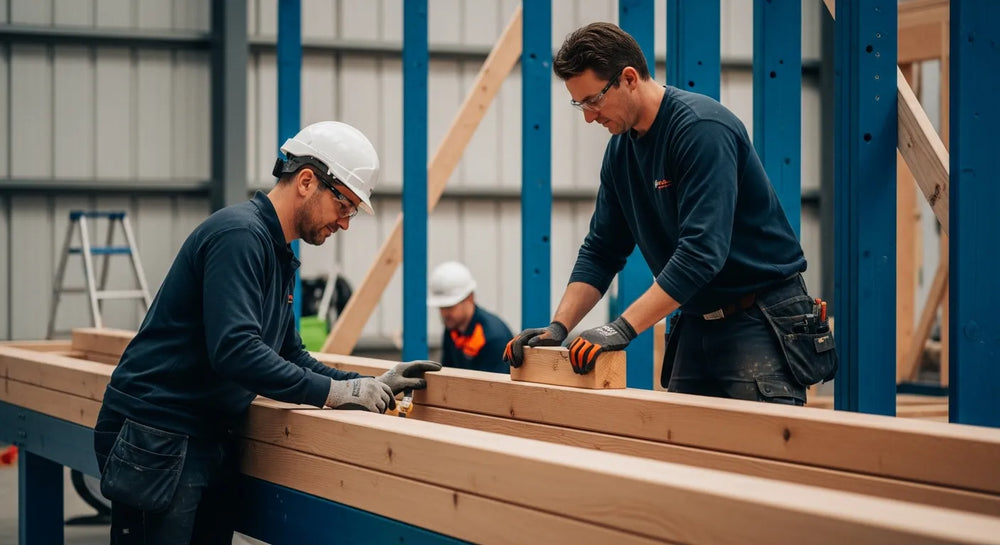
Timber Frame House Construction Costs and Sourcing
Table of Contents
- Introduction
- Defining the Timber Frame Value Proposition
- Estimating the Average Cost per Square Foot
- The Raw Materials: Timber Species and Grades
- The Role of Structural Insulated Panels (SIPs)
- Breaking the Liquidity Barrier: Maden Pay
- Tax Advantages and Capital Expenditure
- Detailed Labor and Design Costs
- Hardware, Fasteners, and Industrial Supplies
- The Cost of Foundation and Site Work
- Mechanical, Electrical, and Plumbing (MEP) Integration
- Why Sourcing U.S.-Manufactured Products Matters
- Comparing Timber Frame to Post-and-Beam
- Long-Term Maintenance and TCO
- Procurement Efficiency in the Modern Age
- Conclusion
- FAQ
Introduction
For a general contractor managing a tight project timeline, or a business owner looking to expand their commercial footprint with a signature structure, the question isn't just about the aesthetics of heavy timber—it’s about the bottom line. Imagine a scenario where a custom timber package is ready for delivery, but the procurement process has stalled because a traditional lender requires another 15 days to verify a credit application. In the construction world, where mobilization costs and crane rentals can run thousands of dollars a day, these liquidity bottlenecks are more than just an inconvenience; they are a threat to project viability.
Determining exactly how much does it cost to build timber frame house requires a deep dive into material grades, specialized labor, and the efficiency of the supply chain. While the visual appeal of exposed joinery is timeless, the modern reality of sourcing these components involves navigating fluctuating lumber prices and complex logistics. At Maden.co, we believe that the U.S. manufacturing revival is here, and it is built on the foundation of transparency and speed. This article will provide a granular breakdown of the costs associated with timber frame construction, from the initial architectural drawings to the final enclosure systems. We will also explore how strategic procurement and embedded financing can drastically reduce "time-to-terms" friction, allowing you to move from design to "raising day" with greater capital efficiency.
Defining the Timber Frame Value Proposition
Before analyzing the line-item expenses, it is essential to distinguish timber framing from more common construction methods. Unlike standard stick-built homes that rely on dimensional lumber and nails, a timber frame house utilizes heavy timbers joined together via traditional mortise-and-tenon joinery. This method creates a self-supporting skeleton that does not require load-bearing interior walls, offering unparalleled design flexibility.
From a procurement perspective, timber framing represents a high-value asset. It is an investment in durability and structural integrity that often commands a higher resale value and lower long-term maintenance costs. However, because it is a specialized craft, the cost to build timber frame house is typically higher than standard residential construction. We see our role at Maden.co as the bridge between these master craftsmen and the modern industrial buyers who need reliable, U.S.-manufactured components to bring these structures to life.
Estimating the Average Cost per Square Foot
When asking how much does it cost to build timber frame house, the industry standard range typically falls between $200 and $450 per square foot for a finished home. However, for a B2B buyer or a commercial developer, it is often more useful to look at the "frame-only" or "shell" costs.
- Timber Frame Package: This usually ranges from $35 to $75 per square foot. This includes the design, the timber itself, the joinery cutting (often via CNC for precision), and the raising of the frame.
- Enclosure Systems (SIPs): Structural Insulated Panels are the most common way to wrap a timber frame. These can add $25 to $45 per square foot.
- Total Turnkey Construction: Including site work, foundation, MEP (mechanical, electrical, plumbing), and finishes, the total cost often settles in the $250–$350 range for high-quality American-made structures.
These figures are highly dependent on the complexity of the design. A simple "saltbox" or rectangular barn-style frame will always be more cost-effective than a multi-gable design with complex hammerbeam trusses.
The Raw Materials: Timber Species and Grades
The choice of wood species is one of the most significant variables in the cost to build timber frame house. In the United States, we have access to some of the finest structural timbers in the world, and sourcing them domestically is crucial for both quality control and supporting the domestic industrial base.
Eastern White Pine
Often the most economical choice, White Pine is prized for its stability and ease of working. It has a relatively low shrinkage rate compared to other species, which is vital for maintaining tight joinery. While it is a "softer" softwood, it is more than adequate for most residential and light commercial loads.
Douglas Fir
Known for its exceptional strength-to-weight ratio and beautiful reddish hue, Douglas Fir is the "gold standard" for many timber framers. Sourced primarily from the Pacific Northwest, it is more expensive than pine but offers higher structural capacities, allowing for longer spans and smaller member sizes.
White Oak
For the ultimate in durability and traditional aesthetics, White Oak is the premier choice. It is incredibly heavy, rot-resistant, and strong. However, it is also the most expensive option due to the difficulty of harvesting, the weight (which increases shipping costs), and the labor required to work such a dense material.
When sourcing these materials, professional buyers must consider the "grade" of the timber. FOHC (Free of Heart Center) timber is less likely to check or twist but comes at a significant premium over box-heart timbers. Using a marketplace like Maden.co allows buyers to connect directly with verified U.S. mills to ensure that the timber arriving on-site meets the exact structural specifications required by the engineering team.
The Role of Structural Insulated Panels (SIPs)
You cannot accurately calculate how much does it cost to build timber frame house without accounting for the enclosure. Because the timber frame itself provides the structural support, the walls do not need to be load-bearing. This makes Structural Insulated Panels (SIPs) the ideal partner for timber framing.
SIPs consist of an insulating foam core (typically EPS or GPS) sandwiched between two layers of oriented strand board (OSB). They are manufactured in a controlled factory environment, ensuring high R-values and incredible airtightness. While the upfront cost of SIPs is higher than traditional fiberglass batt insulation and 2x6 framing, the labor savings during installation are massive. A skilled crew can often enclose a 2,000-square-foot timber frame in just three to four days.
Furthermore, the long-term Total Cost of Ownership (TCO) is greatly improved. A SIPs-enclosed timber frame house can be up to 50% more energy-efficient than a standard home, leading to significant savings on utility costs over the life of the building. To explore the components needed for such high-performance enclosures, you can browse all categories of industrial building supplies on our platform.
Breaking the Liquidity Barrier: Maden Pay
One of the greatest challenges in American manufacturing and construction is the structural liquidity gap. Many timber frame manufacturers and enclosure suppliers operate on thin margins and require significant down payments—often 30% to 50%—to secure lumber and begin the design process. For the buyer, this ties up operating capital for months before a single timber is even cut.
In traditional procurement, establishing credit terms with a new supplier is a grueling process of trade references, bank statements, and weeks of waiting. At Maden.co, we have eliminated this "time-to-terms" friction. Through Maden Pay, our embedded financing solution, we provide industrial buyers with instant access to capital at the point of purchase.
Instead of navigating the complexities of traditional bank credit, which is increasingly tightening for the construction sector, buyers can check eligibility in under 60 seconds with a simple soft credit check. This allows a business to secure their timber package immediately, aligning their cash flow with the project’s conversion cycle.
Strategic Operational Tool: Maden Pay offers credit lines typically ranging from $5,000 to $250,000+ for qualified businesses. With Net 30, 60, or 90-day options, you can pay for your materials after the frame has been raised and the project has progressed to its next funding draw. (Note: Approvals, limits, and terms are subject to business eligibility).
Tax Advantages and Capital Expenditure
For business owners and developers building timber frame structures for commercial use—such as event venues, corporate offices, or agricultural facilities—the timing of the build can offer significant tax advantages.
Under current tax laws, businesses may be eligible for 100% bonus depreciation on certain qualified assets. While the real property (the building itself) is generally depreciated over a longer period, many of the components, equipment, and specialized systems involved in the construction can be accelerated. This can drastically reduce the net cost to build timber frame house in the first year of operation.
Disclaimer: Tax laws are subject to change and vary by jurisdiction. You must always consult your tax professional or CPA to determine how bonus depreciation applies to your specific project and business structure.
By utilizing Maden Pay to finance these capital expenditures, businesses can preserve their cash reserves while simultaneously taking advantage of these aggressive tax incentives.
Detailed Labor and Design Costs
The craftsmanship inherent in timber framing requires a specialized labor force. This is not a project for a standard framing crew. The "how much does it cost to build timber frame house" equation must include:
Architectural and Structural Engineering
Because timber frames involve concentrated loads (where the posts meet the foundation), a structural engineer must review the plans. Engineering fees for a custom timber frame typically range from $2,500 to $6,000, depending on the complexity and the requirements of the local building department.
The Shop Drawing Process
Before a single piece of wood is cut, the timber frame company will produce a set of "shop drawings." These are highly detailed 3D models showing every joint, peg hole, and chamfer. This process ensures that when the timber arrives on-site, it fits together like a massive puzzle. The cost of this design work is often bundled into the timber package price but represents a significant portion of the value.
The Raising Crew
Raising a timber frame is a choreographed event involving cranes, telehandlers, and a crew of skilled timber framers. A typical residential frame might take 3 to 5 days to raise. The cost for this specialized labor can range from $10,000 to $30,000. It is a high-impact phase of the project where safety and precision are paramount.
Hardware, Fasteners, and Industrial Supplies
While the joinery itself is made of wood, modern timber framing relies on a suite of high-performance industrial components to meet contemporary building codes and performance standards. This is where the supply chain becomes critical.
Structural integrity often depends on Structural Fasteners that are specifically engineered for heavy timber applications. Unlike standard screws, these fasteners are designed to handle the movement of large wood members as they season and adjust to the environment. Additionally, specialized Timber Connectors and concealed plates are often required in high-wind or seismic zones to reinforce traditional joinery.
Ensuring the longevity of the structure also requires the right Industrial Wood Sealants and finishes. These are not typical off-the-shelf products; they are breathable, UV-resistant coatings designed to protect the timber while allowing it to "breathe" and reach an equilibrium moisture content.
At Maden.co, we simplify the procurement of these essential items. Instead of managing dozens of individual vendor accounts, you can check eligibility for a single credit line through Maden Pay that works across our entire marketplace. This centralized approach reduces administrative overhead and ensures that your site supervisor has the high-quality, U.S.-made components they need, exactly when they need them.
The Cost of Foundation and Site Work
The foundation for a timber frame house is slightly different from a standard home. Because the weight of the building is carried by specific posts rather than distributed evenly along a sill plate, the foundation often requires reinforced "piers" or footings at the post locations.
- Slab-on-Grade: This is often the most cost-effective foundation for timber frames, especially for commercial workshops or event barns.
- Full Basement: While providing more square footage, a full basement will significantly increase the cost to build timber frame house, often adding $30,000 to $60,000 or more to the budget.
- Crawlspace: A middle-ground option that allows for easier access to MEP systems.
Site accessibility also plays a role in cost. A timber frame requires a crane for the raising. If the site is remote or has restricted access, the cost of specialized equipment and logistical planning will increase. We recommend working with local U.S. manufacturers who understand the regional terrain and logistics to minimize these "hidden" costs.
Mechanical, Electrical, and Plumbing (MEP) Integration
A common question regarding the cost to build timber frame house is how to hide the "guts" of the building—the wires, pipes, and ducts. In a stick-built home, these are hidden inside the hollow stud walls. In a timber frame wrapped in SIPs, there are no hollow walls.
Electrical
Electricians must plan ahead. Wiring is often run through the SIP panels (which can be ordered with pre-cut electrical "chases") or hidden in the flooring and baseboards. This added planning time can increase electrical labor costs by 10% to 20% compared to a standard build.
Plumbing
Plumbing is typically concentrated in interior partition walls that are built after the timber frame is raised. These partition walls look like standard 2x4 framing and act as the housing for your sinks, toilets, and showers.
HVAC
Because timber frame/SIP structures are so airtight, they require much smaller heating and cooling systems than traditional homes. However, they do require an Energy Recovery Ventilator (ERV) or Heat Recovery Ventilator (HRV) to ensure proper air exchange and indoor air quality. While this is an additional upfront cost, it is offset by the reduced size of the primary HVAC unit.
Why Sourcing U.S.-Manufactured Products Matters
At Maden.co, our mission is to democratize access to American manufacturing. When you are calculating how much does it cost to build timber frame house, the origin of your materials matters for more than just patriotic reasons—it’s about supply chain resilience.
By sourcing American-made timbers, fasteners, and SIPs, you are:
- Reducing Lead Times: Avoid the months-long delays and port congestion associated with imported materials.
- Ensuring Compliance: U.S. manufacturers adhere to strict ASTM and building code standards, ensuring that your structural components are safe and verified.
- Enhancing Transparency: We believe in knowing exactly where your materials come from. Our platform connects you with millions of verified American-made products, providing the transparency that modern industrial buyers demand.
If you are a manufacturer of timber frame components or industrial building materials, we invite you to join our mission. You can learn more about vendor registration to list your products on the premier marketplace for U.S. manufacturing.
Comparing Timber Frame to Post-and-Beam
While the terms are often used interchangeably, they represent different price points and construction philosophies.
- Timber Framing: Uses wood-to-wood joinery (mortise and tenon) and wooden pegs. It is a more labor-intensive, "pure" form of the craft and generally costs more.
- Post-and-Beam: Uses heavy timbers but connects them with decorative or functional steel plates and bolts. This is often faster to assemble and can be slightly more affordable, though it lacks the traditional aesthetic of peg-and-hole joinery.
Both methods are supported by the industrial supplies available on Maden.co. Whether you need traditional hand tools for fine joinery or heavy-duty steel connectors for a post-and-beam commercial project, our marketplace provides the resources to build with excellence.
Long-Term Maintenance and TCO
When evaluating the cost to build timber frame house, one must look at the 30-year horizon. Timber frames are incredibly resilient. Many timber-framed structures in Europe and New England have stood for hundreds of years.
The main maintenance cost is the exterior finish. Because the timbers are protected by the enclosure system (the SIPs), the interior wood requires almost no maintenance beyond an occasional dusting or oiling every decade or so. The exterior of the house—whether it be wood siding, stone, or brick—will require standard maintenance.
The real ROI comes from the energy efficiency of the SIPs and the inherent value of the timber. Timber frame houses consistently hold their value better than "cookie-cutter" developments, making them a wise long-term asset for both residential and commercial investors.
Procurement Efficiency in the Modern Age
The traditional way of building a timber frame house involved months of fragmented communication between architects, timber framers, and multiple material suppliers. This fragmentation is where costs spiral out of control.
We are changing that. By serving as a strategic partner in building a resilient, U.S.-based supply chain, Maden.co allows procurement managers to streamline their workflows. Our platform is not just a catalog; it is a hub for industrial excellence.
When you use Maden Pay, you aren't just getting a "loan"—you are gaining a tool that allows you to act with the speed of a cash buyer. This agility is what separates successful developers from those bogged down in paperwork. To learn more about our commitment to the manufacturing sector, visit our About Us page.
Conclusion
The cost to build timber frame house is an investment in quality, sustainability, and American craftsmanship. While the initial price per square foot may be higher than conventional methods, the combination of energy efficiency, structural longevity, and the sheer aesthetic power of the structure provides a compelling business case.
By understanding the variables—from wood species like Douglas Fir and White Oak to the efficiency of SIP enclosure systems—you can better manage your project's budget. More importantly, by utilizing modern procurement tools and embedded financing, you can overcome the liquidity challenges that have traditionally hampered the construction industry.
At Maden.co, we are proud to support the builders and manufacturers who are driving the U.S. manufacturing revival. We invite you to explore our extensive catalog, connect with verified domestic suppliers, and take advantage of the financial tools designed to keep your projects moving forward. If you have any questions about sourcing specific materials or integrating our financing solutions into your procurement process, please do not hesitate to contact us.
The future of American construction is efficient, transparent, and built to last. Let’s build it together.
FAQ
1. How much does it cost to build timber frame house compared to a standard stick-built home?
On average, a timber frame house will cost 10% to 25% more than a standard stick-built home of the same size. This premium covers the cost of high-quality heavy timbers, specialized joinery labor, and high-performance enclosure systems like SIPs. However, this is often offset by lower long-term energy costs and higher resale value.
2. Can I use Maden Pay for all aspects of my timber frame project?
Maden Pay is designed to finance the purchase of products and materials through the Maden.co marketplace. This includes your timber packages, fasteners, SIPs, sealants, and other industrial supplies. It is a strategic tool to manage your B2B cash flow and align your material costs with your project milestones.
3. What is the most cost-effective wood species for a timber frame?
Eastern White Pine is generally the most cost-effective species for timber framing in the United States. It offers a great balance of stability and strength at a lower price point than Douglas Fir or White Oak. For commercial projects where long spans are required, Douglas Fir may be more cost-effective in the long run due to its higher structural capacity.
4. How long does it take to get a credit decision with Maden Pay?
In most cases, you can check eligibility and receive a decision in under 60 seconds. Our system uses a soft credit check that does not impact your credit score, providing instant feedback on your available credit line, which typically ranges from $5,000 to over $250,000 for qualified businesses. (Subject to eligibility).


