
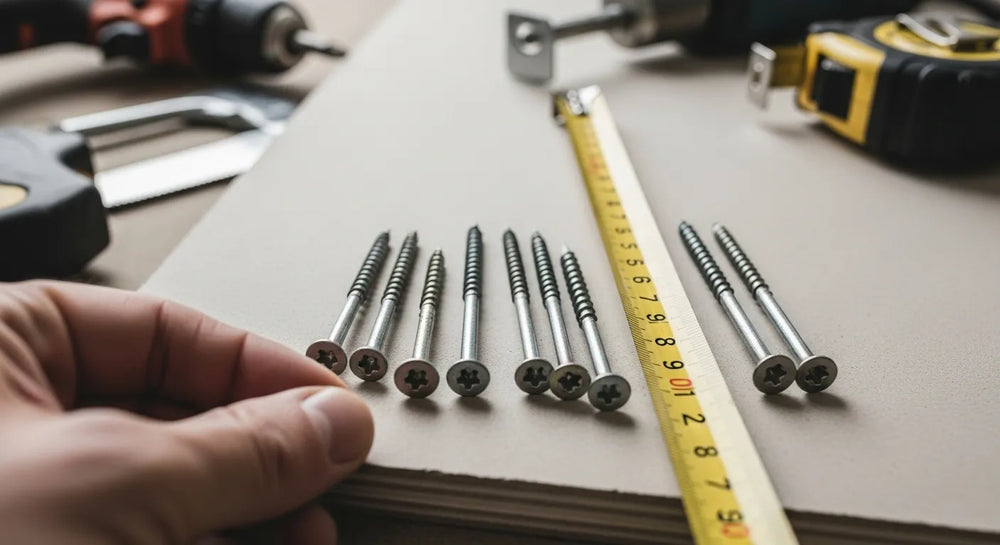
3/8" Concrete Anchor Bit Size: Drilling Right Every Time
Table of Contents
- Introduction
- The Criticality of Correct Bit Sizing for Concrete Anchors
- Understanding 3/8" Concrete Anchors: Types and Applications
- The Definitive Answer: What Size Masonry Bit for a 3/8" Concrete Anchor?
- Choosing the Right Masonry Drill Bit: Beyond Size
- Best Practices for Drilling Concrete Anchor Holes
- The Maden.co Advantage: Sourcing American-Made Anchors and Tools
- Real-World Scenarios and Maden.co Solutions
- Conclusion
- FAQ
Introduction
Imagine a critical structural component failing prematurely, not due to a faulty anchor or inferior concrete, but because the hole drilled for it was just a hair off. This seemingly minor detail can lead to costly rework, project delays, compromised safety, and ultimately, a significant blow to a project's budget and timeline. In the demanding world of industrial construction, maintenance, and manufacturing, precision isn't just a preference—it's a non-negotiable requirement. For procurement managers, MRO buyers, and design engineers, understanding the exact specifications for every component, down to the drilling bit for a seemingly standard 3/8" concrete anchor, is paramount.
This post will demystify the crucial process of selecting the correct masonry bit for 3/8" concrete anchors. We'll delve into the various types of 3/8" anchors, explain why exact bit sizing is critical for structural integrity and project success, and provide best practices for drilling into concrete. Moreover, we'll illustrate how Maden.co, America's premier B2B marketplace, supports these precision demands by offering a vast catalog of verified U.S.-made products and innovative solutions, ensuring you always have the right American-made tools and components for the job. Our mission at Maden.co is to democratize access to American manufacturing, connecting industrial buyers with over 2.5 million American-made products from our network of 800+ verified U.S. manufacturers. We champion the principle that American-made components are as accessible and convenient as any global alternative, driving the manufacturing revival.
The Criticality of Correct Bit Sizing for Concrete Anchors
The seemingly simple act of drilling a hole into concrete for an anchor is, in reality, a precise engineering step that directly impacts the safety, reliability, and longevity of the entire fastening system. When we talk about a "3/8 concrete anchor," we're referring to a component designed to bear significant loads, often in critical applications ranging from structural supports to heavy machinery installations. The bit size used to create the anchor's receptacle in the concrete is arguably the most fundamental aspect determining its performance.
Why Accurate Drilling Matters
-
Optimal Load Bearing Capacity: Concrete anchors work by creating friction, mechanical interlock, or adhesion within the concrete. For expansion anchors, a hole that is too small prevents the anchor from fully expanding or seating correctly, leading to internal stress within the concrete that can cause spalling or premature failure. Conversely, a hole that is too large reduces the critical contact area, severely diminishing the anchor's ability to grip the concrete and resist pull-out forces. Each anchor is engineered to achieve its published load capacities only when installed precisely according to the manufacturer's specifications, which explicitly includes the drill bit size.
-
Structural Integrity and Safety: Inadequate anchoring can have catastrophic consequences. Imagine heavy equipment dislodging, structural elements collapsing, or safety barriers failing due to improperly installed anchors. Lives and significant assets are often at stake. Correct bit sizing ensures that the anchor achieves its designed embedment and expansion characteristics, thereby maintaining the structural integrity of the fastened elements and safeguarding personnel.
-
Preventing Rework and Cost Overruns: Incorrectly sized holes almost inevitably lead to rework. If a hole is too small, it may need to be re-drilled, potentially damaging the base material or wasting valuable time. If a hole is too large, the anchor may be compromised, requiring its removal and the drilling of a new hole, possibly in a different, less optimal location. This not only wastes material and labor but can also delay entire projects, incurring substantial cost overruns that ripple through the supply chain. Procurement managers understand that every minute of downtime or every scrapped component translates directly to lost revenue.
-
Preserving Anchor Life and Performance: The tight fit achieved with the correct bit size protects the anchor from excessive movement, vibration, and environmental factors. A loose anchor can lead to fatigue, corrosion, and premature failure, even under loads significantly below its rated capacity. Precision installation ensures the anchor performs as intended throughout its service life.
Consequences of Incorrect Sizing
- Pull-Out Failure: The most common failure mode, especially with expansion anchors, occurs when the anchor pulls free from the concrete due to insufficient grip.
- Reduced Shear Strength: An anchor's ability to resist forces parallel to the concrete surface is compromised if it's not snugly seated.
- Concrete Spalling or Cracking: An oversized anchor forced into a small hole, or an expansion anchor over-expanded, can cause the concrete to chip, crack, or even shatter, creating a larger problem than the initial fastening.
- Anchor Damage: Bits that are too small can damage the anchor during installation, stripping threads or deforming its body.
- Wasted Materials: Scrapped anchors and concrete drilling bits, along with damaged concrete, add up to significant material waste.
- Compromised Reputation: For contractors and project managers, failures due to improper installation can severely damage professional reputation and future business opportunities.
At Maden.co, we believe in industrial excellence and supply chain transparency. We offer access to high-quality, U.S.-made tools and anchors that meet rigorous standards, ensuring that when you purchase from us, you're getting components designed for precise installation and long-term performance.
Understanding 3/8" Concrete Anchors: Types and Applications
The term "3/8 concrete anchor" is broad, encompassing several distinct types, each with unique installation requirements and ideal applications. Understanding these differences is crucial for selecting the correct drill bit. While the target keyword focuses on "what size masonry bit for 3 8 concrete anchor," the actual drill bit size isn't always exactly 3/8" for all 3/8" nominal anchors. This nuance is critical.
Drop-In Anchors
- Description: Drop-in anchors are internally threaded, female anchors designed for flush mounting in concrete. They consist of an anchor body, often with a knurled or textured exterior, and an internal expander plug. Once inserted into a drilled hole, a setting tool is used to drive the internal plug downwards, expanding the anchor body against the concrete.
- How They Work: The internal plug expands the lower portion of the anchor body, creating a mechanical interlock with the concrete.
- Ideal Applications: These anchors are excellent for overhead applications, suspending conduit, pipe, or threaded rod, and for any situation where a flush mounting is desired to prevent trip hazards or for aesthetic reasons. They are particularly useful when the bolt needs to be inserted and removed multiple times.
- Bit Size Nuance for 3/8" Internal Thread: It's vital to distinguish between the nominal diameter of the anchor body and the size of the internal thread. A "3/8" drop-in anchor" typically refers to an anchor with a 3/8" internal thread, meaning it accepts a 3/8" threaded rod or bolt. However, the body of this anchor is often larger than 3/8" to accommodate the expansion mechanism and provide adequate strength. For example, a drop-in anchor designed to accept a 3/8" threaded rod might require a 1/2" or 5/8" diameter drill bit for its body.
- Maden.co Solution: For reliable, U.S.-made solutions, consider options like the BN Products 3/8-inch Inside Thread Sanko Drop-In Concrete Anchor. Such anchors are manufactured to precise specifications, and their product data sheets will clearly specify the required drill bit diameter, which you must always consult.
Wedge Anchors
- Description: Wedge anchors are one of the strongest and most popular types of expansion anchors. They consist of a threaded stud, a nut, a washer, and an expansion clip at the working end. They are designed for through-fastening applications, meaning the item being fastened is drilled through, and the anchor is inserted through both the item and into the concrete.
- How They Work: As the nut is tightened, it pulls the threaded stud upwards, drawing the tapered end of the stud into the expansion clip. This forces the clip to expand, wedging firmly against the sidewalls of the drilled concrete hole.
- Ideal Applications: Heavy-duty applications, securing structural steel, racking, machinery, and other items requiring high tensile and shear strength.
- Bit Size for 3/8" Wedge Anchor: For a 3/8" nominal diameter wedge anchor, the required drill bit size is typically 3/8". This is a direct match, as the expansion clip needs to engage snugly with the concrete for proper functionality.
Sleeve Anchors
- Description: Sleeve anchors are versatile, medium-duty expansion anchors consisting of a bolt, a metal sleeve, a nut, and a washer. They are also designed for through-fastening.
- How They Work: Similar to wedge anchors, tightening the nut pulls the bolt upwards, drawing a conical nut at the bottom into the expandable sleeve. This forces the sleeve to expand against the walls of the drilled hole.
- Ideal Applications: Securing railings, signs, partitions, light fixtures, and other fixtures to concrete, block, or brick. They offer good performance in various base materials.
- Bit Size for 3/8" Sleeve Anchor: For a 3/8" nominal diameter sleeve anchor, the required drill bit size is typically 3/8". Like wedge anchors, the sleeve needs a precise fit to expand effectively.
Screw Anchors (Tapcon-style)
- Description: Screw anchors, often referred to by the brand name Tapcon, are self-tapping screws designed specifically for masonry. They do not rely on expansion but rather on threads cutting into the concrete.
- How They Work: A pilot hole is drilled, and the hardened screw is then driven directly into the concrete, forming its own threads in the base material.
- Ideal Applications: Light to medium-duty applications, attaching electrical boxes, conduit clips, furring strips, and other fixtures where an expansion-type anchor might not be suitable (e.g., close to an edge or in brittle materials).
- Bit Size Nuance for 3/8" Equivalent Screw Anchor: While screw anchors are typically available in smaller diameters (e.g., 3/16", 1/4"), if a "3/8 concrete anchor" refers to the load capacity equivalent of a 3/8" anchor, it's important to note that screw anchors require a pilot hole significantly smaller than their nominal diameter. For instance, a 1/4" screw anchor might require a 3/16" drill bit. It is highly unlikely a "3/8 screw anchor" refers to its body diameter; rather, it would be an extremely heavy-duty screw anchor, which would still require a pilot hole smaller than 3/8". Always refer to the manufacturer's exact specifications for screw anchors.
Other Expansion Anchors (e.g., Strike Anchors, Hammer Drive)
Briefly, other types like strike anchors and hammer drive anchors also exist, primarily relying on an impact to expand and set. For these, as with all anchors, consulting the manufacturer's specification is paramount for determining the precise drill bit size.
Key Takeaway: The "what size masonry bit for 3/8 concrete anchor" question has a simple answer for wedge and sleeve anchors (3/8"), but becomes more complex for drop-in anchors (where the body diameter is larger than the thread size) and screw anchors (which use smaller pilot holes). Always, without exception, consult the anchor manufacturer's specific instructions and technical data sheet. This is the definitive source of truth for safe and effective installation.
The Definitive Answer: What Size Masonry Bit for a 3/8" Concrete Anchor?
For many industrial professionals, getting straight to the point is key. So, let's address the core question directly, with the critical caveats necessary for proper application.
The most common and straightforward answer, applicable to the majority of wedge anchors and sleeve anchors that are nominally 3/8" in diameter, is that you will need a 3/8" masonry drill bit.
Crucial Nuances and Exceptions
While 3/8" is often the correct bit size for 3/8" nominal expansion anchors like wedge and sleeve types, relying solely on this general rule without verification can lead to costly and dangerous errors. The industrial landscape demands precision, and this applies particularly to anchors.
-
Manufacturer Specifications: The Golden Rule:
- This cannot be overstated: Always, always, always consult the specific anchor manufacturer's technical data sheet or installation instructions. This document is engineered for the exact anchor you are using and will provide the precise drill bit diameter, minimum embedment depth, and other critical installation parameters.
- Why it's paramount: Even within the same anchor type (e.g., 3/8" wedge anchors), slight variations in manufacturing tolerances, material properties, and expansion mechanisms can dictate a precise drill bit size that may deviate from the general rule. Adhering to manufacturer guidelines ensures the anchor performs to its rated capacity and complies with relevant building codes and safety standards.
- For a procurement manager under pressure to source a specific DIN 931 compliant hex cap screw, a design engineer needing specific material certifications for a new prototype, or an MRO buyer facing an unexpected equipment breakdown, the ability to quickly find and verify specifications for a U.S.-made part is a game-changer. Maden.co simplifies this by providing access to comprehensive product information directly from our network of verified manufacturers.
-
Specific Anchor Types and Their Bit Sizing:
- 3/8" Wedge Anchors: Generally require a 3/8" masonry drill bit. The expansion clip is designed to grip firmly against the concrete in a hole of the same nominal diameter.
- 3/8" Sleeve Anchors: Generally require a 3/8" masonry drill bit. The sleeve expands to fill the 3/8" hole, creating the necessary friction and mechanical interlock.
- 3/8" Drop-In Anchors (referring to 3/8" internal thread): This is where the primary confusion often arises. A drop-in anchor accepting a 3/8" threaded rod will have an outer body diameter larger than 3/8". Therefore, it will require a drill bit that matches this larger body diameter. Common sizes for the drill bit for a 3/8" internal thread drop-in anchor might be 1/2" or 5/8". For instance, the BN Products 3/8-inch Inside Thread Sanko Drop-In Concrete Anchor will have specific drilling requirements outlined by the manufacturer to ensure optimal performance. Always check the product specifications.
- Screw Anchors (e.g., Tapcon-style): If "3/8 concrete anchor" refers to a very large screw anchor (which is less common) or an anchor equivalent in load rating, remember that screw anchors always require a pilot hole smaller than their nominal diameter. For example, a 1/4" screw anchor might need a 3/16" bit. The specific bit size is unique to each screw anchor's design and thread pitch.
-
Tolerance and Fit: The Engineering Imperative:
- A snug fit between the anchor and the concrete is absolutely critical. A hole that is too small prevents the anchor from seating fully or expanding correctly, leading to reduced capacity and potential damage to the concrete. A hole that is too large means the anchor cannot properly expand to create the necessary friction or interlock, resulting in drastically reduced pull-out and shear strengths. The difference of even 1/64th of an inch can significantly compromise the anchor's performance.
-
Masonry Bit Standards (ANSI/DIN):
- High-quality masonry drill bits, especially those manufactured in the U.S., adhere to strict dimensional tolerances, often specified by standards bodies like ANSI (American National Standards Institute) or DIN (Deutsches Institut für Normung). When sourcing bits, ensure they meet these standards for reliable and consistent sizing. Our network of verified U.S. manufacturers on Maden.co ensures access to such compliant tooling, aligning with our value of industrial excellence.
In summary, for most 3/8" nominal wedge and sleeve anchors, a 3/8" masonry bit is appropriate. However, for 3/8" threaded drop-in anchors, the drill bit diameter will be larger, typically 1/2" or 5/8". For screw anchors, the pilot hole will be smaller. The unwavering rule is to verify the exact requirement from the anchor manufacturer's specifications. Trusting U.S.-made products ensures you are working with components designed to meet these exacting standards.
Choosing the Right Masonry Drill Bit: Beyond Size
Beyond the critical dimension, the quality and type of your masonry drill bit profoundly influence the success and efficiency of your concrete anchoring project. Using an inferior or incorrect bit can lead to poor hole quality, drill bit breakage, wasted time, and compromised anchor performance.
Bit Material: Carbide-Tipped is Essential
Concrete is an abrasive and hard material. Standard high-speed steel (HSS) drill bits are wholly inadequate for this task. You absolutely need carbide-tipped masonry drill bits.
- Tungsten Carbide: The tips of quality masonry bits are made from tungsten carbide, an extremely hard and wear-resistant material. This carbide tip is brazed onto a steel shank.
- Benefits: Carbide tips allow the bit to pulverize the concrete effectively, withstand the high impact forces of a hammer drill, and maintain a sharp cutting edge for longer, ensuring consistent hole diameter and cleaner cuts.
Shank Type: Matching Your Drill
The shank is the end of the drill bit that fits into your drill chuck. Matching the shank type to your drill is crucial for efficient power transfer and secure gripping.
- SDS-Plus: (Slotted Drive System) The most common shank for hammer drills up to 1" diameter. It has two open slots for the driving splines and two closed slots for the locking balls. This allows the bit to slide back and forth in the chuck, which is essential for the hammer action, while still being securely driven and prevented from falling out. Ideal for light to medium-duty drilling in concrete, brick, and block.
- SDS-Max: A heavier-duty version of SDS-Plus, designed for larger hammer drills and bits typically over 1" diameter. It features three open slots and one closed slot, providing greater impact energy transfer and durability for demanding applications.
- Hex Shank: Common for impact drivers and some rotary drills. Provides a strong, non-slip grip, but typically not designed for the hammering action required for efficient concrete drilling.
- Round Shank: Used with standard three-jaw chucks. Can be used with hammer drills, but often provides less efficient power transfer and is more prone to slipping or wearing the chuck jaws compared to SDS systems.
- Maden.co Solution: For a secure and efficient connection between your drill and bit, precision-engineered chucks are vital. Maden.co offers U.S.-made solutions designed for industrial demands. For instance, the 1-Headed Concrete Anchor Shear Connector Chuck or the more comprehensive Concrete Anchor Shear Connector Chuck Set exemplify the quality and reliability you can expect from American manufacturing. These components are designed to withstand rigorous use, ensuring your drilling operations are both precise and long-lasting.
Flute Design: Efficient Debris Removal
The flutes are the spiral grooves running along the length of the drill bit. Their design is crucial for:
- Debris Evacuation: As the bit grinds concrete, the pulverized dust and debris must be efficiently removed from the hole. Well-designed flutes prevent clogging, which can cause the bit to bind, overheat, and reduce drilling speed.
- Cooling: Flutes also help dissipate heat generated during drilling, extending the life of the bit.
- Optimized Geometry: Different flute designs (e.g., single, double, quad flute) are optimized for various drilling speeds and material types. For concrete, a robust flute design that quickly clears dust is preferable.
Length: Ensure Adequate Depth
The drill bit must be long enough to achieve the required anchor embedment depth, plus an additional 1/2" to 1" for dust accumulation at the bottom of the hole.
- Embedment Depth: This is specified by the anchor manufacturer and is crucial for achieving the anchor's rated load capacity.
- Through-Hole vs. Blind Hole: For through-holes, ensure the bit is long enough to penetrate the entire material thickness plus any dust space. For blind holes, measure carefully.
- Don't Guess: Using a bit that's too short means incomplete anchor installation; too long means unnecessary drilling and potential waste.
Quality: The Difference a U.S.-Made Bit Makes
The investment in high-quality, U.S.-made masonry drill bits pays dividends in performance, durability, and safety.
- Precision Manufacturing: American manufacturers adhere to stringent quality control standards, ensuring consistent diameter, proper carbide tip brazing, and optimal flute geometry. This reduces inconsistencies that can lead to improper anchor fit or bit failure.
- Superior Materials: U.S. manufacturers often utilize higher-grade steel for the bit shank and more advanced tungsten carbide formulations for the tips, resulting in bits that last longer and perform better under demanding conditions.
- Performance and Longevity: A quality bit drills faster, cleaner, and maintains its size throughout its lifespan, reducing the need for frequent replacements and ensuring that the actual hole size remains consistent with the intended hole size. This contributes directly to improved Total Cost of Ownership (TCO) by reducing labor, material waste, and the risk of failure.
- Supply Chain Resilience: Sourcing U.S.-made bits and chucks, like those found on Maden.co, enhances supply chain resilience, mitigating risks associated with global disruptions and ensuring timely access to critical tooling. Our commitment to industrial excellence means providing tools that meet the highest standards.
By prioritizing these factors when selecting your masonry drill bits, you ensure that the drilling process is as precise and efficient as the anchors themselves, laying the foundation for a secure and reliable fastening system.
Best Practices for Drilling Concrete Anchor Holes
Even with the correct bit size and a high-quality bit, improper drilling techniques can compromise anchor performance. Adhering to best practices ensures optimal results and maximizes safety.
1. Safety First: Personal Protective Equipment (PPE)
Drilling into concrete generates significant dust, noise, and vibration. Always wear:
- Eye Protection: Safety glasses or goggles are non-negotiable to protect against flying concrete chips and dust.
- Hearing Protection: Hammer drills are loud; earmuffs or earplugs are essential to prevent hearing damage.
- Respiratory Protection: Concrete dust contains crystalline silica, which can cause serious lung diseases. A NIOSH-approved respirator (e.g., N95) is crucial, especially in enclosed spaces.
- Gloves: Protect hands from abrasions and vibration.
2. Utilize a Hammer Drill (Rotary Hammer)
For drilling into concrete, a standard rotary drill is insufficient. You need a hammer drill or, for larger holes and heavier duty work, a rotary hammer.
- Hammer Action: This feature rapidly pounds the drill bit into the concrete while simultaneously rotating it, breaking up the material much more efficiently than rotation alone.
- Power and Efficiency: Hammer drills are designed for the stresses of concrete drilling, providing the necessary power and durability.
- Correct Setting: Ensure your drill is set to "hammer drill" or "rotary hammer" mode, not just "drill" mode.
3. Mark and Measure Precisely
- Mark the Spot: Clearly mark the exact center of where each hole needs to be drilled.
- Set Depth Stop: Most hammer drills have a depth gauge rod. Set it accurately to ensure the hole is drilled to the manufacturer-specified embedment depth plus an additional 1/2" to 1" for dust clearance. This prevents under-drilling or over-drilling.
4. Start Slowly and Stable
- Initial Engagement: Begin drilling at a slow speed to prevent the bit from walking or wandering, ensuring the hole starts precisely at your mark.
- Firm Pressure: Once the bit bites, apply firm, consistent pressure. Let the drill do the work; don't force it excessively.
- Perpendicular Drilling: Maintain the drill perpendicular to the concrete surface throughout the drilling process. An angled hole will compromise the anchor's pull-out strength and ability to fully engage.
5. Clean the Hole Thoroughly
This is one of the most overlooked, yet critical, steps for anchor performance. Concrete dust left in the hole significantly reduces the anchor's holding power by preventing proper expansion or adhesion.
- Brush: Use a stiff nylon brush (specifically designed for anchor holes) to dislodge dust from the sidewalls.
- Blow: Use a hand pump, compressed air, or a shop vac to blow or suck out the remaining dust. Never blow with your mouth, as concrete dust is hazardous.
- Repeat: Brush and blow at least twice until no dust remains.
- Maden.co Tip: High-quality U.S.-made brushes and blow-out tools, available through our verified manufacturers, ensure effective hole cleaning, reinforcing our commitment to industrial excellence and customer empowerment.
6. Consider the Concrete Condition
- Age and Hardness: Older, fully cured concrete tends to be harder than newer concrete, potentially requiring more effort and a sharper bit.
- Aggregate: The type and size of aggregate in the concrete can affect drilling speed and wear on the bit.
- Reinforcement (Rebar): If you encounter rebar, you'll feel a significant change in resistance. Special rebar-cutting bits are available, but ideally, you should avoid rebar by using rebar locators beforehand to prevent damaging your bits or the rebar itself.
7. Practice Makes Perfect
If you're new to concrete drilling or working with a new type of anchor, consider practicing on a scrap piece of concrete. This allows you to get a feel for the drill, the bit, and the material without risking damage to your actual project.
By following these best practices, you can ensure that your 3/8" concrete anchors, and all other anchor installations, achieve their maximum holding power, providing a secure and durable fastening solution. Our commitment at Maden.co is to equip you with the knowledge and the highest quality American-made tools to achieve these results reliably.
The Maden.co Advantage: Sourcing American-Made Anchors and Tools
In an increasingly complex global marketplace, the importance of a reliable, transparent, and efficient supply chain cannot be overstated. For procurement managers, MRO buyers, design engineers, and business owners, the decision of where to source critical industrial components carries significant weight. At Maden.co, we are not just a marketplace; we are a strategic partner dedicated to strengthening American industry and empowering our customers.
Democratizing Access to American Manufacturing
Our core mission is clear: to democratize access to American manufacturing. We achieve this by connecting industrial buyers like you directly with over 2.5 million American-made products from our extensive network of 800+ verified U.S. manufacturers. This means you gain unparalleled access to a diverse range of high-quality components, from precision-engineered concrete anchors to robust drilling chucks, all produced right here in the USA. You can learn more about our commitment to this mission on our About Us page.
800+ Verified U.S. Manufacturers: Quality and Reliability
Every manufacturer on Maden.co undergoes a rigorous verification process. This commitment to verification ensures that when you source through us, you are partnering with reputable companies that adhere to strict quality standards and contribute directly to the American economy. This focus on American Manufacturing Pride guarantees that the components you receive, whether it's a BN Products 3/8-inch Inside Thread Sanko Drop-In Concrete Anchor or a Concrete Anchor Shear Connector Chuck Set, meet the highest benchmarks for industrial excellence.
2.5 Million+ Products: Vast Selection, Including Hard-to-Find Components
Navigating a complex bill of materials or trying to source an obscure component can be a time-consuming and frustrating endeavor. Our expansive catalog of over 2.5 million products means that the chances of finding exactly what you need are dramatically increased. We specialize in providing access to components that might be hard to locate elsewhere, ensuring your projects stay on track without compromise. Whether you're a design engineer prototyping a new product or an MRO buyer needing a specific replacement part, our platform simplifies the search. Explore the breadth of our offerings starting from our Homepage.
Supply Chain Resilience: Mitigating Global Disruptions
The past few years have underscored the fragility of global supply chains. Sourcing American-made products through Maden.co fundamentally enhances your supply chain resilience. By reducing reliance on overseas manufacturing and shortening lead times, we help you mitigate risks associated with geopolitical instability, shipping delays, and fluctuating international trade policies. This strategic shift ensures greater predictability and stability for your operations, reinforcing our core value of Supply Chain Transparency.
Total Cost of Ownership (TCO): Long-Term Savings
While initial unit price is always a consideration, savvy procurement professionals understand the importance of Total Cost of Ownership. U.S.-made products from Maden.co, built to higher standards and with superior materials, often translate to:
- Reduced Failure Rates: Lower likelihood of component failure, reducing rework and replacement costs.
- Improved Performance: Components that perform precisely as specified, extending the life of your equipment and installations.
- Fewer Delays: Reliable supply and consistent quality mean fewer project delays caused by faulty or backordered parts.
- Enhanced Safety: Trustworthy components contribute to a safer working environment, reducing the risk of accidents and associated liabilities.
These factors significantly reduce the hidden costs often associated with lower-quality alternatives, proving that investing in American manufacturing is an investment in long-term savings.
Compliance with Industry Standards (e.g., DIN, NPT)
Many industrial applications require strict adherence to specific standards such as DIN, NPT, ANSI, or ASTM. Our verified U.S. manufacturers produce components that meet these rigorous specifications, providing the certifications and documentation you need for compliance. This is especially crucial for design engineers who must ensure every component meets the exact technical requirements of their projects.
Digital Innovation: Streamlined Procurement Experience
Maden.co is built on Digital Innovation, offering a user-friendly platform designed to streamline your procurement process. From intuitive search functionalities to detailed product specifications and efficient order management, our marketplace is engineered for ease of use. This reduces procurement friction, saving valuable time for your purchasing teams.
Customer Empowerment: Tools for Your Success
We believe in customer empowerment, providing you with the tools and resources needed to make informed decisions and manage your operations effectively. This includes offering clear product information and an innovative financial solution.
The Power of Instant Financing
A key differentiator for businesses on Maden.co is our Instant Financing option. We understand that large-volume purchases or capital-intensive projects require flexible financial solutions. This feature is not just a payment method; it's a strategic tool designed to help procurement managers and business owners manage cash flow more effectively and make necessary, larger-volume purchases without immediate strain on working capital. You can apply for Instant Financing directly at checkout, simplifying the acquisition of critical components and tools, such as the 1-Headed Concrete Anchor Shear Connector Chuck or bulk orders of anchors. This ensures that your projects can proceed without financial bottlenecks.
Partnering with Maden.co
We invite qualified U.S. manufacturers to join our growing network and contribute to the American manufacturing revival. Are you a U.S. manufacturer? Register as a vendor and join the American manufacturing revival. For buyers, if you have specific sourcing questions or need assistance navigating our vast catalog, our expert team is ready to help. You can easily contact us for personalized support.
Maden.co is more than just a marketplace; it's a commitment to quality, reliability, and the future of American manufacturing. We are confident in our value proposition and humble in our service, striving to be your definitive platform for all U.S.-made industrial components.
Real-World Scenarios and Maden.co Solutions
To truly appreciate the practical value of precise anchoring knowledge and Maden.co's offerings, let's explore common scenarios faced by industrial buyers and how our platform provides solutions.
Scenario 1: Urgent Installation of Overhead Conduit with Drop-In Anchors
A procurement manager is overseeing a new factory floor layout project. The electrical team needs to suspend heavy conduit runs from the concrete ceiling using 3/8" threaded rods. The specification calls for a flush-mounted anchor to maintain overhead clearance and prevent snagging. They've opted for 3/8" internal thread drop-in anchors. The immediate challenge is sourcing these specific anchors quickly and ensuring the correct masonry bits are on hand for precise installation, avoiding costly rework or potential safety hazards from improperly seated anchors.
Maden.co Solution: The procurement manager turns to Maden.co. Within minutes, they locate the exact BN Products 3/8-inch Inside Thread Sanko Drop-In Concrete Anchor from a verified U.S. manufacturer. Critically, the product specifications clearly state the required drill bit diameter (e.g., 1/2" or 5/8", depending on the manufacturer, significantly different from the 3/8" thread size), eliminating guesswork. They can also quickly source the appropriate high-quality carbide-tipped masonry bits from another trusted American supplier on the platform. With the ability to purchase both components from U.S. sources, the supply chain is streamlined, reducing delivery times and ensuring compatibility, all while supporting American manufacturing pride.
Scenario 2: Unexpected Equipment Breakdown Requiring Immediate Drilling System Repair
An MRO buyer receives an urgent call: a critical drilling rig on the production line has a damaged chuck, halting operations. Downtime is measured in thousands of dollars per hour. The replacement part must be high-quality, durable, and compatible with existing tooling. The MRO buyer needs to source a robust, American-made chuck immediately.
Maden.co Solution: The MRO buyer logs onto Maden.co. Leveraging the platform's intuitive search, they quickly find the necessary 1-Headed Concrete Anchor Shear Connector Chuck or even a Concrete Anchor Shear Connector Chuck Set from a U.S. manufacturer known for industrial excellence. The detailed product descriptions and technical specifications ensure they select the correct part. Recognizing the critical nature and potential high cost of downtime, the MRO buyer uses the Instant Financing option at checkout. This allows them to secure the high-quality replacement parts immediately without impacting their immediate operational budget, ensuring the production line is back up and running with minimal delay and optimized cash flow. This empowers them to make agile, critical purchases efficiently.
Scenario 3: Business Expansion Requiring Bulk Anchor Purchases and Capital Management
A business owner is expanding their facilities, necessitating the installation of hundreds of heavy-duty racks and machinery. This project requires a significant volume of 3/8" wedge anchors and associated drilling consumables. While the business is growing, managing cash flow for such a large upfront purchase is a consideration. They want to ensure they are using reliable, American-made components for long-term durability and safety.
Maden.co Solution: The business owner uses Maden.co to source all their 3/8" wedge anchors and corresponding 3/8" masonry drill bits in bulk from verified U.S. manufacturers. They prioritize the long-term value and reliability that American-made products offer, understanding that this contributes to a lower Total Cost of Ownership. To manage the substantial upfront cost without tying up critical operating capital, they apply for Instant Financing directly at checkout. This strategic financial tool allows them to secure the necessary volume of high-quality components, keep their project on schedule, and maintain healthy cash flow, all while investing in superior American-made industrial supplies.
These scenarios highlight how Maden.co addresses the practical challenges faced by industrial buyers, offering not just products but comprehensive solutions that integrate quality, transparency, efficiency, and flexible financing.
Conclusion
Understanding the precise requirements for drilling holes for concrete anchors, especially for a common size like the 3/8" concrete anchor, is far more intricate than it initially appears. The difference between a properly seated anchor and one prone to failure often comes down to meticulous detail: selecting the correct drill bit size, utilizing the right drilling techniques, and sourcing high-quality, compliant components. Precision in this seemingly minor step is a cornerstone of structural integrity, operational safety, and overall project success, directly impacting everything from load-bearing capacity to long-term maintenance costs.
At Maden.co, we are deeply committed to fostering industrial excellence and driving America's manufacturing revival. Our platform provides unparalleled access to a vast array of over 2.5 million American-made products from 800+ verified U.S. manufacturers, ensuring that professionals like you can always find the exact components and tools needed for your most demanding projects. From the specific BN Products 3/8-inch Inside Thread Sanko Drop-In Concrete Anchor to robust drilling accessories like the 1-Headed Concrete Anchor Shear Connector Chuck and the Concrete Anchor Shear Connector Chuck Set, our marketplace embodies supply chain transparency and digital innovation.
By choosing Maden.co, you are not just making a purchase; you are making a strategic investment in enhanced supply chain resilience, reduced Total Cost of Ownership, and the unwavering quality of American manufacturing. We empower our customers with the knowledge and resources to make informed decisions, supported by transparent product information and flexible financial tools like Instant Financing.
Don't let imprecise information or unreliable sourcing compromise your next project. Explore the comprehensive catalog on Maden.co today to find the exact American-made anchors, bits, and tools you need. Streamline your capital-intensive projects and manage your cash flow effectively by applying for Instant Financing at checkout. Join us in building a stronger, more resilient American industrial landscape—because America's manufacturing revival is here.
FAQ
Q1: Is the drill bit size always the same as the anchor's nominal diameter for a 3/8" concrete anchor?
A1: Not always. While 3/8" nominal wedge and sleeve anchors typically require a 3/8" masonry drill bit, this is not universal. For 3/8" internal thread drop-in anchors, the required drill bit for the anchor's body is usually larger (e.g., 1/2" or 5/8"). Screw anchors, if referenced as 3/8" equivalent, require a pilot hole that is significantly smaller than their nominal diameter. Always consult the specific anchor manufacturer's technical data sheet for the exact drill bit size.
Q2: Why is proper hole cleaning so important for concrete anchors?
A2: Proper hole cleaning is critical because concrete dust left in the drilled hole drastically reduces the anchor's holding power. This dust acts as a lubricant, preventing expansion anchors from effectively gripping the concrete and reducing the adhesive bond for chemical anchors. A thoroughly cleaned hole ensures the anchor can achieve its designed embedment and maximum pull-out and shear strengths, safeguarding the integrity of the fastening.
Q3: Can I use a regular drill bit for drilling into concrete?
A3: No, a regular high-speed steel (HSS) drill bit is not suitable for drilling into concrete. Concrete requires specialized carbide-tipped masonry drill bits used with a hammer drill or rotary hammer. The carbide tip is hard enough to pulverize the concrete, and the hammer action is essential for efficient and effective penetration, preventing damage to the bit and the drill.
Q4: How can Maden.co help with sourcing specific 3/8" concrete anchors and related tools?
A4: Maden.co provides direct access to over 2.5 million American-made products from 800+ verified U.S. manufacturers. You can easily find specific 3/8" concrete anchor types, such as the BN Products 3/8-inch Inside Thread Sanko Drop-In Concrete Anchor, along with corresponding high-quality masonry drill bits and chucks like the 1-Headed Concrete Anchor Shear Connector Chuck. Our platform offers detailed product specifications, streamlines procurement, and offers Instant Financing at checkout to support your capital-intensive projects, ensuring you get the right American-made tools efficiently.


