
Do You Need an Impact Driver for Concrete Screws?
Table of Contents
- Introduction
- Understanding the Mechanics: Concrete Screws vs. Traditional Anchors
- The Core Question: Impact Driver, Drill/Driver, or Rotary Hammer?
- Selecting the Right Concrete Screw: A Critical Procurement Decision
- A Step-by-Step Best Practice Installation Guide
- The Maden.co Advantage: Streamlining Industrial Procurement
- Conclusion
- Frequently Asked Questions (FAQ)
Introduction
A critical project is underway, the deadline is non-negotiable, and your team is tasked with anchoring heavy-duty shelving into a dense, poured concrete wall. The choice of tool seems simple, but the wrong decision can lead to a cascade of costly problems: stripped screw heads, fasteners that snap under torque, or anchors that fail to achieve their specified holding power, compromising the entire installation. This scenario, familiar to MRO buyers, facility managers, and contractors alike, highlights a fundamental question in modern construction and maintenance: when it comes to installing concrete screws, is an impact driver a necessity or a convenience?
This article will provide a definitive answer to that question, moving beyond a simple "yes" or "no." We will dissect the mechanics of concrete screw installation, compare the functions of impact drivers, drill/drivers, and rotary hammers, and explore the critical role that fastener selection plays in the success of any project. For procurement professionals and design engineers, understanding these nuances isn't just about getting the job done; it's about optimizing efficiency, ensuring safety, and enhancing the Total Cost of Ownership (TCO) for every component sourced.
Our main message is this: While an impact driver is frequently the superior tool for driving concrete screws due to its unique combination of rotational force and concussive blows, its necessity is dictated by the screw's design, the substrate's density, and the scale of the application. Mastering the complete installation process—from drilling the pilot hole to selecting a verified, American-made fastener—is the true key to a secure and durable result.
Understanding the Mechanics: Concrete Screws vs. Traditional Anchors
Before we can properly evaluate the tools for the job, it's essential to understand the technology of the fastener itself. Concrete screws represent a significant advancement over traditional masonry anchoring methods like expansion or epoxy anchors. Their operational principle is elegant in its simplicity and effectiveness.
Unlike a wedge anchor that expands within a pilot hole to create friction, a concrete screw is a self-tapping fastener. It features specialized, hardened threads designed to cut and engage directly with the masonry material. When driven into a precisely drilled pilot hole, these threads form a strong mechanical interlock with the concrete, brick, or block. This direct engagement provides exceptional tensile and shear strength without exerting the high expansion forces that can crack or damage the substrate, especially near edges or in older materials.
The advantages for industrial and commercial applications are substantial:
- Speed of Installation: The process is typically much faster, involving only drilling a hole and driving the screw. This translates directly to reduced labor costs and tighter project timelines.
- Removability: Concrete screws can be removed, which is a significant benefit for temporary installations, equipment relocation, or fixture adjustments.
- Reduced Stress: The absence of high expansion forces makes them ideal for anchoring in hollow block or close to the edge of a concrete slab.
- Immediate Loading: Once installed, the fastener can be loaded to its full capacity immediately, unlike chemical anchors that require cure time.
Sourcing these critical components from a reliable domestic supply chain is paramount. Inconsistent metallurgy, improper heat treatment, or flawed thread geometry can lead to catastrophic failures. At Maden.co, we connect buyers with a vast network of verified U.S. manufacturers, ensuring that every fastener meets rigorous quality standards. This commitment to industrial excellence is a cornerstone of our mission to prove that American-made components are the most reliable and accessible choice for your business.
The Core Question: Impact Driver, Drill/Driver, or Rotary Hammer?
With a clear understanding of how concrete screws function, we can now address the central question of tool selection. Each tool has a distinct mechanism and is suited for different parts of the installation process.
The Case for the Impact Driver
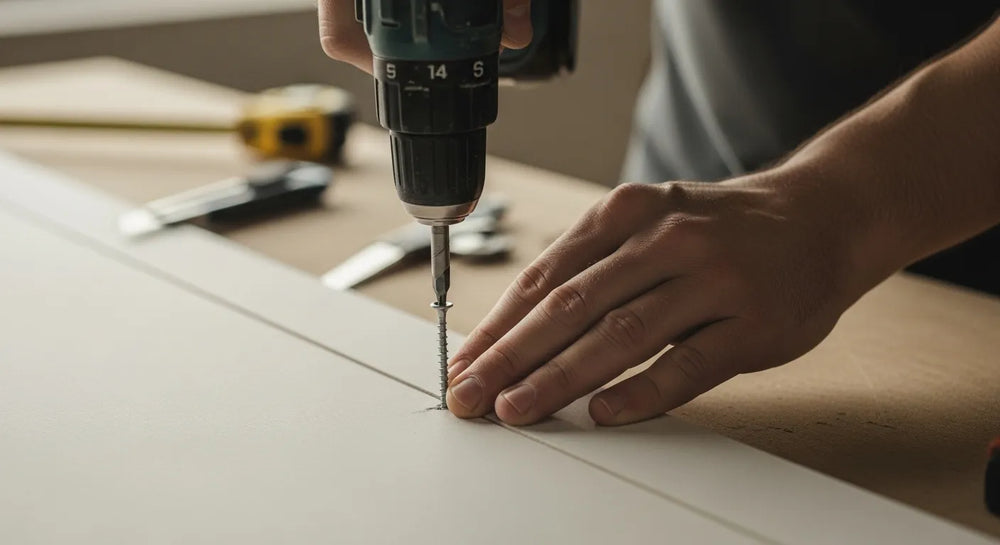
An impact driver is not simply a more powerful drill. Its internal mechanism delivers rapid, powerful rotational impacts (concussive blows) in addition to constant torque. When the tool senses resistance—such as when driving a screw into dense concrete—the impact mechanism engages, delivering thousands of impacts per minute.
Key Benefits for Installing Concrete Screws:
- Massive Torque Output: Impact drivers generate significantly more torque than a standard drill/driver. This raw power is essential for overcoming the immense resistance encountered as the screw's threads cut into hard masonry.
- Reduced Cam-Out: "Cam-out" is the frustrating process where the driver bit slips out of and damages the screw head. The downward and rotational impacts of an impact driver keep the bit firmly seated in the recess, dramatically reducing the risk of stripping the head. This is especially true for Phillips head fasteners but also beneficial for hex and Torx/star drive heads.
- Decreased User Fatigue: The tool's impact mechanism transfers most of the force directly to the screw, not to the user's wrist and arm. For an MRO team installing dozens of electrical conduits or safety railings, this ergonomic advantage is a massive productivity booster, reducing strain and improving consistency over a long day.
For any high-volume or heavy-duty application involving concrete screws, the impact driver is unequivocally the professional's choice. It makes the installation process faster, safer, and more reliable.
When a Standard Drill/Driver Suffices
While an impact driver is often ideal, a high-quality cordless drill/driver can be sufficient in specific situations. These tools provide only rotational torque, meaning the user must supply more downward pressure to keep the bit engaged.
A drill/driver may be an acceptable choice when:
- Working with smaller diameter screws: Fasteners like a 3/16" screw require less torque to install than a 1/2" or larger screw.
- Anchoring into softer substrates: Driving into mortar joints, cinder blocks, or lightweight concrete is significantly easier than into aged, high-PSI poured concrete.
- Performing low-volume installations: If you are only installing a handful of screws, the time savings of an impact driver are less critical, and the risk of fatigue is minimal.
If using a drill/driver, it is crucial to use the adjustable clutch. Start with a mid-range setting and increase it as needed. The clutch will disengage the motor when a set torque is reached, helping to prevent over-driving the screw and stripping the threads you've just cut into the concrete.
The Critical Role of the Rotary Hammer
This is the most common point of confusion, and clarifying it is essential for professional results. Neither an impact driver nor a drill/driver should be used to create the pilot hole in concrete. While a standard drill in "hammer mode" (a hammer drill) can work for block or brick, it is slow and inefficient in hard concrete.
The proper tool for drilling the pilot hole is a rotary hammer. A rotary hammer uses a piston mechanism to create a powerful, hammering blow, pulverizing the masonry as the bit rotates to clear the debris. It is vastly more effective and efficient than a hammer drill.
Key Takeaway: The installation of a concrete screw is a two-tool process. A rotary hammer is used to drill a precise pilot hole. An impact driver is then used to efficiently and safely drive the screw into that hole. Using the wrong tool for either step compromises the entire system.
Our philosophy of customer empowerment is rooted in providing this kind of practical, technical knowledge. A well-informed procurement manager or engineer makes better sourcing decisions, leading to better project outcomes. You can learn more about our mission to champion American manufacturing and empower businesses here.
Selecting the Right Concrete Screw: A Critical Procurement Decision
The choice of tool is only half the equation. The specific concrete screw you select has a profound impact on the longevity, safety, and cost-effectiveness of your project. This is where a strategic procurement process, focused on TCO rather than just upfront price, pays dividends.
Material and Coating Matters
The operational environment dictates the necessary material and coating. Exposure to moisture, chemicals, or salt can rapidly corrode an improperly specified fastener, leading to failure.
- Blue Ceramic Coating: This is a common and highly effective coating that provides a durable barrier against corrosion. It's an excellent choice for a wide range of indoor and outdoor applications where moisture is a concern. For applications demanding superior corrosion resistance, a fastener like the Steel Blue Ruspert Ceramic Coating Flat Phillips® Drive Concrete Screw provides a multi-layer defense against the elements, a key consideration for long-term TCO.
- Zinc Plating: Suitable for dry, indoor environments only, as it offers minimal protection against moisture.
- Hot-Dip Galvanized: A thick coating of zinc provides substantial corrosion resistance for outdoor and damp environments.
- Stainless Steel: Offers the highest level of corrosion resistance and is necessary for highly corrosive environments such as coastal areas, chemical plants, or food processing facilities.
Head Style and Drive Type
The head style is chosen based on the application's functional and aesthetic requirements.
- Hex Head: This is the most common style for industrial applications. The external hex allows for maximum engagement with a socket driver, enabling the application of high torque with minimal risk of cam-out. The Hex Head Concrete Screws 3/16 x 1.97 are a prime example of a design optimized for a secure, high-torque installation with an impact driver.
- Flat Head (Countersunk): When a flush surface is required, a flat head screw is used. These are ideal for installing door frames, window sills, or machinery tracks where a protruding head would be an obstruction or a hazard. When a smooth, snag-free surface is non-negotiable, the 1/4 x 2-3/4 Flat Head Concrete Screws are the ideal choice, designed to sit perfectly level with the fastened material.
- Trim Head: These feature a smaller head for a less conspicuous finish, often used in architectural applications.
The drive type (e.g., Phillips, Torx/Star) also plays a role. Torx drives offer better engagement and are more resistant to stripping than Phillips drives, especially when high torque is applied.
Diameter and Length Considerations
Sizing the screw correctly is not a matter of guesswork; it's a matter of engineering.
- Diameter: The screw's diameter is the primary factor in its holding power (both tensile and shear strength). A larger diameter screw provides a greater surface area for thread engagement and is physically stronger.
- Length: The correct length is determined by adding the thickness of the material being fastened to the required minimum embedment depth in the substrate. This minimum embedment is specified by the manufacturer and is crucial for achieving the screw's published load ratings. Always choose a screw that meets or exceeds this requirement.
A Step-by-Step Best Practice Installation Guide
Following a systematic process ensures every anchor is installed for maximum performance and safety. This dedication to process reflects our core value of Industrial Excellence.
- Safety First: Always wear appropriate Personal Protective Equipment (PPE), including safety glasses to protect from concrete dust and gloves to protect your hands.
- Gather Your Tools & Materials: Select the correct American-made concrete screw for your application, a properly sized carbide-tipped masonry bit for your rotary hammer, the rotary hammer itself, an impact driver with the correct socket or bit, and a method for cleaning the hole (wire brush and compressed air or vacuum).
- Drill the Pilot Hole: Using the rotary hammer, drill a hole to the specified diameter and depth. The required bit diameter is almost always stamped on the screw's packaging or specification sheet. A critical best practice is to drill the hole at least a half-inch deeper than the screw's embedment depth. This creates a space for any remaining dust to settle, ensuring the screw can be fully driven.
- Clean the Hole Thoroughly: This is the most frequently skipped and most critical step. Use a wire brush to scrub the inside of the hole, followed by bursts of compressed air or a vacuum to remove all dust and debris. A clean hole allows the screw's threads to achieve maximum engagement with the solid base material. Failing to clean the hole can reduce holding power by 50% or more.
- Drive the Screw: Position your fixture over the hole. Insert the tip of the concrete screw and begin driving it with your impact driver. Start slowly to ensure the threads engage correctly without cross-threading. Once engaged, use controlled bursts of power to drive the screw until the head is seated firmly against the fixture.
- Avoid Over-Driving: Be very careful not to over-torque the screw. An impact driver has enough power to strip the threads in the concrete or even snap the screw itself. A properly driven screw will feel snug; it does not need to be tightened with excessive force.
- Final Check: Ensure the fixture is secure and does not move. The installation is now complete and can be loaded immediately.
The Maden.co Advantage: Streamlining Industrial Procurement
Understanding the technical details of fastener installation is vital, but for a business, the procurement process itself can be just as challenging. This is where Maden.co provides a transformative solution.
Supply Chain Resilience with American Manufacturing
In recent years, the fragility of global supply chains has become a painful reality for many businesses, leading to project delays, cost overruns, and uncertainty. By focusing exclusively on American-made products, we help you build a more resilient and transparent supply chain. Our platform provides direct access to over 2.5 million products from a network of more than 800 verified U.S. manufacturers. This isn't just about patriotism; it's a strategic business decision that reduces lead times, ensures consistent quality, and supports domestic industrial capacity. America's manufacturing revival is here, and we are proud to be at its forefront.
Digital Innovation and Procurement Efficiency
Traditional B2B procurement is often a cumbersome process of sourcing quotes, vetting suppliers, and managing purchase orders. We replace that friction with a streamlined, digital marketplace. For a procurement manager under pressure to source a specific ANSI-compliant fastener, a design engineer needing material certifications for a new prototype, or an MRO buyer facing an unexpected equipment breakdown, the ability to quickly find and purchase a verified, U.S.-made part is a game-changer.
Furthermore, we understand that managing cash flow is critical. For larger procurement needs or capital-intensive projects, you can apply for Instant Financing at checkout. This powerful tool allows you to acquire the materials you need immediately while managing payments on a schedule that works for your business.
Empowering Manufacturers and Buyers
Our model is designed to create a powerful partnership between American industry and the businesses that rely on it. We provide U.S. manufacturers with a dynamic platform to reach a national audience, fueling their growth and innovation. This symbiotic relationship is the engine of the manufacturing revival. Are you a U.S. manufacturer? Register as a vendor and join us in rebuilding America's industrial backbone.
For buyers, this means unprecedented access and support. We empower you with the technical information and sourcing tools you need to make the best decisions for your projects. If you have specific sourcing questions or need help finding a particular component, our team of experts is ready to help. Please don't hesitate to contact us.
Conclusion
So, do you need an impact driver for concrete screws? For any professional, commercial, or large-scale application, the answer is a resounding yes. The impact driver offers an unparalleled combination of speed, power, and ergonomic benefit that makes installations more reliable and less strenuous. While a drill/driver can work in a pinch for small jobs, the impact driver is the superior tool for the task of driving the screw.
However, the larger lesson is that successful anchoring depends on a complete system: the right tool for drilling the hole (a rotary hammer), the right tool for driving the screw (an impact driver), and most importantly, the right fastener for the application. The selection of a high-quality, correctly specified, American-made concrete screw is not an area for compromise. It is a foundational decision that affects the safety, durability, and total cost of your project.
Don't let fastener selection be an afterthought. Explore our extensive catalog of U.S.-made concrete screws and other industrial components to build a more resilient and efficient supply chain. Secure the parts you need today and leverage our Instant Financing option at checkout to manage your project's budget effectively.
Frequently Asked Questions (FAQ)
1. Can I use a regular cordless drill for concrete screws? For very light-duty applications in softer material like mortar or for a very small number of small-diameter screws, a powerful cordless drill might suffice. However, you will need to apply significant downward pressure to prevent the bit from slipping (cam-out), and you risk straining your wrist. For professional and reliable results, an impact driver is strongly recommended.
2. What happens if I over-tighten a concrete screw with an impact driver? Over-tightening is a significant risk with a powerful tool like an impact driver. It can lead to two primary failure modes: either you strip the threads that the screw has cut into the concrete, completely destroying its holding power, or you can apply so much torque that the fastener itself shears off. It's crucial to use controlled bursts and stop as soon as the fastener head is snug.
3. Why is cleaning the pilot hole so important? The holding power of a concrete screw comes from the direct engagement of its threads with the base material. If the drilled hole is filled with concrete dust and debris, the threads cannot engage properly. The screw will either be difficult to drive or will be embedded in loose dust instead of solid concrete, dramatically reducing its tensile and shear strength. A clean hole is essential for a secure anchor.
4. Are all blue concrete screws the same? No, they are not. While the blue color is often associated with a ceramic coating that provides corrosion resistance, the quality and thickness of this coating can vary significantly between manufacturers. Sourcing from verified, reputable U.S. manufacturers ensures that the coating meets high standards for durability and performance, providing reliable protection against rust and degradation.


