
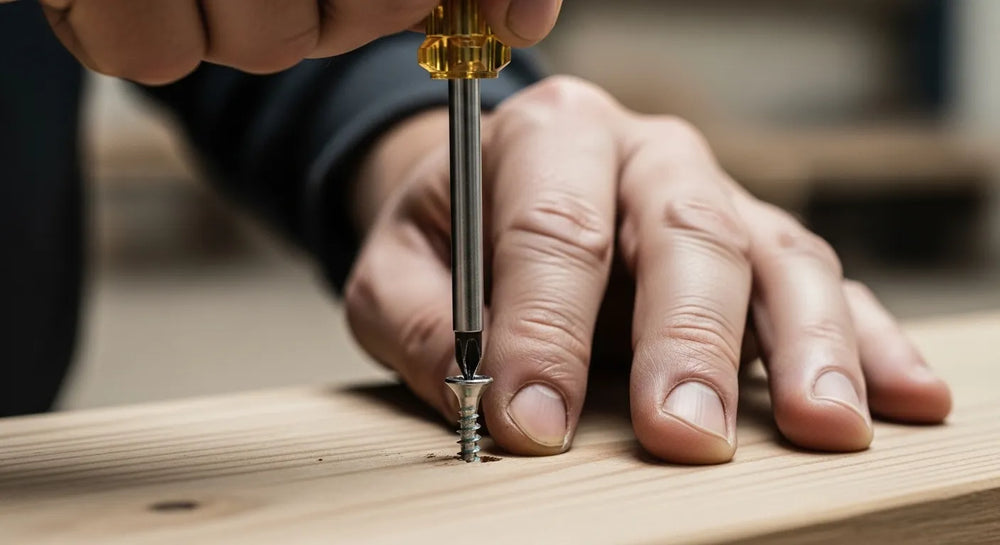
Optimizing Fastening: What Size Wood Screws to Use for Industrial Precision
Table of Contents
- Introduction
- The Crucial Role of Fasteners in Industrial Excellence
- Understanding Wood Screws: Anatomy and Types
- The Science of Sizing: What Size Wood Screws to Use
- Factors Influencing Wood Screw Selection
- Strategic Sourcing for Industrial Buyers: The Maden.co Advantage
- Navigating the Maden.co Platform for Wood Screw Sourcing
- Instant Financing: A Strategic Tool for Procurement
- Conclusion
- FAQ
Introduction
In the exacting world of industrial applications, overlooked details can cascade into significant operational hurdles, project delays, or even structural failures. One such detail, frequently underestimated, is the precise selection of fasteners. Imagine a procurement manager facing an unexpected equipment breakdown, requiring a specific, high-strength fastener, or a design engineer finalizing a critical prototype where every component must meet rigorous standards. The wrong fastener choice—even something seemingly as straightforward as a wood screw—can compromise integrity, complicate assembly, and escalate costs. This is why understanding "what size wood screws to use" is not merely a carpentry question; it's a critical industrial specification.
This article delves into the nuances of wood screw selection, transforming a seemingly simple task into a strategic decision point for procurement managers, MRO buyers, and design engineers. We will explore the anatomy of wood screws, the science behind their sizing, and the multifaceted factors that dictate the optimal choice for various industrial applications. Our aim is to equip you with the knowledge to make informed decisions, ensuring the longevity and reliability of your projects. Ultimately, we demonstrate how sourcing through a platform dedicated to American manufacturing excellence can simplify this complex process, enhancing supply chain resilience and improving your Total Cost of Ownership.
The Crucial Role of Fasteners in Industrial Excellence
Fasteners are the silent workhorses of countless industrial assemblies, from heavy machinery and structural components to intricate electronic housings and custom woodworking projects. Their primary function is to mechanically join two or more objects, but their role extends far beyond mere connection. The right fastener contributes to:
- Structural Integrity: Ensuring that assembled components can withstand intended loads, stresses, and vibrations without failure.
- Safety and Compliance: Meeting industry standards, regulatory requirements, and safety protocols to prevent accidents and liabilities.
- Longevity and Durability: Resisting wear, corrosion, and environmental degradation, thereby extending the lifespan of products and infrastructure.
- Ease of Assembly and Maintenance: Facilitating efficient production and simplifying future repairs or replacements, reducing labor costs and downtime.
- Cost-Efficiency: Preventing premature failures, rework, and the need for expensive replacements, which directly impacts the Total Cost of Ownership (TCO).
Conversely, an incorrect fastener choice can lead to devastating consequences: stripped threads, loosened joints, material damage, catastrophic structural collapse, or non-compliance issues that halt production or trigger costly recalls. For a procurement manager, the challenge lies in navigating a vast array of options to secure components that not only fit but excel in performance and reliability. For an MRO buyer, it’s about quickly finding a suitable replacement that restores operations without compromising safety or quality. For a design engineer, it's about specifying the precise fastener that integrates seamlessly with their design, ensuring both function and manufacturability. This foundational understanding underscores why "what size wood screws to use" is a question deserving of meticulous attention.
Understanding Wood Screws: Anatomy and Types
Before we delve into sizing, it's essential to understand the fundamental characteristics that differentiate wood screws. These components are deceptively simple, yet their design variations are crucial for optimal performance in diverse applications.
Head Types
The head of a wood screw serves multiple functions: driving the screw, providing a bearing surface for clamping, and influencing the aesthetic finish.
- Flat Head (Countersunk): Designed to sit flush with or below the surface of the material, offering a smooth finish. Ideal for applications where aesthetics and preventing snags are important.
- Round Head: Sits proud of the surface, providing a decorative look and sometimes a slightly larger bearing surface. Often used when a flush finish isn't required or for softer materials where the head might sink in.
- Oval Head (Raised Countersunk): A hybrid of flat and round heads, providing a decorative, slightly raised dome while allowing the conical underside to countersink. Frequently used for aesthetic purposes.
- Pan Head: Features a slightly rounded, low-profile dome with a flat bearing surface. Offers a good balance of appearance and clamping force, often preferred for sheet metal or general fastening.
- Hex Head: Designed to be driven with a wrench or socket, providing maximum torque. Common in heavy-duty applications where strong clamping force is needed, though less common for traditional wood screws unless structural.
- Trim Head: Smaller and narrower than standard flat heads, designed for fine woodworking or trim applications where a less visible fastener is desired.
- Washer Head: Combines a pan head with an integrated washer, distributing the clamping force over a wider area, reducing the risk of crushing softer materials.
For specialized industrial applications demanding precision and a refined finish, especially in architectural details or custom fixtures, options like the Round Slot Drive Brass Wood Screw or the Flat Slot Drive Brass Wood Screw offer both functionality and aesthetic appeal.
Drive Types
The drive type dictates the tool required for installation and significantly impacts the torque transfer and resistance to cam-out (the driver slipping out of the screw head).
- Slotted: The oldest and simplest drive, prone to cam-out. Still used for traditional aesthetics and in certain low-torque applications.
- Phillips: Developed to allow the driver to cam-out under excessive torque, preventing over-tightening. Very common, but can still strip if not properly driven.
- PoziDriv: An improvement on Phillips, with additional slots to provide better grip and reduce cam-out.
- Square (Robertson): Offers excellent torque transfer and minimal cam-out. Widely popular in Canada and increasingly in the U.S. for its ease of use.
- Torx (Star): Provides the best torque transfer and virtually eliminates cam-out. Ideal for high-torque applications and when screws need to be removed and reinserted multiple times.
- Combination Drives: Some screws feature a combination of drive types (e.g., Phillips and slotted) for versatility.
Thread Types
The thread design is critical for holding power and ease of installation.
- Coarse Thread: Deeper, wider threads suitable for softer woods, providing aggressive bite and fast installation.
- Fine Thread: Shallower, tighter threads, ideal for hardwoods to minimize splitting and provide a strong grip.
- Tapered vs. Fully Threaded: Traditional wood screws have a tapered, unthreaded shank near the head, pulling materials together. Modern construction screws often have full threads for maximum holding power along the entire length. For robust outdoor or marine applications, the Oval Slot Drive Silicon Bronze Wood Screw offers superior corrosion resistance with a thread profile designed for strong engagement.
Materials and Coatings
The material and any applied coatings determine the screw's strength, corrosion resistance, and suitability for specific environments.
- Steel (Plated): Most common and cost-effective. Often zinc-plated for basic corrosion resistance or black oxide for aesthetics.
- Stainless Steel: Excellent corrosion resistance, crucial for outdoor, marine, or damp environments. Types 304 and 316 are common, with 316 offering superior resistance to saltwater.
- Brass: Softer, non-magnetic, and highly corrosion-resistant. Prized for its aesthetic appeal in fine woodworking and historical restoration, and used where sparking is a concern. Our Round Slot Drive Brass Wood Screw exemplifies this blend of form and function.
- Silicon Bronze: A copper alloy with superior strength and corrosion resistance compared to brass, making it ideal for marine and outdoor architectural applications where both durability and aesthetics are paramount. The Oval Slot Drive Silicon Bronze Wood Screw is a testament to this material's versatility.
- Aluminum: Lightweight and corrosion-resistant, but generally lower strength.
- Coatings: Beyond plating, advanced coatings (e.g., ceramic, polymer-based) offer enhanced corrosion resistance, lubricity, and UV protection for specialized applications.
Selecting the right material and coating ensures the fastener performs as expected throughout its intended lifespan, preventing premature failure and maintaining structural integrity.
The Science of Sizing: What Size Wood Screws to Use
Determining "what size wood screws to use" involves a precise consideration of both length and diameter, which together dictate a screw's holding power, shear strength, and suitability for a given application.
Length Considerations
The length of a wood screw is arguably the most critical dimension, as it directly impacts the screw's ability to engage securely with the base material.
- General Rule for Penetration: A common guideline is that the screw should penetrate the receiving (second) material by at least two-thirds to three-quarters of its total length. For example, if you're joining two pieces of wood, and the first piece is 1 inch thick, the screw should extend another 2 inches into the second piece, totaling a 3-inch screw. This ensures adequate embedment for pull-out resistance.
- Thickness of the First Material: The screw must be long enough to pass through the first material completely, allowing sufficient length to anchor into the second material. If the screw is too long, it risks poking through the other side, creating a hazard or an aesthetic flaw. If too short, it won't provide adequate grip.
- Desired Shear and Pull-out Strength: Longer screws generally offer greater pull-out resistance, as more threads engage with the wood fibers. Thicker screws (larger diameter) offer greater shear strength, resisting forces parallel to the screw's axis. The specific load-bearing requirements of your application will dictate the necessary balance between length and diameter.
-
Application-Specific Needs:
- Shelving/Cabinetry: Often requires screws that provide strong pull-out resistance to hold shelves securely, without being excessively long to avoid splitting or breakthrough.
- Structural Framing: Demands screws with both excellent shear strength and significant pull-out resistance. Longer, thicker screws are typically employed here.
- Decking/Exterior: Requires lengths that accommodate deck board thickness and penetrate deeply into joists for durability against weathering and foot traffic.
- Avoiding Breakthrough: Always measure the combined thickness of the materials to be joined and err on the side of caution. A screw that is too long can spoil the appearance, weaken the wood, or create a safety hazard.
Diameter (Gauge) Considerations
The diameter, or gauge, of a wood screw is its second critical dimension, influencing its strength and the size of the pilot hole required. Wood screws are typically measured by a gauge number, ranging from #0 (very thin) to #24 (very thick), with common sizes for industrial applications falling between #6 and #14.
- Relationship Between Diameter and Holding Power: A larger diameter screw displaces more wood, creating a stronger mechanical interlock and thus greater pull-out resistance and shear strength. However, an excessively thick screw can split the wood, particularly in hardwoods or near edges.
-
Matching Diameter to Wood Species:
- Softwoods (e.g., pine, spruce, cedar): Can accommodate slightly larger diameter screws without splitting, as their fibers are more yielding. However, softer wood also means less inherent holding power, so a larger diameter screw helps compensate.
- Hardwoods (e.g., oak, maple, cherry): Are denser and more prone to splitting. They require smaller diameter screws or larger pilot holes to prevent damage. The trade-off is often slightly less holding power compared to a similarly sized screw in softwood, but the hardwood itself provides greater inherent strength.
- Pilot Hole Considerations: The diameter of the screw directly dictates the size of the pilot hole. A pilot hole is essential to prevent splitting and reduce driving resistance, ensuring the screw threads cut cleanly into the wood. The pilot hole should match the diameter of the screw's shank (the unthreaded part) or its core diameter (the diameter of the screw without the threads) to allow the threads to fully engage.
Thread Pitch and Design
Beyond length and diameter, the screw's thread design also plays a significant role in its performance.
- Coarse Threads for Softwoods: Deeper, wider-spaced threads are excellent for quickly grabbing and holding in softer, less dense woods. They create a strong mechanical bond by displacing more wood.
- Fine Threads for Hardwoods: Shallower, more closely spaced threads are preferred for hardwoods. They are less likely to cause splitting, create a smoother entry, and provide excellent holding power in dense materials.
-
Fully Threaded vs. Partially Threaded:
- Partially Threaded (Traditional Wood Screws): Have an unthreaded shank below the head. When driven, this unthreaded portion allows the screw to pull the two pieces of wood tightly together, creating a clamping action. The unthreaded shank should pass completely through the first piece of wood.
- Fully Threaded: Provide maximum holding power along their entire length. They are effective for securing thin materials to thicker ones or for applications where maximum pull-out resistance is paramount. However, they may not offer the same clamping action as partially threaded screws if the first material is very thick.
Understanding these dimensions and their interplay is foundational for any professional asking "what size wood screws to use." Precision in selection prevents common fastening failures and ensures long-term reliability.
Factors Influencing Wood Screw Selection
Beyond the basic dimensions of length and diameter, several other critical factors must be considered to ensure the optimal performance and longevity of a wood screw in industrial settings.
Material Compatibility
- Wood Type (Density, Grain, Moisture Content): As discussed, softwoods and hardwoods react differently to screw insertion. High-density hardwoods may require specific screw materials or designs to prevent snapping or stripping. The grain direction also matters; driving screws parallel to the grain reduces splitting risk. Moisture content can affect wood's behavior, with wet wood being softer but more prone to splitting upon drying around the screw.
-
Corrosion Resistance: This is paramount for fasteners exposed to moisture, chemicals, or outdoor environments.
- Outdoor/Damp Environments: Stainless steel (304 or 316) is often the go-to for its robust resistance to rust and corrosion. For exceptional durability in marine or severe outdoor architectural applications, the Oval Slot Drive Silicon Bronze Wood Screw offers superior performance.
- Treated Wood: Modern pressure-treated lumber contains chemicals (like ACQ) that are highly corrosive to standard zinc-plated or galvanized steel fasteners. Specialized coatings or stainless steel are mandatory to prevent premature fastener failure and wood staining.
- Chemical Exposure: In industrial settings, screws may be exposed to specific chemicals. The fastener material must be inert to these substances to prevent degradation.
- Dissimilar Metals (Galvanic Corrosion): When two different metals are in contact in the presence of an electrolyte (like moisture), an electrochemical reaction can occur, causing one metal to corrode preferentially. For example, using a steel screw with aluminum components, or certain types of stainless steel with copper, can lead to accelerated corrosion. Careful material selection or isolation measures are necessary. For applications requiring non-ferrous, corrosion-resistant options with aesthetic appeal, our Round Slot Drive Brass Wood Screw and Flat Slot Drive Brass Wood Screw are excellent choices, particularly where galvanic corrosion with steel is not a concern, or where they are paired with compatible materials.
Application Requirements
-
Load Bearing (Shear vs. Tension):
- Shear Loads: Forces acting perpendicular to the screw, trying to cut or bend it. Larger diameter screws and stronger materials (e.g., steel, silicon bronze) excel in shear strength.
- Tension/Pull-out Loads: Forces acting parallel to the screw, trying to pull it straight out of the material. Longer screws with aggressive threads provide greater pull-out resistance. Understanding the primary load type is crucial for determining "what size wood screws to use."
- Environmental Exposure: Factors like extreme temperature fluctuations, UV radiation, humidity, and airborne pollutants all influence fastener material and coating choices.
- Aesthetics: In visible applications, the head type, material (e.g., brass, bronze), and finish are critical. Countersunk heads provide a flush finish, while decorative heads like oval or round offer a distinct visual element.
- Frequency of Disassembly: If components need to be disassembled and reassembled frequently, screws with durable drive types (like Torx or Square) that resist stripping are preferred. The screw material should also be resistant to thread wear.
Pre-drilling and Pilot Holes
The importance of pre-drilling cannot be overstated, especially when working with hardwoods or near wood edges.
- Purpose: Pre-drilling prevents wood splitting, reduces driving torque (making installation easier and preventing screw breakage), and ensures the screw goes in straight.
-
Selecting Correct Pilot Hole Diameter:
- Shank Diameter: The pilot hole for the unthreaded shank should be equal to or slightly larger than the shank diameter to allow the screw to pull the two pieces of wood tightly together.
- Core Diameter (Thread Root Diameter): The pilot hole for the threaded portion should be equal to the screw's core diameter (the diameter of the screw without the threads) to allow the threads to cut into the wood fibers and provide maximum holding power. Using a drill bit that matches the screw's core diameter is critical.
- Countersinking/Counterboring: For flat or oval head screws, countersinking creates a conical recess for the screw head to sit flush or below the surface. Counterboring creates a flat-bottomed hole for the entire screw head, allowing it to be completely concealed with a plug.
Tooling and Installation
- Driver Bits: Always use the correct driver bit for the screw head type. Using an ill-fitting bit leads to cam-out, stripping the screw head, and potential injury.
- Power Tools vs. Manual: While power drills speed up installation, they also increase the risk of over-tightening, stripping, or splitting. Clutch settings on power drills are essential for controlling torque.
- Preventing Cam-out and Stripping: Beyond the correct driver bit, applying firm, consistent pressure during driving is key. Selecting drive types with high torque transfer, such as Square or Torx, significantly reduces these issues.
Considering these factors holistically ensures that procurement managers, MRO buyers, and design engineers specify fasteners that not only hold but perform reliably under the demanding conditions of industrial use.
Strategic Sourcing for Industrial Buyers: The Maden.co Advantage
For industrial buyers, the journey to secure the right fasteners—like precisely determining "what size wood screws to use"—is often fraught with challenges. The global supply chain can introduce complexities such as uncertain lead times, variable quality, inconsistent material certifications, and a lack of transparency regarding manufacturing origins. These issues directly impact project timelines, budget adherence, and overall operational efficiency.
At Maden.co, we recognized these systemic pain points and built a platform dedicated to democratizing access to American manufacturing. Our mission is to connect industrial buyers with over 2.5 million American-made products sourced from our extensive network of 800+ verified U.S. manufacturers. This isn't just about offering products; it's about rebuilding and strengthening the domestic supply chain.
We champion several core values that directly address the needs of today's industrial buyer:
- American Manufacturing Pride: We firmly believe in the quality, innovation, and reliability of U.S.-made products. Sourcing through us means investing in domestic industries and ensuring unparalleled product standards. Our vision is to become the definitive platform that proves American-made components are as accessible and convenient as any global alternative, driving the manufacturing revival with our tagline: "America's manufacturing revival is here."
- Digital Innovation: Our platform leverages cutting-edge technology to create a seamless, efficient, and user-friendly procurement experience. From intuitive search filters to instant financing options, we continually innovate to simplify your purchasing journey.
- Supply Chain Transparency: We provide clear visibility into product origins and manufacturer details, empowering you to make informed decisions and build a more resilient supply chain. This transparency is key to mitigating risks and ensuring compliance. Our entire business model is built on this principle; you can learn more about our mission to champion American manufacturing here: About Us.
- Industrial Excellence: Every product listed on Maden.co meets rigorous quality standards. We understand that components, whether a precision fastener or a complex assembly, must perform flawlessly. This commitment extends to ensuring compliance with critical industry standards such as DIN and NPT, where applicable, providing peace of mind to design engineers and MRO buyers.
- Customer Empowerment: We put the buyer in control, offering powerful tools and resources to streamline procurement, reduce friction, and improve efficiency. This means less time spent searching and more time focusing on core business objectives.
By choosing Maden.co, you are not just purchasing a product; you are making a strategic decision to:
- Improve Total Cost of Ownership (TCO): High-quality, reliable, U.S.-made components reduce the risk of failure, rework, and costly replacements, contributing to significant long-term savings.
- Enhance Supply Chain Resilience: Direct access to a vast network of domestic manufacturers minimizes reliance on volatile international logistics and geopolitics.
- Reduce Procurement Friction: Our intuitive platform and comprehensive product data streamline the purchasing process, saving valuable time and resources.
- Partner with Verified U.S. Manufacturers: Ensuring quality, ethical sourcing, and supporting the domestic economy.
For a procurement manager under pressure to source a specific DIN 931 compliant hex cap screw, a design engineer needing specific material certifications for a new prototype, or an MRO buyer facing an unexpected equipment breakdown, the ability to quickly find and finance a verified, U.S.-made part is a game-changer. Explore the full range of American-made products on Maden.co to experience this advantage firsthand.
Navigating the Maden.co Platform for Wood Screw Sourcing
Finding the precise wood screw you need, down to the exact size, material, and head type, is made simple on Maden.co. Our platform is designed with industrial buyers in mind, ensuring a procurement process that is both efficient and transparent.
Imagine you are a procurement manager tasked with sourcing fasteners for a new production line assembling custom wooden crates for high-value industrial equipment. You need a reliable supply of specific flat slot drive brass wood screws that offer both corrosion resistance and a secure hold without marring the wood. Navigating our extensive catalog, you can quickly filter by material (brass), head type (flat slot drive), and then refine by gauge and length. Each product listing provides comprehensive specifications, including material composition, dimensions, and relevant industry standards, allowing for precise matching to your engineering requirements.
Consider an MRO buyer overseeing the maintenance of a historical building's exterior woodwork. The demand is for fasteners that not only provide structural integrity but also blend seamlessly with the building's aesthetic and resist environmental degradation. The Oval Slot Drive Silicon Bronze Wood Screw becomes an ideal candidate due to its superior corrosion resistance and classic appearance. Through Maden.co, you can quickly locate suppliers offering these specialized fasteners, ensuring compliance with preservation guidelines and long-term durability.
Similarly, a design engineer prototyping a new line of ergonomic wooden jigs for a manufacturing plant needs precise and consistent fasteners. They might require a quantity of Round Slot Drive Brass Wood Screws for their specific tensile strength and machinability. Our platform allows engineers to dive deep into product specifications, compare options, and source directly from U.S. manufacturers who can meet their exact design requirements.
Our intuitive search and filtering capabilities mean you spend less time sifting through irrelevant options and more time connecting with the right American manufacturer. Detailed product specifications and high-quality images provide all the necessary information for confident decision-making. Moreover, Maden.co isn't just for buyers; it's a vibrant ecosystem for the entire American manufacturing sector. Are you a U.S. manufacturer? Register as a vendor and join the American manufacturing revival to connect with industrial buyers nationwide. If you have specific sourcing questions or need assistance navigating our platform, our team is ready to help.
Instant Financing: A Strategic Tool for Procurement
Beyond efficient sourcing, Maden.co offers a key differentiator designed to empower procurement managers and business owners: Instant Financing. We understand that large-volume purchases, especially for critical components or capital-intensive projects, can strain cash flow. Instant Financing isn't merely a payment method; it's a strategic tool engineered to provide financial flexibility and support your operational continuity.
This feature allows businesses to manage their capital more effectively by enabling larger, necessary purchases without immediate upfront payment. For a procurement manager overseeing a major equipment overhaul, or a business owner investing in a new production line, the ability to secure required fasteners and components promptly, while spreading out payment terms, can be invaluable. It ensures that projects stay on schedule and budgets remain agile.
The process for Instant Financing is seamlessly integrated into the checkout experience on Maden.co. There's no need to navigate to a separate application page; qualified buyers can apply directly when finalizing their order. This streamlines the procurement cycle, eliminating delays often associated with traditional financing approvals.
Leveraging Instant Financing means you can:
- Optimize Cash Flow: Preserve working capital for other operational needs.
- Make Timely Purchases: Avoid delays on critical projects by securing necessary components immediately.
- Capitalize on Volume Discounts: Purchase larger quantities to benefit from better pricing, improving TCO in the long run.
- Enhance Project Continuity: Ensure a steady supply of materials, reducing the risk of production stoppages.
For instance, if a manufacturing firm needs a bulk order of several thousand flat slot drive brass wood screws for a new product line launch, Instant Financing allows them to place that substantial order without tying up immediate funds, ensuring their inventory is stocked for production. Similarly, a contractor managing a large commercial build-out requiring a continuous supply of specialized oval slot drive silicon bronze wood screws for exterior cladding can use this option to manage project costs over time. You can apply for Instant Financing at checkout to streamline your capital-intensive projects and ensure your business keeps moving forward.
Conclusion
The seemingly simple question of "what size wood screws to use" reveals a critical layer of detail essential for industrial excellence. As we've explored, the selection of a wood screw involves a meticulous evaluation of length, diameter, head type, drive type, material, and environmental factors. An informed decision in this area is not merely about achieving a connection; it's about ensuring structural integrity, enhancing longevity, and ultimately, safeguarding your investment in every project.
For procurement managers, MRO buyers, and design engineers, the strategic importance of sourcing reliable, high-quality fasteners cannot be overstated. Compromising on these components can lead to costly failures, operational delays, and a diminished reputation. This is where Maden.co stands as your strategic partner. Our platform is purpose-built to democratize access to over 2.5 million American-made products from 800+ verified U.S. manufacturers, ensuring that you can find the exact components you need with transparency and efficiency.
We empower you to enhance supply chain resilience, improve Total Cost of Ownership, and contribute to the American manufacturing revival by providing access to industrial excellence. Whether your project demands the aesthetic precision of a Round Slot Drive Brass Wood Screw, the robust durability of a Flat Slot Drive Brass Wood Screw, or the corrosion resistance of an Oval Slot Drive Silicon Bronze Wood Screw, our vast catalog has you covered.
Don't let fastener selection be a source of uncertainty. Equip your projects with the precision and reliability of American-made components. We invite you to explore the unparalleled selection on Maden.co today. Streamline your procurement process, confidently meet your technical specifications, and leverage our Instant Financing option at checkout to manage your capital-intensive projects with unparalleled flexibility. The future of American manufacturing is here, and it's built on informed choices and strategic partnerships.
FAQ
Q1: How do I determine the right length of a wood screw?
A1: The general rule for determining the right length is that the screw should penetrate the receiving (second) material by at least two-thirds to three-quarters of its total length. For example, if you are joining a 1-inch thick piece of wood to another, a 3-inch screw would allow for 1 inch to pass through the first piece and 2 inches to embed securely into the second. Always ensure the screw is long enough to provide adequate holding power but not so long that it penetrates through the opposite side of the material.
Q2: What is the significance of wood screw gauge?
A2: The gauge of a wood screw refers to its diameter. A higher gauge number indicates a larger diameter screw. The significance lies in its direct impact on holding power and shear strength. Larger diameter screws generally offer greater pull-out resistance and can withstand more shear force. However, selecting an appropriate gauge is crucial to prevent splitting the wood, especially in hardwoods, where a smaller gauge or a precisely sized pilot hole is often necessary.
Q3: When should I use brass or bronze wood screws?
A3: Brass or bronze wood screws are typically chosen for their superior corrosion resistance, aesthetic appeal, and non-magnetic properties. Brass screws are often preferred for fine woodworking, decorative applications, and historical restorations where their classic look is desired, or where spark resistance is needed. Silicon bronze screws, such as the Oval Slot Drive Silicon Bronze Wood Screw, offer even greater strength and corrosion resistance, making them ideal for demanding outdoor, marine, or architectural applications where exposure to harsh elements is a concern.
Q4: Why is pre-drilling important for wood screws?
A4: Pre-drilling is essential to prevent wood splitting, especially when working with hardwoods, dense materials, or near the edges of a workpiece. It also reduces the torque required to drive the screw, which prevents screw breakage or stripping of the drive head. The pilot hole should be carefully matched to the screw's shank diameter for the unthreaded portion and the core diameter for the threaded portion to ensure proper thread engagement and strong holding power.


