
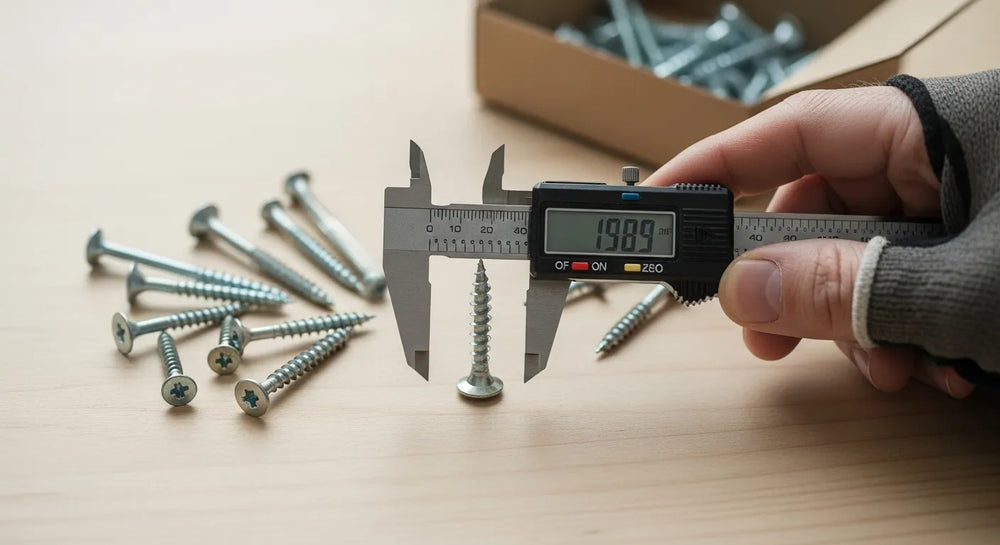
The Right Fit: What Size Wood Screws for 3/4 Plywood
Table of Contents
- Understanding 3/4-Inch Plywood: A Versatile Workhorse
- The Anatomy of a Wood Screw: Knowing Your Fastener
- Critical Factors for Screw Selection with 3/4-Inch Plywood
- The Indispensable Role of Pilot Holes
- Beyond the Basics: Enhancing Supply Chain Resilience with Maden.co
- Choosing the Right Screw for Your 3/4 Plywood Project: A Summary
- Conclusion
- FAQ
In the realm of industrial procurement and design engineering, the seemingly simple choice of a fastener can often dictate the success or failure of an entire project. Imagine a critical piece of equipment failing prematurely, a structural element losing integrity, or a custom build exhibiting unsightly splitting – all due to an improperly selected screw. This common pitfall highlights a fundamental truth: precision in component selection is paramount, even for everyday materials like plywood. For professionals working with 3/4-inch plywood, selecting the correct wood screw isn't just about grabbing what's available; it's a strategic decision that impacts structural integrity, aesthetic finish, project longevity, and ultimately, the total cost of ownership.
This comprehensive guide delves into the intricate details of selecting the ideal wood screws for 3/4-inch plywood applications. We'll explore the critical factors that influence this choice, from screw anatomy and material science to practical application scenarios and installation best practices. Our aim is to provide procurement managers, MRO buyers, design engineers, and business owners with the authoritative insights needed to make informed decisions, ensuring durable, reliable, and compliant outcomes for every project that relies on the versatility of 3/4-inch plywood. By understanding the nuances of fastener selection, you not only improve project quality but also enhance the efficiency and resilience of your supply chain, especially when sourcing high-quality, American-made components.
Understanding 3/4-Inch Plywood: A Versatile Workhorse
Before diving into fasteners, it's essential to appreciate the material we're working with. Three-quarter-inch (or 19mm) plywood is a ubiquitous material in construction, manufacturing, and industrial design due to its exceptional strength-to-weight ratio, stability, and workability. Its laminated structure, consisting of multiple thin wood veneers glued together with alternating grain directions, makes it far more resistant to splitting, warping, and shrinking than solid lumber of comparable thickness.
Common applications for 3/4-inch plywood include:
- Cabinetry and Furniture: Providing sturdy shelves, side panels, and backings that can withstand significant loads.
- Flooring and Subflooring: Creating a robust, stable base for various floor finishes in residential and commercial settings.
- Structural Sheathing: Offering lateral bracing and structural support in walls and roofs.
- Jigs, Fixtures, and Shop Furniture: Its stability and strength make it ideal for fabricating tools and workstations.
- Industrial Crating and Packaging: Protecting valuable goods during transit.
- Vehicle and Trailer Construction: Forming durable floors and walls in utility and recreational vehicles.
Despite its inherent strength, plywood, like any wood product, presents unique fastening challenges. The layers, while strong, can delaminate or split if screws are driven too close to an edge or without proper pilot holes. The goal is always to maximize holding power without compromising the material's integrity.
The Anatomy of a Wood Screw: Knowing Your Fastener
To make an educated choice about what size wood screws for 3/4 plywood are best, understanding the components of a wood screw is crucial. Each part plays a vital role in the screw's performance and suitability for specific applications.
Head Types
The head of a screw is not merely for aesthetics; it determines how the screw interacts with the surface and the tool used to drive it.
- Flat Head (Countersunk): Designed to sit flush with or slightly below the surface, creating a smooth finish. Ideal for applications where aesthetics are critical or where other components need to sit directly on top. Requires a countersink.
- Round Head: Sits above the surface, offering a decorative look and sometimes used when maximum clamping force is desired without countersinking. Often paired with a washer.
- Oval Head: A decorative variation of the flat head, with a slightly rounded top that protrudes subtly above the surface. It offers a cleaner look than a round head while still providing some decorative appeal. This type, such as the Oval Slot Drive Silicon Bronze Wood Screw, is excellent for applications where both a slight decorative protrusion and good clamping force are desired, particularly in marine or outdoor settings where silicon bronze's superior corrosion resistance is a benefit.
- Pan Head: Features a slightly rounded, low-profile dome. Offers a larger bearing surface than a flat head, which can be useful for softer materials or when attaching thin sheet goods.
Drive Types
The drive type dictates the tool required and affects driving efficiency and cam-out resistance.
- Slotted Drive: The traditional, single-slot drive. While prone to cam-out (the driver slipping out of the slot) with power tools, it offers a classic aesthetic, particularly with brass screws, and requires only a flat-blade screwdriver. For projects requiring a traditional appearance, such as period furniture or decorative accents, a Round Slot Drive Brass Wood Screw can be an excellent choice, offering both historical accuracy and the workability of brass. Similarly, the Flat Slot Drive Brass Wood Screw provides a flush finish with this classic drive type.
- Phillips Drive: The most common drive type, offering good engagement but still susceptible to cam-out, especially with higher torque.
- Square (Robertson) Drive: Excellent cam-out resistance and positive bit engagement. Popular in woodworking and construction.
- Torx (Star) Drive: Offers the best cam-out resistance and allows for maximum torque transfer. Increasingly popular in heavy-duty applications.
Thread Types and Shank
- Threads: Wood screws typically have coarse threads designed to grip wood fibers effectively. The threads create their own mating threads in the wood as the screw is driven.
- Full vs. Partial Thread: Many wood screws are fully threaded. However, some have a partial thread with a smooth shank near the head. The smooth shank allows the top piece of material to be pulled tightly against the base material, preventing the "jacketing" effect where the top piece might remain slightly separated. For 3/4-inch plywood, fully threaded screws are often sufficient, especially when attaching it to a thicker substrate.
- Shank Diameter (Gauge): The diameter of the unthreaded portion of the screw, or the overall diameter of the threaded portion, is known as its gauge. This measurement (e.g., #6, #8, #10) indicates the screw's strength and influences the size of the pilot hole needed.
Point Type
- Sharp Point: Most common, designed to pierce wood fibers easily.
- Self-Tapping/Self-Drilling Point: Features a drill-bit-like tip that creates its own pilot hole, though often not recommended for plywood without a pre-drilled pilot hole to prevent splitting.
Critical Factors for Screw Selection with 3/4-Inch Plywood
Selecting the correct wood screw for 3/4-inch plywood involves a careful evaluation of several interconnected factors. Dismissing any of these can lead to project failure or a suboptimal finish.
Determining Screw Length: The Golden Rule for 3/4 Plywood
The length of the screw is arguably the most critical factor. The goal is to achieve sufficient penetration into the base material (the material the screw is being driven into) without protruding through the other side or bottoming out in a blind hole. A commonly accepted guideline is the "2/3 rule": the screw should penetrate at least two-thirds of its length into the base material, ideally extending through the full thickness of the top piece.
For 3/4-inch plywood (which is approximately 0.75 inches or 19mm thick):
-
Attaching 3/4-inch Plywood to a 2x4 (nominal 1.5 inches thick):
- Top material: 0.75 inches
- Base material: 1.5 inches
- Applying the 2/3 rule to the base material: (2/3) * 1.5 inches = 1 inch penetration.
- Total screw length: 0.75 inches (top) + 1 inch (base) = 1.75 inches.
- Recommendation: A 1-1/2 inch to 1-3/4 inch screw would be appropriate, with 1-5/8 inch (common) often being ideal. This allows for excellent holding power in the 2x4 without risking protrusion.
-
Attaching 3/4-inch Plywood to Another Piece of 3/4-inch Plywood (Face-to-Face):
- Top material: 0.75 inches
- Base material: 0.75 inches
- Applying the 2/3 rule to the base material: (2/3) * 0.75 inches = 0.5 inches penetration.
- Total screw length: 0.75 inches (top) + 0.5 inches (base) = 1.25 inches.
- Recommendation: A 1-1/4 inch screw is usually sufficient for strong joinery in this scenario.
-
Attaching 3/4-inch Plywood to a Thicker Substrate (e.g., hardwood framing, 2-inch thick material):
- Top material: 0.75 inches
- Base material: 2 inches
- Applying the 2/3 rule: (2/3) * 2 inches = 1.33 inches penetration.
- Total screw length: 0.75 inches (top) + 1.33 inches (base) = 2.08 inches.
- Recommendation: A 2-inch to 2-1/4 inch screw would provide ample holding power.
-
Edge-to-Face Joins (e.g., attaching a cabinet side to a bottom piece):
- When screwing into the edge of plywood, extra caution is needed to prevent splitting. The screw length should be carefully chosen to penetrate deeply into the face of the receiving piece without blowing out the other side. A common technique is to use shorter screws, combined with glue, or to reinforce the edge with solid wood blocking. For this application, a 1-1/4 inch screw for 3/4-inch plywood is often a good starting point, aiming for full penetration into the face of the receiving panel.
Important Note: Always consider the specific application. For structural components under heavy load, erring on the side of slightly longer screws (while still respecting the two-thirds rule in the base) can provide added security. Conversely, for purely decorative or light-duty applications, a slightly shorter screw might suffice.
Determining Screw Gauge (Diameter)
The gauge, or diameter, of the wood screw impacts its shear strength, pull-out resistance, and the potential for splitting the wood. Common gauges for woodworking include #6, #8, and #10.
- #6 Gauge: A thinner screw, often used for lighter-duty applications, attaching trim, or where minimizing the screw head profile is important. Good for preventing splitting in delicate plywood.
- #8 Gauge: This is the workhorse screw for general-purpose applications involving 3/4-inch plywood. It offers an excellent balance of strength, holding power, and manageable driving characteristics. It's robust enough for most cabinet, furniture, and light framing applications.
- #10 Gauge: A heavier-duty screw providing maximum holding power and shear strength. Best suited for structural applications, heavy loads, or where superior pull-out resistance is required. However, it necessitates larger pilot holes and increases the risk of splitting if not carefully installed, particularly near edges.
For the vast majority of 3/4-inch plywood applications, a #8 gauge screw will be your go-to choice, often in a flat head configuration for a flush finish. When sourcing, remember that the precise dimensions and quality of these components significantly impact project integrity. At Maden.co, we connect industrial buyers with a vast network of verified U.S. manufacturers, ensuring access to high-quality fasteners like the Flat Slot Drive Brass Wood Screw that meet stringent industrial standards.
Material and Finish Considerations
The material and finish of a wood screw dictate its durability, corrosion resistance, strength, and aesthetic qualities.
- Steel (Zinc-Plated): The most common and economical choice. Zinc plating provides a measure of corrosion resistance, making them suitable for indoor applications where moisture is not a significant concern. They offer good strength for general construction and woodworking.
- Stainless Steel (304 or 316): Offers excellent corrosion resistance, making them ideal for outdoor use, marine environments, or areas with high humidity. 316 stainless steel provides superior resistance to saltwater and harsh chemicals. They are, however, softer than hardened steel screws and can be more prone to stripping if not installed carefully.
- Galvanized Steel: Coated with a layer of zinc for enhanced corrosion resistance, making them suitable for outdoor and treated lumber applications. The coating can sometimes be thick, requiring larger pilot holes.
- Brass: Softer than steel, brass screws are primarily chosen for their aesthetic appeal in decorative applications, fine furniture, or historical reproductions. They are naturally corrosion-resistant but lack the sheer strength of steel. When appearance is key, a Round Slot Drive Brass Wood Screw provides a classic, elegant finish that complements many woodworking projects.
- Silicon Bronze: A premium material offering superior corrosion resistance to brass and excellent durability, particularly in marine or highly corrosive outdoor environments. Its higher cost is justified by its performance and longevity in demanding applications. The Oval Slot Drive Silicon Bronze Wood Screw is a prime example of a fastener chosen for its resilience and aesthetic qualities in specific, high-value projects.
For a procurement manager under pressure to source a specific DIN 931 compliant hex cap screw, a design engineer needing specific material certifications for a new prototype, or an MRO buyer facing an unexpected equipment breakdown, the ability to quickly find and finance a verified, U.S.-made part is a game-changer. These material choices, when sourced from reliable domestic manufacturers, ensure consistent quality and performance.
Application Specifics
The ultimate purpose of the assembly significantly influences screw choice:
- Structural Applications (e.g., subflooring, heavy-duty shelving): Demand stronger, longer, and larger gauge screws (e.g., #8 or #10, 1-3/4" to 2" length) with good shear strength and pull-out resistance. Consider materials like galvanized or stainless steel for longevity.
- Cabinetry and Furniture (e.g., attaching face frames, drawer slides): Often prioritize a clean finish and moderate holding power. Flat head #6 or #8 screws (1-1/4" to 1-5/8" length) are common, often paired with glue. Brass or silicon bronze screws might be used for visible elements.
- Outdoor Projects (e.g., deck furniture, sheds): Require fasteners with superior corrosion resistance, such as stainless steel, galvanized steel, or silicon bronze, to withstand environmental exposure.
The Indispensable Role of Pilot Holes
For any wood screw driven into plywood, pilot holes are not optional; they are critical for preventing splitting, ensuring the screw drives straight, and achieving optimal holding power. Plywood's laminated structure, while strong, can delaminate or split, especially near edges, if a screw is driven without adequate clearance.
Sizing Pilot Holes
Correct pilot hole sizing involves two key diameters:
- Clearance Hole (for the top piece): This hole should be slightly larger than the screw's unthreaded shank (or the screw's outside diameter if fully threaded) in the top piece of material. This allows the screw to pass freely through the top piece, ensuring that the threads only engage with the base material, thereby pulling the top piece tightly against the base. If the threads also engage the top piece, it can prevent a tight joint.
- Pilot Hole (for the base material): This hole should be slightly smaller than the screw's root diameter (the diameter of the screw shaft between the threads). This allows the threads to bite firmly into the base material without undue resistance that could strip the screw or split the wood.
Practical Pilot Hole Guidelines for 3/4-inch Plywood
While specific drill bit sizes can vary slightly by screw manufacturer and wood density, here are general guidelines:
| Screw Gauge | Clearance Hole (Top 3/4" Plywood) | Pilot Hole (Base Material) |
|---|---|---|
| #6 | 9/64" or 5/32" | 3/32" or 7/64" |
| #8 | 5/32" or 3/16" | 7/64" or 1/8" |
| #10 | 3/16" or 13/64" | 1/8" or 9/64" |
Countersinking: For flat head and oval head screws, a countersink bit is essential to create a tapered recess for the head to sit flush or slightly proud. This prevents surface damage and ensures a clean finish.
Beyond the Basics: Enhancing Supply Chain Resilience with Maden.co
Choosing the right wood screws for 3/4-inch plywood is a microcosm of a larger, more critical challenge faced by procurement managers and design engineers across industries: sourcing the right components reliably and efficiently. In today’s dynamic global economy, the ability to secure high-quality, specialized parts can mean the difference between project success and costly delays. This is where the strategic value of sourcing through a platform like Maden.co becomes undeniable.
Our mission at Maden.co is to democratize access to American manufacturing. We understand that finding specific, high-quality, American-made components – even something as fundamental as a specialized wood screw or a custom-machined part – can be a significant hurdle. Fragmented supply chains, lengthy lead times, and opaque sourcing channels often force buyers to compromise on quality or rely on uncertain foreign alternatives. We exist to bridge this gap, connecting industrial buyers with over 2.5 million American-made products from our network of 800+ verified U.S. manufacturers. Our entire business model is built on this principle; you can learn more about our mission to champion American manufacturing here: About Us.
The Maden.co Advantage: More Than Just a Marketplace
When you choose Maden.co, you're not just buying a product; you're investing in a more resilient, transparent, and efficient procurement process. We embody core values that directly address the pain points of modern industrial sourcing:
- American Manufacturing Pride: We firmly believe that "America's manufacturing revival is here." By exclusively featuring U.S.-made products, we support domestic industries, ensure higher quality control, and contribute to job creation. This pride is reflected in the craftsmanship of every fastener, every tool, and every component available on our platform.
- Digital Innovation: Our B2B marketplace is designed with the modern buyer in mind. It's intuitive, powerful, and built to streamline your search for even the most obscure components. For a general overview of our offerings, explore our Homepage.
- Supply Chain Transparency: We connect you directly with verified U.S. manufacturers. This transparency reduces risk, ensures compliance with critical industry standards (e.g., DIN, NPT), and provides clarity on origin and quality.
- Industrial Excellence: Every product listed on Maden.co meets rigorous industrial standards. This commitment to excellence means you can trust that the wood screws you procure, whether a standard #8 flat head or a specialized silicon bronze variant, will perform as expected in your demanding applications.
- Customer Empowerment: We put the buyer in control. With a vast catalog, detailed product specifications, and competitive pricing, you have the tools to make the best decisions for your projects.
Consider a scenario where a design engineer is finalizing plans for a new outdoor public art installation, requiring thousands of fasteners that must withstand harsh weather and resist corrosion. Sourcing these through fragmented channels often leads to inconsistent quality, late deliveries, and questions about material certification. With Maden.co, that engineer can confidently browse options like the Oval Slot Drive Silicon Bronze Wood Screw, knowing it comes from a verified U.S. manufacturer, with clear specifications, improving the Total Cost of Ownership (TCO) by reducing future maintenance and replacement costs.
Similarly, an MRO buyer needing to quickly restock a critical but hard-to-find brass fastener for vintage machinery repairs might struggle with international suppliers offering uncertain lead times. Finding a reliable source for a Round Slot Drive Brass Wood Screw or a Flat Slot Drive Brass Wood Screw through Maden.co ensures that the necessary part is American-made, readily available, and reduces procurement friction significantly.
Strategic Financing for Industrial Purchases
A key differentiator that further empowers our customers is our Instant Financing option. We understand that large-volume purchases, or unexpected capital-intensive projects, can strain cash flow. Instant Financing isn't just a payment method; it's a strategic tool designed for businesses. It allows procurement managers and business owners to manage their capital effectively, enabling them to make necessary purchases without immediate upfront expenditure. This feature is seamlessly integrated into the checkout process, providing a quick and efficient way to secure the components you need when you need them, without compromising your financial liquidity. You can apply for Instant Financing at checkout to streamline your capital-intensive projects and ensure your operations continue smoothly.
Join the Movement
For qualified U.S. manufacturers, Maden.co offers an unparalleled opportunity to expand your reach and connect directly with industrial buyers across the nation. By joining our network, you become a vital part of the American manufacturing revival. Are you a U.S. manufacturer looking to amplify your market presence? Register as a vendor and join the American manufacturing revival: Vendor Registration.
Choosing the Right Screw for Your 3/4 Plywood Project: A Summary
When working with 3/4-inch plywood, remember these key takeaways for optimal fastener selection:
- Length is paramount: Aim for the screw to penetrate at least two-thirds into the base material after passing through the 3/4-inch plywood. This typically means 1-1/4" to 2" screws depending on the thickness of the receiving material.
- Gauge matters: A #8 gauge screw is the ideal general-purpose choice for 3/4-inch plywood, offering a balance of strength and splitting resistance. Use #6 for lighter tasks and #10 for heavy-duty structural applications.
- Material and Finish: Match the screw material to the environment and desired aesthetics. Zinc-plated steel for indoor, general use; stainless or silicon bronze for outdoor or marine; brass for decorative accents.
- Pilot holes are non-negotiable: Always drill correctly sized pilot holes (clearance for the top piece, pilot for the base) and countersink flat or oval heads to prevent splitting and ensure a clean finish.
- Source strategically: Partner with platforms that prioritize quality, transparency, and domestic manufacturing, like Maden.co, to ensure long-term supply chain resilience and product integrity. If you have specific sourcing questions, our team is ready to help: Contact Us.
By adhering to these principles, you ensure that your 3/4-inch plywood projects are not only structurally sound and aesthetically pleasing but also built to last, reflecting a commitment to industrial excellence from the smallest fastener to the largest component.
Conclusion
The selection of fasteners, while seemingly a minor detail, profoundly impacts the success, durability, and cost-effectiveness of any project involving 3/4-inch plywood. Understanding the precise interplay of screw length, gauge, material, and proper installation techniques is essential for procurement managers, design engineers, MRO buyers, and business owners striving for industrial excellence. The emphasis on American-made quality, coupled with a transparent and efficient sourcing process, further elevates project outcomes, contributing to a more resilient and reliable supply chain.
At Maden.co, we are committed to being your strategic partner in this endeavor. We don't just offer parts; we offer peace of mind, empowering you with access to over 2.5 million high-quality, U.S.-manufactured products. By leveraging our platform, you gain the confidence that every component, from the simplest wood screw to the most complex assembly, meets the highest standards of industrial excellence. We invite you to explore our extensive catalog and discover the unparalleled quality and convenience of sourcing American-made. Begin your next project with confidence and streamline your procurement process. You can also apply for Instant Financing at checkout to manage your capital effectively and ensure your critical projects are never delayed. Explore the difference American manufacturing makes today!
FAQ
Q1: What is the most common screw length for attaching 3/4-inch plywood?
A1: For most general applications where 3/4-inch plywood is attached to a thicker substrate (like a 2x4 or another piece of plywood), screws ranging from 1-1/4 inches to 1-5/8 inches are most common. The ideal length depends on the thickness of the receiving material, following the guideline that the screw should penetrate at least two-thirds into the base material.
Q2: Is it always necessary to drill pilot holes when screwing into 3/4-inch plywood?
A2: Yes, it is highly recommended to always drill pilot holes when screwing into 3/4-inch plywood. Plywood, despite its strength, can delaminate or split, especially near edges, if screws are driven without proper clearance and pilot holes. This ensures the screw drives straight, reduces the risk of stripping, and maximizes holding power without damaging the material.
Q3: What gauge of wood screw is best for general use with 3/4-inch plywood?
A3: For general-purpose applications with 3/4-inch plywood, a #8 gauge wood screw is typically the best choice. It offers an excellent balance of strength, holding power, and manageable driving characteristics for most cabinetry, furniture, and light framing tasks. #6 gauge screws are for lighter duty, while #10 gauge is reserved for heavy structural applications.
Q4: How does sourcing American-made wood screws from Maden.co benefit my projects?
A4: Sourcing American-made wood screws from Maden.co provides numerous benefits, including assured quality control, transparent supply chains, reduced lead times, and support for domestic manufacturing. Our platform connects you with verified U.S. manufacturers, ensuring compliance with industrial standards, enhancing supply chain resilience, and ultimately improving the Total Cost of Ownership for your projects. Additionally, our Instant Financing option at checkout helps manage cash flow for large or urgent purchases.


