
Why Your Drywall Anchors Are Pulling Out & How to Stop It
Table of Contents
- Introduction
- The Foundation of the Problem: Understanding Drywall's Limitations
- The Critical Mismatch: Wrong Anchor, Wrong Load, Wrong Application
- The Human Element: Common Installation Errors That Guarantee Failure
- The Procurement Perspective: How Sourcing Decisions Impact Success
- Repairing the Damage and Ensuring Future Success
- Conclusion: A Systematic Approach to Secure Fastening
- Frequently Asked Questions (FAQ)
Introduction
It’s a scenario that plays out in commercial buildings, manufacturing facilities, and office spaces across the country: a newly installed shelf, a heavy piece of equipment, or a critical safety sign suddenly gives way, leaving behind a gaping hole and a cascade of problems. The culprit is almost always the same: a failed drywall anchor. This seemingly small component failure can lead to significant costs, from damaged equipment and materials to project delays and, most importantly, serious safety hazards. For a procurement manager trying to stay on budget, an MRO buyer responsible for facility uptime, or a design engineer specifying components, a pulled-out anchor is more than an inconvenience; it's a breakdown in operational integrity.
The frustration is understandable. You followed the instructions, used the provided hardware, and yet the wall couldn't hold. The question, "why are my drywall anchors pulling out?" is a critical one that points to deeper issues than just a faulty piece of plastic. The answer lies in a combination of physics, material science, and process discipline. It involves understanding the inherent limitations of gypsum board, the specific mechanics of different anchor types, and the crucial role of proper installation technique.
This comprehensive article will dissect the common and not-so-common reasons for drywall anchor failure from an industrial and commercial perspective. We will move beyond simple DIY tips to provide a professional framework for diagnosing issues and implementing robust, long-lasting solutions. We will explore the critical differences between anchor types, identify the most frequent installation errors, and discuss how sourcing high-quality, reliable components is the ultimate preventative measure. Our goal is to empower you with the knowledge to ensure that what you mount on the wall, stays on the wall, safeguarding your assets, personnel, and operational efficiency.
The Foundation of the Problem: Understanding Drywall's Limitations
Before we can diagnose why an anchor failed, we must first respect the material it’s installed in. Drywall, also known as gypsum board or sheetrock, is the default interior wall surface in most modern construction for good reason: it's inexpensive, easy to install, and provides a smooth, paintable finish. However, its core structural property is also its greatest weakness.
Drywall consists of a layer of hardened gypsum plaster pressed between two thick sheets of paper. This composition makes it fundamentally brittle and crumbly. Unlike wood, metal, or concrete, it has very little inherent tensile or shear strength. When you drive a screw directly into drywall, you are essentially just pushing aside soft, chalky gypsum. There is almost nothing for the screw threads to bite into, which is why an unanchored screw can be pulled out by hand with minimal effort.
A drywall anchor’s entire purpose is to work around this weakness. It is a mechanical intermediary designed to distribute the load of a hanging object over a larger surface area of the drywall, preventing the concentrated force of the screw from simply tearing through the soft gypsum core.
Key Factors in Drywall Composition
- Thickness: The most common drywall thicknesses in commercial applications are 1/2-inch and 5/8-inch Type X fire-rated board. The thicker 5/8-inch board offers slightly more rigidity and holding power, but it is still fundamentally a fragile material. An anchor rated for 1/2-inch drywall may not perform optimally in 5/8-inch, and vice versa.
- Condition: The age and condition of the drywall are paramount. Drywall in older buildings can become brittle. More critically, any exposure to moisture—from a past leak, high humidity, or condensation—can catastrophically weaken the gypsum core, turning it into a paste-like substance with virtually no structural integrity. Attempting to install an anchor in compromised drywall is a guaranteed failure.
- The Paper Facing: The paper on the front and back of the gypsum board provides all of its tensile strength. When an anchor pulls out, it often tears a cone-shaped chunk of gypsum and paper out with it. The integrity of this paper is crucial for the anchor to hold.
Understanding this context is the first step. The anchor isn't failing on its own; it's failing because the load placed upon it has exceeded what the surrounding gypsum board can support. The solution, therefore, is to either reduce the effective load or increase the anchor's ability to distribute that load effectively.
The Critical Mismatch: Wrong Anchor, Wrong Load, Wrong Application
The single most common reason for anchor failure is a fundamental mismatch between the anchor selected and the demands of the application. The world of fasteners is vast and specialized, and treating all drywall anchors as interchangeable is a direct path to failure. To make the right choice, you must first analyze the load.
Understanding Shear vs. Tensile Load
Every object hung on a wall exerts force, which can be broken down into two primary types:
- Shear Load: This is the downward-pulling force that acts parallel to the wall's surface. Think of hanging a simple picture frame or a whiteboard. The weight of the object is trying to shear the screw off. Drywall anchors are generally quite effective at handling moderate shear loads because the weight is distributed downward.
- Tensile (or Pull-Out) Load: This is the outward-pulling force that acts perpendicular to the wall. This is a much more challenging force for drywall to handle. Examples include shelving that holds items far from the wall, grab bars, or wall-mounted monitors on an articulating arm. The force is actively trying to pull the anchor straight out of the wall, which is the weakest direction for drywall.
Key Takeaway: Many procurement decisions are based on a simple weight rating provided by the manufacturer. However, this number is often for a pure shear load under ideal lab conditions. An anchor rated for 50 pounds in shear might fail with a 15-pound tensile load. Always consider the direction of the force, not just the weight of the object.
A Taxonomy of Common Drywall Anchors
Choosing the correct anchor requires matching its mechanical design to the load type and weight. Here is a breakdown of common categories, from light-duty to heavy-duty.
1. Expansion Anchors
These are the most common and often misused types of anchors. They work by expanding behind or within the drywall as a screw is inserted.
-
Ribbed Plastic Anchors: These are simple, tapered plastic sleeves with ribs on the outside. When a screw is driven in, the anchor is forced to expand slightly, pressing the ribs against the inside of the pilot hole.
- Best For: Very light-duty, pure shear load applications like hanging small decorations, smoke detectors, or lightweight signage.
- Common Failure Point: They offer minimal resistance to tensile (pull-out) loads. If the pilot hole is even slightly too large, they will spin in place instead of expanding. They are highly susceptible to failure in old or soft drywall. For reliable, U.S.-made light-duty fastening, a product like this Ribbed Plastic Anchor from a verified manufacturer provides consistency that generic hardware often lacks.
2. Self-Drilling Anchors
These anchors are prized for their installation speed, as they typically do not require a pre-drilled pilot hole. They have a sharp, auger-like tip that bores a hole as they are screwed into the wall.
-
Nylon or Zinc "Zip-It" Style Anchors: These feature wide, deep threads designed to cut into the drywall and provide a secure base.
- Best For: Medium-duty applications with primarily shear loads, such as installing thermostats, lightweight shelving, or control panels. They are a favorite for MRO teams needing to perform quick, reliable installations.
- Common Failure Point: They can be easily over-torqued, stripping the hole they just created. They offer better pull-out resistance than simple expansion anchors but are not suitable for significant tensile loads. Sourcing a high-quality version, such as this American-made Medium-Duty Nylon Wall Anchor #6 Self-Drilling Drywall Zip-It®, ensures the material won't snap during installation and the threads are sharp enough to cut cleanly.
3. Sleeve-Type Anchors
These are a step up in holding power, providing a more robust expansion mechanism.
-
Split-Ribbed Anchors: When a screw is inserted, the anchor splits apart into "legs" that brace against the back of the drywall. This creates a much larger footprint, distributing the load more effectively.
- Best For: Medium-duty applications that may involve a combination of shear and light tensile loads. This includes heavier pictures, mirrors, and some types of wall-mounted dispensers in commercial restrooms.
- Common Failure Point: They require a precisely sized pilot hole. If the hole is too small, the anchor can be damaged during insertion. If it's too large, the legs won't be able to brace properly. The Medium Duty Nylon Wall Anchor #8 for Drywall is an excellent example of this design, providing reliable holding power for crucial fixtures.
4. Heavy-Duty Anchors (Toggle and Molly Bolts)
When dealing with significant loads, especially those with a tensile component, expansion and self-drilling anchors are no longer sufficient. You must use an anchor that braces against the back of the drywall.
- Toggle Bolts: These consist of a spring-loaded "wing" attached to a bolt. You drill a hole, fold the wing, push it through, and the wing springs open flat against the back of the wall. As you tighten the bolt, the wing is pulled tight, clamping the drywall between the wing and the fixture. They offer exceptional holding power.
- Molly Bolts (Hollow Wall Anchors): These are metal sleeves with a screw. As you tighten the screw, the sleeve is designed to crumple and expand behind the drywall, creating a strong, permanent anchor point.
These heavy-duty options are the correct choice for shelving, grab bars, TV mounts, and any application where failure is not an option.
The Human Element: Common Installation Errors That Guarantee Failure
Even with the perfect anchor, poor installation technique will lead to a pull-out. These procedural errors are incredibly common and often stem from rushing or a lack of understanding of the mechanics involved.
1. The Wrong Size Pilot Hole
This is the number one cause of failure for non-self-drilling anchors.
- Hole Too Large: This is a catastrophic error. The anchor has nothing to grip. An expansion anchor won't expand correctly, and a sleeve-type anchor will just spin in the hole when you try to drive the screw. The anchor is useless before it's even loaded.
- Hole Too Small: This can cause the anchor to buckle, bend, or crack as it's hammered into the wall. For plastic anchors, this can shear off the ribs, reducing its holding power. For molly bolts, it can prevent the sleeve from inserting correctly.
2. Over-Torquing the Screw
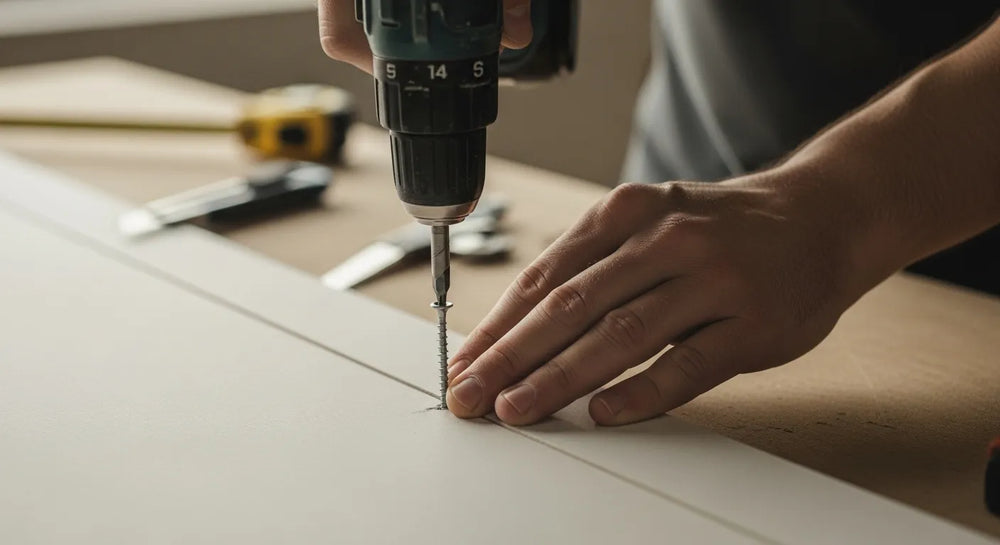
There's a fine line between "tight" and "too tight." Once the anchor is properly seated, further turning of the screw does not increase its strength. Instead, it begins to strip the material the anchor is gripping—the drywall itself. With a power drill, it's incredibly easy to over-torque a screw, creating a pulverized pocket of gypsum around the anchor, which then has nothing to hold onto.
3. Not Hitting a Stud (or Hitting One by Accident)
The golden rule of mounting anything heavy is to anchor directly into a wall stud whenever possible. A stud is a solid piece of wood or metal that provides immense structural support. Use a stud finder to locate them.
Conversely, sometimes you drill a pilot hole and hit the edge of a stud. Trying to force a drywall anchor into wood is ineffective and can damage both the anchor and the wall. If you hit a stud, your plan should change: either move your mounting point to the center of the stud and use a wood screw, or move it far enough away from the stud to properly deploy a drywall anchor.
4. Bottoming Out the Screw
This happens when the screw you use is too long. It passes through the anchor and hits the back of the drywall or a vapor barrier. As you continue to tighten it, instead of expanding the anchor, it pushes the entire anchor assembly forward, breaking it loose from the wall. Always use the screw size specified for the anchor.
The Procurement Perspective: How Sourcing Decisions Impact Success
For businesses, anchor failure isn't just a maintenance issue; it's a supply chain and procurement issue. The temptation to source generic, low-cost fasteners in bulk can lead to significant hidden costs down the line. This is where Total Cost of Ownership (TCO) comes into play. The price of a single anchor is negligible, but the cost of its failure is not.
Consider the TCO of a failed anchor:
- Labor Costs: The time required for maintenance staff to remove the failed anchor, patch the wall, repaint, and then reinstall the fixture correctly.
- Material Costs: The cost of patching compound, paint, and a new, higher-quality anchor.
- Asset Damage: The cost of replacing the item that fell—be it a monitor, a shelf of inventory, or a piece of diagnostic equipment.
- Safety & Liability: The immense potential cost associated with an injury caused by a falling object.
This is why we founded Maden.co. Our mission is to democratize access to American manufacturing, connecting industrial buyers directly with a vast network of verified U.S. manufacturers. By sourcing components through our marketplace, you are not just buying a part; you are investing in quality, consistency, and a transparent supply chain. Our entire business model is built on this principle; you can learn more about our mission to champion American manufacturing on our About Us page.
Choosing U.S.-made fasteners from our network of over 800 manufacturers provides tangible benefits:
- Material Consistency: American manufacturers adhere to strict quality control standards, ensuring the nylon isn't brittle and the metal has the proper tensile strength.
- Dimensional Accuracy: A U.S.-made anchor will have precise, consistent dimensions, which is critical for proper installation and performance.
- Reliable Load Ratings: The performance specifications are based on rigorous testing, not optimistic marketing.
We believe that American-made components should be as accessible as any global alternative. For procurement managers and business owners, this means reducing risk and improving the long-term TCO of every facility and project. If you are a U.S. manufacturer producing high-quality industrial components, we invite you to join our cause. Register as a vendor and become a part of the American manufacturing revival.
Repairing the Damage and Ensuring Future Success
When an anchor does pull out, you're left with an unsightly and structurally useless hole. Simply trying to put a new, larger anchor in the same spot is rarely successful, as the surrounding drywall is now fractured and weak.
How to Properly Repair a Pulled-Out Hole
- Clean the Area: Remove any loose paper, chunks of gypsum, and the old anchor. If needed, carefully use a utility knife to trim away torn paper for a cleaner edge.
- Fill the Void: For small holes, a high-quality spackling compound is sufficient. For larger, more significant holes, use a setting-type joint compound (hot mud) or a dedicated drywall patching kit. Apply the compound, forcing it deep into the hole to ensure there are no air pockets. Overfill it slightly, as the compound will shrink as it dries.
- Sand and Finish: Once the compound is completely cured (this can take up to 24 hours), sand it smooth and flush with the surrounding wall.
- Prime and Paint: Apply a coat of primer before painting to match the rest of the wall.
After the repair is fully cured, you can install a new anchor. It is highly advisable to use a more robust anchor type than the one that failed previously. If possible, relocate the mounting point by a few inches to utilize fresh, undamaged drywall.
Conclusion: A Systematic Approach to Secure Fastening
The persistent problem of drywall anchors pulling out is solvable, but it requires a shift from a reactive to a proactive mindset. It demands that we treat these small components with the engineering respect they deserve. The solution is not to find a bigger anchor after a failure, but to prevent the failure in the first place through a systematic approach.
This approach involves three key stages:
- Assessment: Thoroughly evaluate the weight and type of load (shear vs. tensile) and the condition of the drywall itself. Never underestimate the destructive power of a tensile load.
- Selection: Choose the correct anchor for the job. Do not default to a simple plastic expansion anchor for anything beyond the lightest of tasks. Invest in high-quality, specified anchors whose performance can be trusted.
- Execution: Follow proper installation procedures with precision. Use the correct drill bit, avoid over-torquing, and always check for studs first.
At Maden.co, we are committed to empowering businesses with the components and resources needed to execute projects correctly the first time. Our platform provides direct access to over 2.5 million American-made products, giving you the confidence that comes from using high-quality, verified parts. By building a more resilient supply chain focused on domestic manufacturing, you reduce risk, lower your total cost of ownership, and contribute to the industrial strength of our nation.
Explore our extensive catalog of fasteners and industrial components today. For larger projects or MRO stock-ups, you can improve your cash flow and streamline procurement by selecting our Instant Financing option at checkout.
Frequently Asked Questions (FAQ)
1. Can I reuse a drywall anchor after removing it? Generally, no. Most drywall anchors, especially plastic expansion and self-drilling types, are designed for a single use. Removing them damages their structure, and they will not provide the same holding power if reinstalled. Metal molly bolts can sometimes be reused if the screw is removed and the sleeve remains intact in the wall, but it's always safer and more reliable to use a new anchor.
2. What is the difference between shear weight and tensile weight? Shear weight (or shear load) is the force pulling down, parallel to the wall surface, like a clock hanging on a nail. Tensile weight (or pull-out load) is the force pulling straight out, perpendicular to the wall, like tugging on a towel rack. Drywall is significantly weaker against tensile loads. An anchor's weight rating is often for shear load, so it's critical to consider any outward-pulling forces when selecting a fastener.
3. How do I know for sure if I've hit a wall stud? The most reliable method is to use a modern electronic stud finder. You can also try the "knock test"—tapping on the wall will produce a hollow sound between studs and a more solid, dull thud when you tap over a stud. Another method is to use existing features like electrical outlets or light switches, which are typically mounted to the side of a stud, as a starting point for measuring.
4. Why is sourcing U.S.-made anchors a better strategy for a business? Sourcing U.S.-made anchors through a platform like Maden.co offers several key business advantages. It ensures adherence to stringent quality control and material standards, leading to a more reliable and consistent product. This reduces the risk of fastener failure, which can cause costly damage, downtime, and potential safety liabilities. Furthermore, it provides a more transparent and resilient supply chain, protecting your projects and operations from the volatility of international shipping and geopolitical disruptions. If you have specific sourcing needs or technical questions, our team is always ready to help; you can reach us via our Contact page.


