
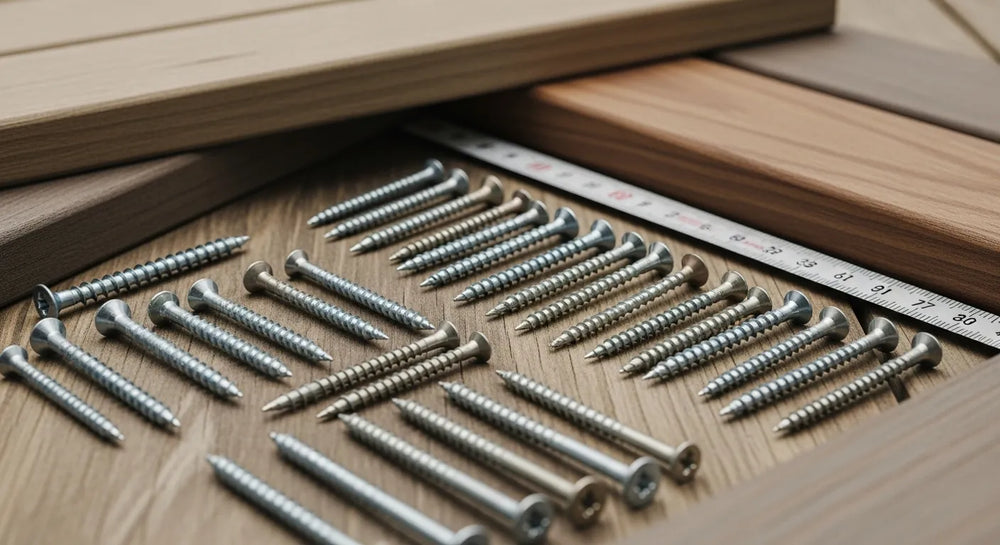
Wood Screw Sizes: A Buyer's Guide to Dimensions & Selection
Table of Contents
- Introduction
- Understanding the Fundamentals of Wood Screw Sizing
- Deciphering Wood Screw Length: Precision in Procurement
- Wood Screw Diameter (Gauge): A Critical Strength Factor
- Beyond Size: Material, Thread Type, and Head Design
- Strategic Sourcing: Why American-Made Wood Screws Matter
- Maden.co: Your Partner in Precision Procurement
- Practical Scenarios: Choosing the Right Wood Screw
- The Future of Fastener Procurement: Digital Innovation and Trust
- Conclusion
- FAQ
Introduction
Imagine a critical assembly line grinding to a halt, not due to a major component failure, but because the wrong size wood screw was ordered. Or picture a finely crafted piece of furniture failing prematurely because its fasteners lacked adequate holding power. In the intricate world of industrial manufacturing, MRO, and design, even the smallest components wield immense influence over project success, product integrity, and operational efficiency. The humble wood screw, a seemingly simple fastener, is a prime example. Its performance hinges entirely on precise selection, beginning with a thorough understanding of its dimensions.
The challenge for procurement managers, design engineers, and business owners often lies not just in finding a screw, but in finding the exact right screw – one that meets specific load requirements, material compatibility, and application demands. This often requires navigating a complex landscape of sizing standards, material properties, and head designs. In an era where supply chain resilience and product quality are paramount, making informed decisions at every procurement touchpoint is non-negotiable.
This post will demystify the intricacies of wood screw sizing, from gauge and length to thread type and head design. We'll explore the critical factors that influence selection, provide practical scenarios, and highlight the strategic advantages of sourcing high-quality, American-made fasteners. Our goal is to empower you with the knowledge to make precise procurement decisions, ensuring optimal performance and longevity in your projects. Ultimately, understanding wood screw dimensions is crucial for optimal performance, and leveraging platforms like Maden.co simplifies sourcing high-quality, American-made fasteners, driving efficiency and reliability across your operations.
Understanding the Fundamentals of Wood Screw Sizing
Before delving into the specifics of dimensions, it's essential to understand the basic anatomy of a wood screw. Each part plays a crucial role in its function and dictates how it interacts with the material it's fastening. This foundational knowledge is key to making informed selections for any application.
The Anatomy of a Wood Screw
A wood screw is designed to create its own mating thread in wood or other soft materials, providing strong holding power. Key components include:
-
Head Type: This is the visible part of the screw once installed. Common types include:
- Flat Head: Designed to be countersunk, sitting flush or slightly below the surface for a smooth finish.
- Round Head: Sits proud of the surface, offering a decorative look and a larger bearing surface under the head.
- Oval Head: A decorative head that is partially countersunk, leaving a slightly rounded profile above the surface. It combines aspects of both flat and round heads. For a robust and aesthetically pleasing option, consider an Oval Slot Drive Silicon Bronze Wood Screw.
- Pan Head: A low-profile, slightly rounded head with a flat underside, offering a large bearing surface without requiring countersinking.
- Hex Head: Features a hexagonal drive, allowing for higher torque application using a wrench or socket.
-
Drive Type: The recess in the head that accepts the screwdriver or driver bit. Common types include:
- Slotted: A single slot, prone to cam-out if not properly aligned.
- Phillips: A cross-shaped recess, reducing cam-out risk.
- Square (Robertson): A square recess, offering excellent cam-out resistance and easy single-handed driving.
- Torx (Star): A six-lobed star recess, providing superior torque transmission and virtually eliminating cam-out.
- Shank: The unthreaded portion of the screw, located directly beneath the head. In many modern wood screws, this portion is minimal or absent, with threads extending nearly to the head. When present, it allows the top piece of material to be drawn tightly against the bottom piece without being "jacked apart" by threads.
- Thread: The helical ridge that wraps around the screw's body, creating the grip within the wood. Wood screws typically have coarse threads optimized for soft materials. The thread profile determines its cutting and holding characteristics.
-
Point: The tip of the screw.
- Sharp/Gimlet Point: The most common type, designed to easily penetrate wood, often without a pilot hole in softer woods.
- Type 17 (Self-Drilling/Cut Point): Features a flute at the tip that acts like a drill bit, clearing wood chips and reducing the need for pilot holes, especially in harder woods.
Key Dimensions: Diameter, Length, and Gauge
Understanding these three primary dimensions is fundamental to selecting the correct wood screw. Misjudging any one can lead to compromised structural integrity, unsightly finishes, or project failures.
Gauge (Nominal Diameter)
The gauge of a wood screw refers to its nominal diameter. This is a standardized numbering system, not a direct measurement in inches or millimeters, though each gauge number corresponds to a specific diameter. Wood screw gauges typically range from #0 (the smallest) up to #24 (very large, less common for standard woodworking). The most commonly encountered gauges are between #6 and #12.
-
Understanding the Numbering System: As the gauge number increases, so does the diameter of the screw. For instance, a #8 screw is thicker than a #6 screw.
- #0: Approx. 0.058 inches (1.47 mm)
- #4: Approx. 0.112 inches (2.84 mm)
- #6: Approx. 0.138 inches (3.51 mm)
- #8: Approx. 0.164 inches (4.17 mm)
- #10: Approx. 0.190 inches (4.83 mm)
- #12: Approx. 0.216 inches (5.49 mm)
- Impact on Holding Power: A larger gauge screw means more material displacement and a greater threaded surface area engaging with the wood. This directly translates to increased pull-out resistance and enhanced shear strength. When considering the strength requirements for your application, matching the gauge to the anticipated load is paramount. For example, a heavy-duty application like securing structural framing might require a #10 or #12 gauge screw, whereas light-duty applications such as attaching decorative trim might only need a #4 or #6.
Length
The length of a wood screw is crucial for ensuring adequate penetration into the base material without protruding through. How length is measured depends on the head type:
- Flat Head and Oval Head Screws: The length is measured from the top of the head to the tip of the screw. This is because these heads are designed to sit flush or partially flush, and the head itself contributes to the overall engaged length. When precise flush mounting is needed, a Flat Slot Drive Brass Wood Screw would be measured this way.
- Round Head, Pan Head, and Hex Head Screws: The length is measured from the underside of the head (where it meets the material surface) to the tip of the screw. Since these heads sit proud, only the portion that penetrates the material is considered for structural length. For applications where a distinct, proud head is desired, such as with a Round Slot Drive Brass Wood Screw, this measurement convention applies.
Pitch (Threads Per Inch)
While less commonly specified for wood screws than for machine screws, thread pitch refers to the number of threads per unit of length (typically inches). Wood screws inherently have coarse threads designed to grip wood fibers effectively. A coarser thread generally provides better holding power in softer woods and allows for faster driving. Fine threads, while offering a more precise adjustment, are typically reserved for metal-to-metal applications or very dense hardwoods where splitting is a concern. For most standard wood applications, a coarse thread is assumed.
Deciphering Wood Screw Length: Precision in Procurement
The length of a wood screw is one of the most critical dimensions to consider, directly impacting the strength and stability of your joinery. Selecting the wrong length can lead to insufficient holding power, material damage, or an unprofessional finish.
Measuring Length Correctly
As discussed, the measurement method varies by head type, a detail often overlooked but vital for accurate procurement.
- Flat Head & Oval Head Screws: For these types, the measurement includes the head because they are designed to be countersunk, and the head's taper plays a role in the screw's overall engagement and how it pulls the material together. A 1-inch flat head screw will measure 1 inch from the very top of its head to its tip. When your project demands a flush finish, selecting the correct length for a Flat Slot Drive Brass Wood Screw means considering this top-of-head measurement.
- Round Head & Pan Head Screws: With these screws, the head remains above the material surface. Therefore, their length is measured from the underside of the head to the tip. A 1-inch round head screw will have 1 inch of shank and thread that penetrates the material. This distinction is crucial for applications where the head's visual presence is intentional, such as with a Round Slot Drive Brass Wood Screw, and you need to calculate penetration accurately.
Practical Implications of Length Selection
The chosen length dictates several key performance aspects:
- Adequate Engagement: The most fundamental rule for wood screws is to ensure sufficient thread engagement in the base material. A common guideline suggests that at least two-thirds, and ideally three-quarters, of the screw's threaded length should penetrate the receiving material. For instance, if fastening a 3/4-inch board to a 2-inch stud, a 1-1/2 inch screw might be appropriate, leaving 3/4 inch of thread in the stud. Insufficient penetration leads to weak joints prone to pull-out.
- Avoiding Over-Penetration: Conversely, a screw that is too long risks protruding through the back of the material, creating an unsightly and potentially hazardous finish. This is especially critical in visible applications or when working with thinner materials. Careful measurement of material thickness is paramount.
- Material Thickness: The screw's length must be chosen in direct relation to the thickness of the materials being joined. The sum of the thickness of the piece being fastened and the desired penetration into the base material will determine the overall length required. For example, when mounting a 1/2-inch panel onto a 1-inch frame, a 1-1/4 inch screw might provide adequate penetration without breaking through.
- Load Bearing: Longer screws generally provide greater resistance to pull-out forces because more threads are engaged with the wood fibers. In applications subject to significant stress, such as framing or structural components, opting for a slightly longer screw (within the bounds of avoiding over-penetration) can enhance the joint's strength.
For a procurement manager under pressure to source a specific DIN 931 compliant hex cap screw, a design engineer needing specific material certifications for a new prototype, or an MRO buyer facing an unexpected equipment breakdown, the ability to quickly find and finance a verified, U.S.-made part is a game-changer. This same precision applies to wood screws; getting the length right saves time, reduces material waste, and ensures project integrity.
Wood Screw Diameter (Gauge): A Critical Strength Factor
While length determines penetration, the diameter, or gauge, of a wood screw is directly correlated to its intrinsic strength, resistance to shear forces, and ultimate holding power within the wood. Understanding the gauge system is crucial for selecting a fastener that can withstand the demands of its application.
Understanding the Gauge System
As previously outlined, wood screw gauges are denoted by numbers ranging from #0 to #24. This system provides a convenient way to classify diameters without needing to remember precise decimal inch or millimeter measurements for each size.
-
Standard Numbering:
- Common gauges like #6, #8, #10, and #12 are widely used across various woodworking and construction projects.
- Smaller gauges (#0, #2, #4) are typically for very light-duty applications or delicate joinery where minimal material disruption is desired.
- Larger gauges (#14, #16, #20, #24) are reserved for heavy-duty construction, structural applications, or when fastening thick materials that demand maximum holding power.
-
Correspondence to Actual Diameter: Each gauge number corresponds to a precise major diameter (the outside diameter of the threads). For instance:
- A #6 screw has a major diameter of approximately 0.138 inches (3.51 mm).
- An #8 screw has a major diameter of approximately 0.164 inches (4.17 mm).
- A #10 screw has a major diameter of approximately 0.190 inches (4.83 mm). The difference in diameter between successive gauges might seem small, but these increments translate to significant differences in material displacement and, consequently, holding power.
Impact on Holding Power and Shear Strength
The gauge of a wood screw directly influences two primary mechanical properties:
- Pull-out Resistance (Holding Power): This refers to the force required to pull a screw straight out of the material. A thicker screw (larger gauge) has a greater surface area of thread engaging with the wood fibers. This larger contact area creates more friction and distributes the load over a wider section of wood, significantly increasing the screw's resistance to being pulled out. For applications under tension, such as attaching shelving brackets or securing components that will experience outward pulling forces, a larger gauge screw is always preferable.
- Shear Strength: This is the screw's ability to resist forces acting perpendicular to its shank, tending to cut or "shear" the screw in half. A thicker screw inherently possesses greater shear strength due to its larger cross-sectional area. In applications where lateral forces are prevalent, such as framing, deck construction, or securing structural elements that might shift or bear weight from the side, a robust gauge is critical. The screw itself must be strong enough not to break under these side loads.
-
Considerations for Wood Type: The type of wood also plays a significant role in how gauge selection impacts performance.
- Softwoods (e.g., pine, spruce): While larger gauges provide more holding power, overly thick screws can split softwoods if pilot holes are not appropriately sized or if the wood is dry and brittle.
- Hardwoods (e.g., oak, maple, cherry): Hardwoods offer greater natural holding power. Thicker screws can be used more aggressively, but larger pilot holes are often necessary to prevent splitting and reduce driving torque.
-
Matching Gauge to Application Stress: The ultimate decision on gauge should always be driven by the anticipated stress on the joint.
- For delicate work or when fastening very thin materials, a smaller gauge (#4 or #6) might be sufficient.
- For general woodworking, cabinetry, or furniture assembly, #8 and #10 are common workhorses.
- For heavy construction, structural applications, or when attaching components that will bear significant weight, #12 or even larger gauges are often specified.
Procurement teams must recognize that selecting the optimal gauge is a critical aspect of Total Cost of Ownership (TCO). A slightly more expensive, but appropriately gauged, U.S.-made screw can prevent costly failures, rework, and potential safety hazards down the line. Leveraging platforms like Maden.co allows buyers to precisely filter for the gauges they need, ensuring they procure components that meet exacting standards for strength and reliability. For a general-purpose yet high-quality option, consider a Round Slot Drive Brass Wood Screw in the appropriate gauge.
Beyond Size: Material, Thread Type, and Head Design
While diameter and length are foundational, a wood screw's utility extends significantly to its material composition, the specifics of its thread, and the design of its head. These elements determine its durability, corrosion resistance, aesthetic contribution, and ease of installation in various environments and applications.
Material Selection: Durability and Environment
The material of a wood screw is paramount, especially when considering the environment it will operate in and the longevity expected of the fastening.
-
Steel (Plain, Zinc-Plated, Galvanized):
- Plain Steel: Strong and economical, but highly susceptible to rust and corrosion. Best for indoor, dry applications where appearance isn't critical.
- Zinc-Plated Steel: A thin coating of zinc provides moderate corrosion resistance, making these suitable for general indoor use or slightly humid environments. The plating also offers a brighter, cleaner appearance.
- Galvanized Steel: A thicker zinc coating (hot-dip galvanized) offers significantly better corrosion resistance, making these ideal for outdoor use where exposure to moisture is common, such as deck building.
-
Brass:
- Offers excellent corrosion resistance, especially in humid or marine environments, although not as strong as steel.
- Highly valued for its aesthetic appeal, often chosen for decorative purposes in fine woodworking, furniture, or antique restoration. Brass screws can add a touch of elegance and warmth to a project. For a classic and corrosion-resistant option, our marketplace features options like the Flat Slot Drive Brass Wood Screw and the Round Slot Drive Brass Wood Screw.
-
Stainless Steel (e.g., 304, 316):
- Provides superior corrosion resistance, making it the preferred choice for outdoor applications, marine environments, and anywhere moisture, chemicals, or saltwater are present.
- While generally strong, certain grades might be slightly less robust than hardened steel, but their resistance to rust is unmatched.
- Available in various grades, with 316 stainless offering even greater resistance to chlorides.
-
Bronze (e.g., Silicon Bronze):
- Similar to brass in appearance but often offers enhanced strength and corrosion resistance, particularly in marine or harsh outdoor conditions. Silicon bronze is especially tough and resistant to saltwater, making it a premium choice for boat building, exterior architectural details, and high-end outdoor furniture.
- Its rich, warm patina develops beautifully over time. An Oval Slot Drive Silicon Bronze Wood Screw exemplifies a choice for both durability and sophisticated aesthetics in demanding environments.
Thread Types for Wood
While wood screws are generally characterized by coarse threads, there are nuances that can impact performance.
- Coarse Threads: This is the standard for wood screws. The wide spacing and deep profile are optimized to grip the wood fibers, providing excellent holding power. They also drive faster and generate less heat than fine threads, reducing the risk of stripping.
-
Specialty Threads:
- Hi-Low Threads: Feature alternating high and low threads, designed to provide superior holding power and faster installation in softwoods and particleboard, reducing splitting.
- Twinfast Threads: Two threads running parallel, allowing for even faster driving and increased pull-out resistance.
- Deep Threads: Some screws have particularly deep threads to maximize grip in softer, less dense woods or composite materials.
Head Designs and Their Applications
The head design isn't just about aesthetics; it dictates how the screw sits in the material, the type of drive required, and the bearing surface it provides.
-
Flat Head:
- Application: Ideal for applications where the screw head must be completely flush with or slightly below the surface of the material, such as in cabinet construction, furniture assembly, or trim work. Requires countersinking.
- Benefit: Provides a clean, smooth finish that can be easily filled or painted over.
-
Round Head:
- Application: Used when a decorative, proud finish is desired, or when the screw needs a larger bearing surface to hold a washer or strap. Common in exposed fastenings.
- Benefit: Adds a distinctive look, provides strong clamping force, and is less prone to cam-out during driving compared to flat heads. A classic example is the Round Slot Drive Brass Wood Screw.
-
Oval Head:
- Application: A hybrid between flat and round heads. It is partially countersunk, leaving a slightly rounded, decorative dome above the surface. Often used in furniture where a subtle, elegant finish is required.
- Benefit: Offers an attractive, finished look that is softer than a fully round head but more pronounced than a flat head. The Oval Slot Drive Silicon Bronze Wood Screw highlights this design's appeal.
-
Pan Head:
- Application: Features a low-profile, slightly rounded top with a flat underside. Provides a large bearing surface without requiring countersinking, similar to a round head but with a less pronounced dome.
- Benefit: Good for general-purpose fastening where a flush finish isn't required but a smaller head profile than a round head is preferred.
-
Hex Head:
- Application: Designed for heavy-duty applications where high torque is needed for driving. Driven with a wrench or socket, minimizing cam-out. Common in construction, outdoor structures, and where structural integrity is paramount.
- Benefit: Allows for maximum tightening force, providing a very secure connection.
Understanding these details empowers buyers to move beyond generic choices to select fasteners that truly optimize performance and aesthetic outcomes for their specific projects.
Strategic Sourcing: Why American-Made Wood Screws Matter
In an increasingly complex global supply chain, the origin of your industrial components is more critical than ever. For procurement managers, MRO buyers, and design engineers, sourcing American-made wood screws is not just a matter of patriotism; it’s a strategic business decision that directly impacts quality, reliability, and ultimately, your bottom line.
Quality Control and Consistency
At the heart of American manufacturing is a commitment to rigorous quality control and adherence to established industry standards. When you source wood screws made in the U.S., you're investing in:
- Adherence to Standards: U.S. manufacturers operate under stringent quality management systems (like ISO certifications) and adhere to domestic and international standards (e.g., for related products, this might include DIN, ANSI, ASME, NPT). This translates to fasteners with consistent dimensions, material properties, and performance characteristics.
- Reduced Defects: Strict manufacturing processes, from raw material sourcing to final finishing, significantly reduce the likelihood of defects such as inconsistent threading, brittle materials, or improper head formation. This consistency minimizes product failure, rework, and costly project delays.
- Reliable Performance: Knowing that your fasteners meet precise specifications means they will perform as expected, providing optimal holding power, shear strength, and corrosion resistance. This reliability is critical in preventing structural failures and ensuring the longevity of your assembled products.
Supply Chain Resilience and Reliability
The past few years have underscored the vulnerabilities of extended global supply chains. Sourcing domestically mitigates many of these risks:
- Mitigating Disruptions: Relying on U.S. manufacturers reduces exposure to geopolitical events, international shipping delays, customs issues, and labor shortages in distant countries. This enhances the predictability and stability of your supply chain.
- Faster Lead Times: Shorter geographical distances typically mean faster order fulfillment and reduced transit times. This agility allows for more responsive inventory management, reduces the need for large safety stocks, and ensures parts are available when you need them, minimizing downtime.
- Reduced Shipping Costs and Carbon Footprint: Domestic shipping is often more cost-effective and has a smaller environmental impact compared to international freight, aligning with corporate sustainability goals.
- Supporting Domestic Industries: By choosing American-made, businesses contribute directly to the strength of the U.S. manufacturing sector, supporting local jobs, innovation, and economic growth. Our mission at Maden.co is to democratize access to American manufacturing, connecting industrial buyers with over 2.5 million American-made products from our network of 800+ verified U.S. manufacturers. Our vision is to become the definitive platform that proves American-made components are as accessible and convenient as any global alternative, driving the manufacturing revival.
Transparency and Traceability
For many industries, particularly those with strict regulatory requirements, traceability of components is non-negotiable.
- Known Origin: Sourcing from U.S. manufacturers provides clear lineage of your products, from raw material to finished fastener. This transparency is crucial for compliance with various industry standards and regulations.
- Ethical Sourcing: U.S. manufacturing generally adheres to higher labor and environmental standards, ensuring your supply chain aligns with corporate social responsibility initiatives.
- Simplified Audits: With clear documentation and direct communication channels, material and quality audits become significantly simpler and more reliable. This focus on Supply Chain Transparency is a core value at Maden.co.
Procuring U.S.-made wood screws through a dedicated marketplace like Maden.co isn't just about buying a fastener; it's about making a strategic investment in quality, resilience, and the future of your operations. Our entire business model is built on this principle; you can learn more about our mission to champion American manufacturing here.
Maden.co: Your Partner in Precision Procurement
In the complex landscape of industrial procurement, finding the right component – especially one that meets specific dimensions, materials, and quality standards – can be a significant challenge. At Maden.co, we are dedicated to transforming this experience, offering a streamlined, reliable, and powerful solution for sourcing American-made industrial products.
Democratizing Access to U.S.-Made Fasteners
Our core mission is to democratize access to American manufacturing. We believe that securing high-quality, U.S.-made components should be straightforward and efficient, not an arduous task. We achieve this by connecting industrial buyers – from procurement managers to MRO specialists and design engineers – with an unparalleled selection of over 2.5 million American-made products. These products come from our extensive network of over 800 verified U.S. manufacturers, each committed to Industrial Excellence and adhering to stringent American standards. Our vision is clear: to become the definitive platform that proves American-made components are as accessible and convenient as any global alternative, driving the manufacturing revival with our tagline: "America's manufacturing revival is here."
Streamlined Search and Selection
The Maden.co platform is engineered for efficiency and precision. We understand that time is a critical resource in procurement, and every minute spent searching for a part is a minute lost.
- Robust Search Filters: Our intuitive interface allows you to quickly narrow down your search using detailed filters for specific dimensions (like wood screw gauge and length), material composition (brass, silicon bronze, stainless steel), head type (flat, round, oval), drive type, and more. This eliminates the guesswork and tedious manual catalog browsing.
- Detailed Product Specifications: Every product listing on Maden.co provides comprehensive specifications, often including technical drawings, material certifications, and compliance information. This level of detail empowers design engineers to confirm exact fit and function, and procurement managers to ensure adherence to project requirements. For example, whether you need a specific length for a Flat Slot Drive Brass Wood Screw or the robust dimensions of a Round Slot Drive Brass Wood Screw, you'll find the information you need.
- Real-World Problem Solving: For a procurement manager under pressure to source a specific DIN 931 compliant hex cap screw, a design engineer needing specific material certifications for a new prototype, or an MRO buyer facing an unexpected equipment breakdown, the ability to quickly find and finance a verified, U.S.-made part is a game-changer. Our platform is designed to alleviate these common procurement friction points, empowering our customers.
Instant Financing: Empowering Your Procurement Strategy
A key differentiator that sets Maden.co apart is our "Instant Financing" option, seamlessly integrated into the checkout process. We view this not merely as a payment method, but as a strategic tool for businesses.
- Effective Cash Flow Management: Instant Financing allows procurement managers and business owners to manage cash flow more effectively, especially when making larger-volume purchases or investing in capital-intensive projects. It provides the flexibility to acquire critical components without immediately impacting working capital.
- Strategic Purchasing Power: This feature empowers businesses to seize opportunities, such as purchasing in bulk to achieve better pricing or ensuring uninterrupted project timelines, without being constrained by immediate budget limitations. It's about enabling strategic growth and operational continuity.
- Seamless Integration: You can apply for Instant Financing directly at checkout, making the process smooth and integrated into your purchasing workflow. It reflects our commitment to Digital Innovation and Customer Empowerment, making high-quality American-made products more accessible than ever.
For Manufacturers: Join the Revival
Maden.co is also a powerful platform for U.S. manufacturers. If you are a qualified U.S. manufacturer, our marketplace offers an unparalleled opportunity to expand your market reach, connect with a vast network of industrial buyers, and contribute to the resurgence of American manufacturing. By joining our platform, you gain exposure to businesses actively seeking high-quality, domestically produced components. We invite you to register as a vendor and join the American manufacturing revival. Together, we can build stronger, more resilient supply chains.
Practical Scenarios: Choosing the Right Wood Screw
Applying the theoretical knowledge of wood screw sizing and selection to real-world scenarios is where true procurement expertise shines. Let's explore a few common situations.
Scenario 1: Securing Hardwood Cabinetry
Requirement: A cabinet maker needs to assemble high-end hardwood cabinetry (e.g., maple or cherry). The screws must provide strong pull-out resistance, have an aesthetically pleasing head that can be partially concealed or become a subtle design feature, and offer good corrosion resistance for kitchen or bathroom environments where humidity might fluctuate.
Solution:
- Gauge: For robust holding power in hardwoods, a #8 or #10 gauge would be appropriate. Hardwoods are dense, so they offer excellent grip, but a larger gauge still adds a significant margin of safety against pull-out.
- Length: The length would depend on the thickness of the cabinet panels and frames. If joining 3/4-inch stock, a 1-1/2 inch or 1-3/4 inch screw would provide ample penetration into the receiving member (e.g., 3/4 inch into the first piece, and 3/4 to 1 inch into the second).
- Material: Given the potential for humidity and the desire for aesthetic appeal, solid brass or silicon bronze is an excellent choice. These materials offer good corrosion resistance and develop an attractive patina over time.
- Head Type: An oval head is often preferred in fine cabinetry. It allows for partial countersinking, providing a refined, slightly proud finish that complements the wood. For this application, an Oval Slot Drive Silicon Bronze Wood Screw would be a superior choice, offering both strength and a sophisticated look, especially against darker woods.
Scenario 2: General Purpose Woodworking for Softwoods
Requirement: A small furniture workshop needs a reliable, cost-effective screw for assembling various softwood projects, such as pine shelving units or simple cedar garden benches. The screws need good holding power but must also be easy to drive without excessive splitting.
Solution:
- Gauge: A #6 or #8 gauge is a versatile choice for most softwoods. A #6 is good for lighter trim or small boxes, while a #8 offers a bit more strength for structural joints without being overly aggressive.
- Length: Depending on the material thickness, lengths from 1 inch to 1-1/2 inches are common. For instance, joining two 3/4-inch pine boards, a 1-1/4 inch screw would be effective, with 1/2 inch in the first board and 3/4 inch in the second.
- Material: Zinc-plated steel is a cost-effective and suitable material for indoor softwood projects. For outdoor use (like the garden bench), a hot-dip galvanized steel screw or stainless steel would be preferred for superior weather resistance. If a slightly more refined finish is desired for indoor projects, a Flat Slot Drive Brass Wood Screw could be used where the limited strength of brass is acceptable.
- Head Type: A flat head is often ideal for general-purpose applications as it can be countersunk for a smooth, paintable, or stainable finish.
Scenario 3: Heavy-Duty Outdoor Decking or Structural Framing
Requirement: A construction firm needs robust, weather-resistant fasteners for building a large outdoor deck structure, including securing deck boards, railings, and structural joists. The screws must withstand significant shear and pull-out forces, resist severe weather conditions, and be easy to drive with power tools.
Solution:
- Gauge: For structural applications and heavy load-bearing, a larger gauge such as #9, #10, or even #12 is essential. These provide the necessary shear strength and pull-out resistance for safety and longevity.
- Length: Lengths will vary significantly based on the components being joined. Deck boards to joists might require 2-1/2 to 3-inch screws, while securing larger structural members could demand 4-inch or longer fasteners.
- Material: Stainless steel (e.g., 305 or 316 for enhanced corrosion resistance) or premium coated (e.g., polymer-coated or ceramic-coated) exterior-grade screws are mandatory. These materials are engineered to resist rust, rot, and degradation from constant exposure to elements.
- Head Type: Often, a bugle head (a variant of a flat head designed to sit flush) or a pan head with a star drive (Torx) is preferred. The star drive allows for maximum torque transmission from power tools, preventing cam-out and ensuring fast, secure installation. While the specific example provided, a Round Slot Drive Brass Wood Screw, would not be suitable for structural decking, it illustrates the critical role of material and head type in matching the screw to the application's demands. For decking, you would typically look for specialized screws designed for that environment.
These scenarios illustrate that the "best" wood screw is always context-dependent. Precision in selection, informed by a deep understanding of sizing, material, and application, is the hallmark of Industrial Excellence in procurement.
The Future of Fastener Procurement: Digital Innovation and Trust
The landscape of industrial procurement is undergoing a profound transformation. In an era demanding greater efficiency, transparency, and reliability, the way businesses acquire their essential components, including wood screws and other fasteners, is evolving rapidly. At Maden.co, we are at the forefront of this evolution, championing a future built on digital innovation and unwavering trust in American manufacturing.
Digital Innovation in Procurement
Our platform embodies Digital Innovation by providing a modern, intuitive, and powerful online marketplace. Gone are the days of endless paper catalogs, fragmented supplier lists, and uncertain lead times. Maden.co offers:
- Centralized Access: A single point of access to millions of U.S.-made products, simplifying the search and discovery process.
- Advanced Search Capabilities: Sophisticated filtering tools allow procurement teams to quickly pinpoint fasteners by specific dimensions, materials, and certifications, streamlining decision-making.
- Seamless Transactions: From comprehensive product data to integrated financing options, our platform is designed for end-to-end efficiency, reducing procurement friction and administrative burdens.
Supply Chain Transparency as a Core Principle
The demand for transparency in the supply chain has never been higher. Businesses increasingly need to know the origin, manufacturing processes, and quality assurances behind every component they use.
- Verified Manufacturers: Every U.S. manufacturer on Maden.co is thoroughly vetted, ensuring adherence to quality standards and providing clear traceability for their products. This commitment to transparency builds trust and provides peace of mind.
- Ethical and Sustainable Sourcing: Knowing that your fasteners are made in the USA often implies higher labor standards and environmental responsibility, aligning with your company's values and compliance requirements.
Industrial Excellence Through Quality and Reliability
Our platform is a testament to Industrial Excellence. We believe that American-made products represent a benchmark for quality, precision, and durability.
- Uncompromising Standards: By exclusively featuring U.S. manufacturers, we ensure that the components you source meet exacting standards, contributing to the superior performance and longevity of your own products.
- Resilience and Agility: Partnering with domestic suppliers through Maden.co strengthens your supply chain, making it more resilient to global disruptions and more agile in responding to market demands.
Customer Empowerment Through Knowledge and Tools
Ultimately, our mission is about Customer Empowerment. We provide procurement managers, design engineers, and MRO buyers not just with products, but with the knowledge, tools, and support they need to make the best possible decisions. This includes detailed product information, reliable sourcing, and strategic financial options like Instant Financing. If you have specific sourcing questions, our team is ready to help; you can contact us here for expert guidance.
The future of fastener procurement is one where informed choices lead to superior outcomes, where digital efficiency meets trusted quality, and where American manufacturing pride translates into tangible business advantages. Maden.co is building that future, one connection at a time.
Conclusion
Understanding the nuances of wood screw sizing – from gauge and length to material and head type – is far more than a technicality; it's a fundamental aspect of successful industrial procurement and product design. The right screw ensures structural integrity, enhances longevity, prevents costly rework, and maintains the reputation of your finished products. In an era where precision, reliability, and supply chain resilience are paramount, making informed fastener selections is an indispensable skill for any professional involved in manufacturing, maintenance, or engineering.
By prioritizing factors like adequate thread engagement, appropriate diameter for load bearing, and material compatibility for environmental conditions, you not only ensure optimal performance but also reduce your Total Cost of Ownership. Moreover, choosing American-made fasteners provides an inherent advantage in terms of consistent quality, reliable supply chains, and transparent manufacturing practices.
At Maden.co, we stand as America's premier B2B marketplace, dedicated to connecting you with the vast and varied world of U.S.-manufactured components. We offer a comprehensive catalog of over 2.5 million products from 800+ verified American manufacturers, simplifying the procurement process for everything from specific wood screw dimensions to complex industrial parts. Our commitment to Digital Innovation, Supply Chain Transparency, and Customer Empowerment means you can source with confidence, knowing you're building a more reliable and efficient procurement process.
We invite you to explore our extensive catalog and discover the unmatched quality and convenience of American manufacturing. Find the exact wood screws your project demands, whether it’s a specific Round Slot Drive Brass Wood Screw, a precise Flat Slot Drive Brass Wood Screw, or a durable Oval Slot Drive Silicon Bronze Wood Screw, among millions of other products. Leverage our Instant Financing option at checkout to streamline your capital-intensive projects and manage cash flow effectively. America's manufacturing revival is here, and Maden.co is your strategic partner in driving it forward.
FAQ
Q1: How do I determine the correct length for a wood screw?
A1: The correct length depends on the thickness of the materials being joined and the desired penetration into the base material. For flat and oval head screws, measure from the top of the head to the tip. For round, pan, and hex head screws, measure from the underside of the head to the tip. A good rule of thumb is to ensure at least two-thirds, and ideally three-quarters, of the screw's threaded length penetrates the receiving material, without protruding through.
Q2: What does "gauge" mean for wood screws, and why is it important?
A2: Gauge refers to the nominal diameter of the screw, represented by a number (e.g., #6, #8, #10). A higher gauge number indicates a thicker screw. Gauge is crucial because it directly impacts the screw's holding power (resistance to pull-out) and shear strength (resistance to breaking from side forces). Larger gauge screws provide greater strength and are suitable for heavier-duty applications, while smaller gauges are for lighter, more delicate work.
Q3: What material should I choose for wood screws in outdoor applications?
A3: For outdoor applications, you need materials with excellent corrosion resistance. Stainless steel (e.g., 304 or 316 grade) is a top choice due to its superior rust prevention. Silicon bronze is another premium option, especially for marine environments, offering robust durability and resistance to saltwater. Hot-dip galvanized steel screws are also suitable and cost-effective for general outdoor use, providing a thick protective zinc coating.
Q4: How does Maden.co help with sourcing specific wood screw sizes and types?
A4: Maden.co provides a powerful online marketplace with extensive search filters, allowing you to quickly locate specific wood screw sizes (gauge, length), material types (brass, silicon bronze, steel), head designs (flat, round, oval), and drive types. Each product listing includes detailed specifications to ensure you find the exact component you need. Our platform democratizes access to millions of American-made products, simplifying the procurement process and ensuring quality and reliability. Additionally, our Instant Financing option at checkout helps manage large-volume purchases effectively.


