

Real-Time DSP Control Processor with Analog-Digital I/O
Real-Time DSP Control Processor with Analog-Digital I/O
SKU:INT-838aac
Empower real-time control with our DSP Control Processor featuring 16/32MB memory, analog outputs, preprogrammed algorithms, and JTAG/Serial Ports.
Regular price
$599.99
Regular price
Sale price
$599.99
Unit price
per
Initiate Order

Real-Time DSP Control Processor with Analog-Digital I/O
$599.99
Quantity: 1
Claim Your Seller Account
Real-Time DSP Control Processor with Analog-Digital I/O
$599.99
Quantity: 1
Delivery via Maden
Expect your order to arrive on time.
Secure Payments
All orders are processed through a secure, PCI-compliant checkout.
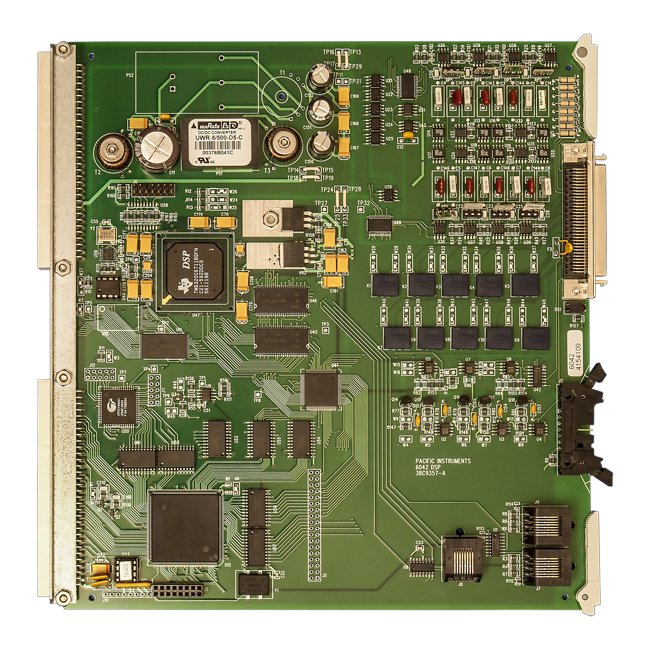
Enhance data acquisition and control operations with the Real-Time DSP Control Processor. Powered by a Texas Instruments TMS320C6711 floating point digital signal processor, it offers 16/32MB memory, ±10V analog outputs, preprogrammed algorithms, and JTAG/IEEE 1145.1 ports for debugging. Ideal for PID control loops, frequency analysis, waveform generation, and facility-dependent operations.
Ready to Grow Without Cash Flow Constraints?


Product Specifications
Control Application 0
In the application shown below it is desired to produce a predetermined load distribution on a test article using individual actuators attached to eight different locations. Load cells between the actuator and load point on the test article measure the force output of each actuator. Strain gauges measure the resulting strain on the test article and are continuously monitored to prevent catastrophic failure.In order to impart the proper load distribution a control algorithm will drive the actuators using the DACs on the 6042 DSP module or daughter board with voltage-to-current drivers. A PID algorithm loaded into the 6042's DSP processor generates the DAC outputs according to the desired loading profile. Load cells provide the feedback to the PID algorithm that determines the level of force applied by the actuators. The PID algorithm ensures that the desired load distribution is achieved over time and checks load and strain from transducers attached to the test article to assure they are within limits programmed by the operator. Should any measurement violate programmed limits automatic shutdown procedures may be initiated.
Control Execution 0
The 6000 system simultaneously acquires, records and displays data from the measurement transducers while the 6042 is executing the PID algorithm in the DSP processor providing real-time control of the actuators loading the test article. All of the measurement data being acquired in the enclosure in which the 6042 resides is available to it within two sample periods. Data from any channel, analog or digital, along with inputs and outputs of the Control Processor itself is available for use in the control or data processing algorithms.The 6042 Control Processor has 64 outputs that can be recorded and displayed like any other channel in the 6000 data acquisition system. Each output has settable alarm limits that are continuously monitored. The DAC and digital outputs of the 6042 and its daughter card, if installed, are mapped to output registers. The remaining output registers are available for derived parameters or other user applications.
Dsp Programming 0
The 6042 Control Processor is supplied with generic DSP control and data processing algorithms that can get the user application started and serve as prototypes for advanced algorithm development. The supplied algorithms are known to PI660 the operating software for the 6000 system. This enables the user to easily program the input and output parameters for each algorithm, which means that the 6042 can run control applications immediately upon installation in the 6000 system.The user can develop application specific control algorithms for the 6042 using the Texas Instrument Code Composer Studio Software Development Kit (SDK). Once the algorithm exists it can be made into executable code using the SDK, debugged on a Windows based PC using an emulator, and downloaded into the 6042 for execution. If the user wishes to debug the algorithm directly on the 6042, a debugging pod may be attached to the JTAG port and stepped through the program execution while the 6000 is operating. User developed algorithms can be saved in the Flash RAM where they are available for future use.The primary hardware layer for programming the 6042 is the 6000's GPIB, USB or Ethernet interface. Alternatively a McBSP port is available that provides a high speed serial interface for downloading programs (algorithms) and large data sets to the Control Processor's data and program memory.
Overview Measurement Type
Digital In | Digital Out | DSP