
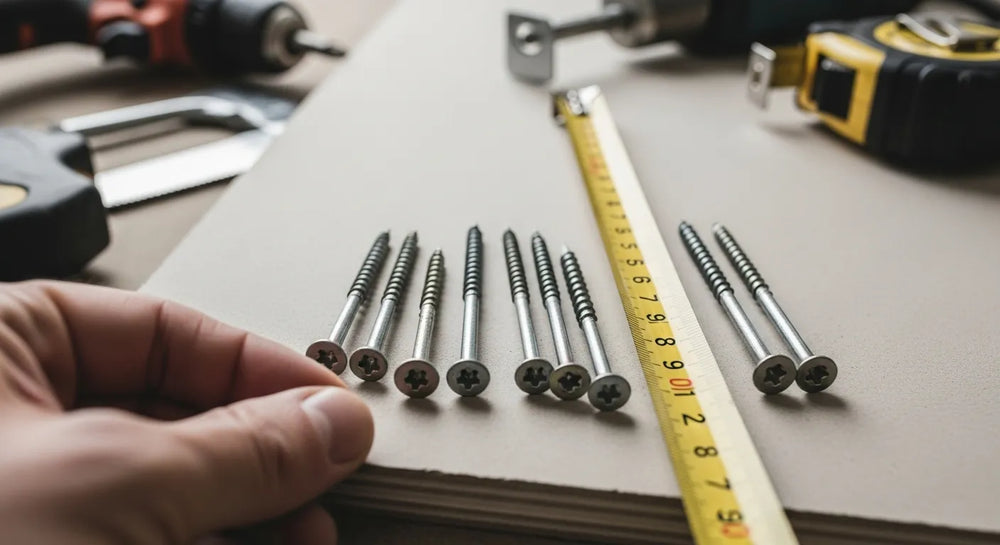
Drywall Screws: Understanding the Key Differences
Table of Contents
- Introduction
- The Fundamental Anatomy of a Drywall Screw
- Coarse Thread vs. Fine Thread Drywall Screws: The Primary Distinction
- Beyond Coarse and Fine: Specialized Drywall Screw Types
- Head Styles and Their Impact on Finish and Performance
- Lengths and Gauges: Matching the Screw to the Job
- Coatings and Materials: Durability and Environment
- Why American-Made Drywall Screws Matter: Quality, Compliance, and Supply Chain Resilience
- Strategic Procurement with Maden.co: Beyond the Screw
- The Advantage of Instant Financing
- Conclusion
- FAQ
A seemingly minor choice, like selecting the wrong fastener, can send a critical construction or MRO project spiraling into delays and budget overruns. Imagine a procurement manager tasked with ensuring a new facility build stays on schedule, only to find that hundreds of thousands of fasteners are causing board blowouts or failing to grip correctly in metal studs. This isn't just an inconvenience; it's a significant financial and operational setback. The truth is, not all drywall screws are created equal, and understanding their nuanced differences is paramount for ensuring structural integrity, project efficiency, and ultimately, cost-effectiveness.
In this comprehensive guide, we will demystify the world of drywall screws, dissecting their various types, features, and optimal applications. From the fundamental anatomy of these essential fasteners to the critical distinctions between coarse and fine threads, specialized designs, head styles, and protective coatings, we'll explore every facet. Our purpose is to equip procurement professionals, MRO buyers, and design engineers with the knowledge to make informed decisions, emphasizing why the right American-made screw is not just a purchase, but a strategic investment in project success and supply chain resilience.
Introduction
In the intricate world of construction and manufacturing, where every component plays a vital role in the integrity and longevity of a project, the humble drywall screw often goes overlooked. Yet, its seemingly simple design belies a surprising complexity and an array of variations, each engineered for specific applications and environments. Misunderstanding these differences can lead to disastrous consequences: weakened structures, increased material waste, lengthy rework, and ultimately, significant financial losses. For a procurement manager under pressure to source the correct fasteners for a large-scale commercial build, or an MRO buyer needing to quickly repair a critical interior structure, knowing "how are drywall screws different" is not merely academic—it's a critical skill that directly impacts the bottom line and operational continuity.
This article delves deep into the specific characteristics that differentiate various drywall screws. We'll explore the impact of thread type, head design, length, material composition, and protective coatings on performance and application. Our aim is to provide clarity and practical insights, highlighting how selecting the appropriate U.S.-made drywall screw contributes to enhanced durability, compliance with industry standards, and overall project success. By the end of this discussion, you'll possess a robust understanding of these fasteners, enabling you to make precise, confident procurement choices that support your projects with the reliability and quality synonymous with American manufacturing.
The Fundamental Anatomy of a Drywall Screw
To truly grasp the differences between drywall screws, we must first understand their foundational components. While seemingly uniform, each part of a drywall screw is meticulously designed for a specific function, contributing to its overall performance.
Head Type
The head of a drywall screw is typically designed to sit flush or slightly below the surface of the drywall, creating a smooth finish for subsequent layers of joint compound and paint. The most common type is the bugle head, characterized by its flared, conical shape that prevents the paper facing of the drywall from tearing as the screw is driven in. Other less common head types include pan heads (for surface mounting) and wafer heads (for maximum clamping force, often with lath or thin sheeting), though these are less frequently used for direct drywall-to-stud fastening.
Shank and Thread
The shank is the unthreaded part of the screw, though many drywall screws are fully threaded. The threading itself is crucial: it determines the screw's grip and ease of installation. Drywall screws are generally "self-tapping," meaning they create their own mating threads in the material they are driven into. The pitch and depth of these threads are primary differentiators we will explore in detail.
Point Type
The tip of a drywall screw is usually a sharp, pointed design, engineered to quickly pierce through drywall and into the underlying framing material (wood or light-gauge metal studs). Some specialized screws feature a self-drilling or "Tek" point, which includes a drill bit-like tip that can bore through thicker metal studs without the need for pre-drilling.
Length and Gauge
Screws come in various lengths to accommodate different thicknesses of drywall and types of applications (e.g., single-layer, double-layer, specialty boards). Common lengths range from 1-1/4 inches to 3 inches or more. The gauge refers to the screw's diameter, with #6 and #8 being the most common for drywall applications, influencing its shear strength and holding power.
Material and Coating
Most drywall screws are made from hardened carbon steel for strength. To protect against corrosion, they typically feature a protective coating. The most prevalent is a black phosphate coating, which provides basic corrosion resistance and creates a surface that adheres well to joint compound. For more demanding environments, zinc-plated or ceramic-coated screws offer enhanced protection against moisture and chemicals.
Understanding these fundamental elements lays the groundwork for appreciating the specialized variations that make each type of drywall screw uniquely suited for particular tasks.
Coarse Thread vs. Fine Thread Drywall Screws: The Primary Distinction
The most fundamental difference when answering "how are drywall screws different" lies in their thread design. This distinction dictates which type of framing material a screw is best suited for, directly impacting holding power, ease of installation, and structural integrity.
Coarse Thread Drywall Screws
Coarse thread drywall screws are easily identified by their wider threads and deeper grooves, spaced further apart along the shank. This design is specifically engineered to provide superior grip in fibrous, softer materials, making them the fastener of choice for attaching drywall to wooden studs.
- Design Rationale: The aggressive pitch of the threads allows the screw to bite firmly into the wood fibers, creating a strong mechanical bond that resists pull-out. The wider spacing of the threads also helps to prevent stripping in wood, even when driven at higher speeds.
- Optimal Application: Their primary application is securing gypsum board to traditional wooden framing members in residential and light commercial construction. They are effective for single or multiple layers of drywall on wood studs. For heavy-duty applications requiring superior grip in wood, consider our American-made 6 x 1-1/4 Coarse Thread Drywall Screws for your next project. These are manufactured with precision to ensure reliable performance.
- Procurement Insight: For procurement managers overseeing projects predominantly utilizing wood framing, stocking high-quality, U.S.-made coarse thread screws is a strategic move that minimizes material failures and ensures compliance with building codes.
Fine Thread Drywall Screws
In contrast, fine thread drywall screws feature threads that are closer together, shallower, and less aggressive in their pitch. This design is optimized for fastening drywall to light-gauge metal studs, typically between 20 and 25 gauge.
- Design Rationale: When driven into thin metal, the finer threads create more individual points of contact with the steel, allowing the screw to cut into the metal without stripping the hole. This provides a more secure and consistent engagement in a non-fibrous, harder material. A coarser thread might ream out the metal, leading to a loose connection.
- Optimal Application: Fine thread screws are indispensable in commercial buildings, multi-story residential structures, and any project where metal stud framing is specified. They ensure that drywall panels are securely fastened to steel framing, preventing movement and maintaining the integrity of the wall assembly. For metal stud applications, our 6 x 1 Fine Thread Drywall Screw offers precise engagement and secure fastening, crucial for demanding commercial projects where precision is paramount.
- Procurement Insight: MRO buyers dealing with facility maintenance or new installations in commercial spaces must prioritize fine thread screws to ensure proper fastening to metal studs, thereby avoiding callbacks and potential structural issues. This is a critical factor in enhancing total cost of ownership by reducing long-term maintenance needs.
The choice between coarse and fine threads is not arbitrary; it's a critical decision that directly impacts the strength and stability of the entire drywall installation. Using the wrong type can lead to screws failing to hold, stripping out of the material, or causing damage to the drywall itself.
Beyond Coarse and Fine: Specialized Drywall Screw Types
While coarse and fine threads cover the majority of drywall applications, the answer to "how are drywall screws different" extends to several specialized types designed for unique challenges and materials. These variations are crucial for advanced applications, ensuring optimal performance and safety.
Self-Drilling (Tek) Drywall Screws
Self-drilling drywall screws, often referred to as "Tek" screws, are easily recognizable by their unique tip, which resembles a small drill bit. This design eliminates the need for pre-drilling pilot holes, significantly speeding up installation in specific scenarios.
- Mechanism: The drill bit tip first bores a hole through the material, and then the threads engage to secure the fastener. This single-step operation streamlines the fastening process.
- Use Case: These screws are primarily used for attaching drywall to thicker gauge metal studs (typically 12-20 gauge) that standard fine-thread screws might struggle to penetrate or that would require a separate drilling step. They are also sometimes used for light-gauge steel framing connections or even subflooring applications.
- Benefits: The main advantages are increased speed and efficiency on the job site, reducing labor costs and project timelines. For complex structural installations, the ability to rapidly secure components without additional tools is a significant asset for design engineers.
Hi-Low Thread Drywall Screws
Hi-low thread screws feature a unique thread pattern consisting of alternating high and low threads. This specialized design enhances their performance in certain materials.
- Mechanism: The high threads provide aggressive engagement and holding power, while the low threads improve thread formation and reduce driving torque. This combination allows for a more secure and less destructive fastening.
- Use Case: They are particularly effective in extremely dense materials, certain types of engineered wood products, plastics, or even some composite boards where standard threads might struggle to create a strong purchase or could cause the material to crack. The design helps prevent stripping in brittle materials and offers enhanced pull-out resistance.
- Benefits: Improved grip, reduced material cracking, and lower driving torque make them a valuable solution for niche applications where conventional screws fall short.
Drywall to Wood/Metal Framing Screws (General Purpose)
While we've detailed specific thread types, it's important to remember that many manufacturers also offer screws broadly categorized as "drywall to wood" or "drywall to metal" framing screws. These designations typically refer to the coarse and fine thread variations, respectively, but may also indicate additional features like specific coatings for certain environments.
- Versatility: These are the workhorse fasteners of drywall installation, designed for general-purpose applications within their respective framing types. For robust and versatile fastening requirements, explore our range, including this durable 8 x 4 Drywall Screw, designed for a variety of applications and built to last.
- Considerations: When sourcing these, always verify the specific thread type and material compatibility to ensure they align with your project's framing.
Procurement managers and MRO buyers must go beyond the "drywall screw" label and understand these specialized options. Having the correct specialized screw on hand can prevent costly rework, ensure material integrity, and maintain compliance, especially for projects involving non-standard materials or structural elements.
Head Styles and Their Impact on Finish and Performance
The design of a drywall screw's head is not just an aesthetic choice; it significantly impacts the finished appearance of a wall or ceiling and the overall stability of the fastening. Understanding these differences is key to achieving professional results and efficient workflows.
Bugle Head
The bugle head is by far the most common and recognizable head style for drywall screws. Its distinctive flared, conical shape is specifically engineered for drywall installation.
- Purpose and Functionality: As the screw is driven, the bugle head gradually widens the opening in the drywall paper and gypsum core. This design prevents the paper facing from tearing, which is crucial for maintaining the integrity of the board. The conical shape also allows the screw head to countersink itself smoothly into the drywall surface, ending up flush or slightly recessed below the surface. This creates a small depression that is easily filled with joint compound, ensuring a perfectly smooth and paint-ready finish.
- Importance: For professional finishes, the bugle head is indispensable. Tearing the paper facing significantly weakens the drywall's holding power and can lead to unsightly "pillows" or "dimples" that are difficult to conceal, requiring more labor and material for finishing.
- Application Scenario: Whether installing a single layer of standard gypsum board in a residential remodel or multiple layers for fire-rated assemblies in a commercial building, the bugle head ensures a clean, strong, and aesthetically pleasing fastening point.
Pan Head
Pan head screws feature a flat bottom and a slightly rounded, domed top. Unlike bugle heads, they are not designed to countersink into the material.
- Purpose and Functionality: Pan heads are primarily used when the screw needs to sit on the surface of the material, providing a broad bearing surface to clamp down a component. They are commonly used for attaching fixtures, brackets, or thin metal sheets to a surface, where the head's profile is either acceptable or will be covered.
- Application Scenario: While not typically used for fastening drywall directly to studs, pan head screws might be seen in drywall-related applications for attaching corner beads, metal lath, or other trim elements where surface mounting is required and a flush finish is not the primary goal.
Wafer Head
Wafer head screws are characterized by their very wide, flat, and shallow head profile.
- Purpose and Functionality: This design maximizes the clamping force over a larger surface area without significantly protruding. The wide head provides excellent pull-through resistance, making them ideal for securing thinner materials or materials that might otherwise tear or pull over a smaller screw head.
- Application Scenario: Wafer heads are often used for attaching lath, thin plywood, or other sheeting materials where a strong, broad clamping action is needed. In some drywall applications, they might be employed for specialized backer boards or when attaching furring strips where maximum surface contact is desired.
For any project involving drywall, the bugle head is almost always the correct choice for fastening the board itself. Procurement managers and MRO buyers should ensure that the fasteners specified and stocked have the appropriate head design, as this seemingly minor detail has a major impact on both the structural integrity and the cosmetic quality of the finished surface. Choosing the right head style is a testament to industrial excellence and attention to detail.
Lengths and Gauges: Matching the Screw to the Job
Beyond thread type and head style, the physical dimensions of a drywall screw—its length and gauge (diameter)—are critical factors in selecting the right fastener. An incorrect length or gauge can compromise the integrity of the fastening, lead to blowouts, or fail to provide adequate holding power.
Common Lengths and Their Uses
The length of a drywall screw refers to the measurement from the underside of the head to the tip of the point. The primary rule of thumb is that the screw must penetrate the framing material by at least 5/8 inch to 3/4 inch (or a minimum of 1/2 inch in some building codes, though more is always better for strength).
- 1-1/4 inches: This is the most common length for fastening a single layer of 1/2-inch or 5/8-inch thick drywall to wood or light-gauge metal studs. The length ensures sufficient penetration into the framing.
- 1-5/8 inches: Often used for fastening 5/8-inch thick drywall, especially when slightly more embedment into the stud is desired for increased holding power, or for fastening two thinner layers of drywall.
- 2 inches and 2-1/2 inches: These longer screws are typically specified for attaching multiple layers of drywall (e.g., two layers of 1/2-inch drywall for soundproofing or fire-rating) or for fastening specialty, thicker gypsum panels.
- 3 inches and above: Reserved for very thick drywall panels, multi-layer applications, or when fastening through furring strips into a deeper substrate.
Scenario: Consider a design engineer specifying a fire-rated wall assembly that requires two layers of 5/8-inch drywall. Using 1-1/4-inch screws would be a critical failure, as they would barely penetrate the second layer, let alone adequately anchor into the studs. In this case, 2-1/2-inch or 3-inch screws would be essential to ensure compliance and structural integrity.
Gauge (Diameter): #6, #7, #8
The gauge of a screw refers to its major diameter. For drywall screws, the most common gauges are #6, #7, and #8. A higher number indicates a larger diameter.
- #6 Gauge: This is the most common and versatile gauge for standard drywall applications. It offers a good balance of strength and ease of driving without excessive splitting in wood or deforming metal studs.
- #7 Gauge: Less common but offers slightly increased shear strength and holding power compared to #6, often used in specific light-duty structural or fixture applications.
- #8 Gauge: A heavier gauge, #8 screws provide significantly greater shear strength and pull-out resistance. They are typically chosen for demanding applications, such as fastening denser specialty boards, multiple layers of drywall, or in areas requiring enhanced structural integrity.
Scenario: An MRO buyer needs to select fasteners for repairing a high-traffic area in an industrial facility where the drywall is subjected to more impact. Opting for a #8 gauge screw, combined with an appropriate length and thread type, would provide the necessary robustness to withstand the environment and reduce the frequency of future repairs, contributing to better long-term TCO.
At Maden.co, we understand the critical nature of these specifications. Our vast catalog, featuring over 2.5 million American-made products from 800+ verified U.S. manufacturers, ensures that procurement professionals can precisely match the right length and gauge to their exact project requirements. This commitment to industrial excellence and product diversity helps us democratize access to American manufacturing, ensuring you always have the right tool for the job.
Coatings and Materials: Durability and Environment
The material composition and protective coating of a drywall screw are often overlooked, yet they are crucial for determining its suitability for various environments and its long-term durability. The answer to "how are drywall screws different" also lies in their resistance to corrosion and their interaction with finishing materials.
Black Phosphate Coating
The most common finish for standard drywall screws is a black phosphate coating.
- Purpose: This coating provides a basic level of corrosion resistance, making it suitable for interior applications in typically dry environments. More importantly, the matte, somewhat porous surface of black phosphate is excellent for adhering to joint compound and paint. This ensures that the screw head remains concealed and does not "bleed through" or cause discoloration in the finished wall.
- Limitations: While effective for standard interior use, black phosphate coated screws are not designed for high-moisture areas (like bathrooms or basements) or exterior exposure. In such conditions, they will quickly corrode, weakening the fastening and potentially causing unsightly rust stains to appear through the finished surface.
Zinc Plated
Zinc plating offers an enhanced level of corrosion resistance compared to black phosphate.
- Purpose: A thin layer of zinc is electroplated onto the steel screw, creating a sacrificial barrier that protects the underlying steel from rust. Zinc-plated screws are often bright silver or yellowish in appearance. They are suitable for interior environments where some humidity might be present, or where a slightly higher degree of corrosion protection is desired.
- Application: While not typically the first choice for standard drywall, zinc-plated screws might be specified for certain damp interior areas or for fastening components that require better long-term corrosion resistance than phosphate offers.
Ceramic Coated / Polymer Coated
For the most demanding environments, specialized ceramic or polymer-coated drywall screws are the superior choice.
- Purpose: These advanced coatings provide exceptional corrosion resistance, often exceeding 1,000 hours of salt spray testing. They act as a robust barrier against moisture, chemicals, and even some treated lumber reactions. Many ceramic-coated screws are color-coded (e.g., green, bronze) for easy identification.
- Application: These screws are essential for exterior drywall applications (such as exterior sheathing or cement board), in high-moisture interior areas (like showers, saunas, or commercial kitchens), or when fastening into pressure-treated lumber (which can contain chemicals corrosive to standard steel fasteners).
- Importance for Design Engineers and Procurement: Specifying and procuring ceramic-coated fasteners for these critical applications is non-negotiable for long-term durability and to prevent premature structural failure or aesthetic degradation. Failing to do so can lead to costly repairs and compromise the project's longevity.
Understanding the environmental conditions of a project is crucial for selecting the appropriate screw coating. A procurement manager who sources black phosphate screws for an outdoor facade risks catastrophic failure, whereas an MRO buyer using ceramic-coated screws in a standard office might be overspending. The key is to match the coating to the anticipated environmental exposure, ensuring both performance and cost-efficiency. This strategic approach to material selection is a cornerstone of industrial excellence, a core value at Maden.co.
Why American-Made Drywall Screws Matter: Quality, Compliance, and Supply Chain Resilience
In today's complex global market, the decision to source components domestically, particularly fasteners like drywall screws, goes far beyond simple economics. It's a strategic choice that impacts quality, compliance, and the very resilience of your supply chain. At Maden.co, we believe that American-made drywall screws are not just a product; they are a testament to our core values of American Manufacturing Pride, Digital Innovation, Supply Chain Transparency, Industrial Excellence, and Customer Empowerment.
Consistent Quality and Adherence to Standards
U.S. manufacturers adhere to stringent quality control processes and often surpass industry standards. When you procure American-made drywall screws, you are assured of consistent material composition, precise thread geometry, and reliable coatings. This consistency minimizes the risk of manufacturing defects that could lead to stripped heads, compromised holding power, or premature corrosion. For design engineers, this translates into confidence that the fasteners will perform exactly as specified, meeting critical load-bearing and durability requirements. Our entire business model is built on this principle; you can learn more about our mission to champion American manufacturing here.
Reduced Lead Times and Increased Supply Chain Predictability
The volatility of global supply chains has highlighted the inherent risks of relying on distant sources. Tariffs, geopolitical events, and transportation disruptions can cause unpredictable delays and cost escalations. Sourcing American-made drywall screws through Maden.co significantly reduces these risks.
- Shorter Lead Times: Domestic production means less time in transit, allowing for quicker delivery and greater flexibility in inventory management.
- Predictable Logistics: Eliminating international shipping complexities translates to more reliable arrival times, crucial for "just-in-time" inventory strategies and keeping projects on schedule.
- Improved Communication: Direct access to U.S. manufacturers facilitates clearer communication regarding product specifications, availability, and custom orders, fostering true supply chain transparency.
For a procurement manager under pressure to keep a project on schedule, the ability to quickly source and receive a verified, U.S.-made part is a game-changer. It enhances supply chain resilience, a critical benefit in today's dynamic industrial landscape.
Supporting the Local Economy: America's Manufacturing Revival
Every purchase of an American-made product directly supports U.S. jobs, fosters innovation, and strengthens the domestic manufacturing base. This commitment aligns with our vision to become the definitive platform that proves American-made components are as accessible and convenient as any global alternative. We believe America's manufacturing revival is here, and every connection made on our platform contributes to this vital national effort.
Tangible Benefits for Procurement Managers and MRO Buyers
By choosing American-made through Maden.co, procurement professionals gain significant advantages:
- Improved Total Cost of Ownership (TCO): While the upfront cost might sometimes differ, the long-term savings from reduced project delays, fewer material failures, minimized rework, and enhanced durability often result in a lower TCO.
- Ensured Compliance: Meeting strict industry standards (e.g., for fire-rated assemblies, structural integrity) is easier with U.S.-made products that typically adhere to rigorous testing and certification protocols.
- Reduced Procurement Friction: Our platform simplifies the sourcing process, making it easy to find hard-to-find, U.S.-made components. This efficiency saves valuable time and resources.
At Maden.co, we connect industrial buyers with over 2.5 million American-made products from our network of 800+ verified U.S. manufacturers. Our mission is to democratize access to this vital resource, providing you with authoritative, practical, and valuable solutions for all your industrial supply chain needs.
Strategic Procurement with Maden.co: Beyond the Screw
Understanding the differences between drywall screws is only one piece of the puzzle. The true challenge for procurement managers, MRO buyers, and design engineers lies in efficiently sourcing these specific, high-quality, American-made components. This is where Maden.co transforms the procurement landscape, offering a platform designed to meet the rigorous demands of industrial buyers while championing the values of American manufacturing.
Our platform is meticulously engineered to democratize access to American manufacturing. We connect you directly with over 2.5 million American-made products from our extensive network of 800+ verified U.S. manufacturers. This isn't just about offering a catalog; it's about building a robust ecosystem where industrial excellence meets digital innovation. Our main goal is to connect you with the essential American-made components your business needs.
Reducing Procurement Friction
Finding the exact part, especially when dealing with specific material certifications or compliance requirements, can be a time-consuming and frustrating endeavor. Maden.co streamlines this process by:
- Extensive, Curated Catalog: Our marketplace is built to allow precise searches for highly specific components, reducing the time spent sifting through irrelevant options.
- Verified Manufacturers: Every manufacturer on our platform is carefully vetted, ensuring that you are partnering with reliable, high-quality U.S. producers. This commitment to verification underscores our value of Supply Chain Transparency.
- Consolidated Sourcing: Instead of managing multiple vendors for different parts, Maden.co allows you to consolidate your sourcing, simplifying logistics and administrative tasks.
Ensuring Supply Chain Resilience
In an era marked by unprecedented supply chain disruptions, relying on domestic sources is a strategic imperative. By choosing Maden.co, you are actively building a more resilient supply chain:
- Mitigating Geopolitical Risks: Reduce exposure to international trade disputes, tariffs, and shipping delays.
- Faster Lead Times: Domestic production and shipping significantly cut down lead times, crucial for maintaining project schedules and avoiding costly downtime.
- Direct Manufacturer Access: Our platform fosters direct relationships, enhancing communication and problem-solving capabilities between buyers and manufacturers.
Customer Empowerment and Industrial Excellence
Our commitment extends to empowering our customers through a seamless and efficient procurement experience. We understand that time is money, and every moment saved in sourcing translates to improved operational efficiency. Our platform embodies Industrial Excellence by providing the tools and access necessary for optimal material acquisition.
For U.S. manufacturers, Maden.co represents an unparalleled opportunity to expand market reach and connect with industrial buyers who prioritize American-made quality. Are you a U.S. manufacturer? Register as a vendor and join the American manufacturing revival. This is an invitation to be part of a movement that is rebuilding and strengthening the domestic manufacturing base.
The Advantage of Instant Financing
One of Maden.co's key differentiators and a strategic tool for businesses is our "Instant Financing" option. This feature is more than just a payment method; it's a powerful financial solution designed to empower procurement managers and business owners to optimize their cash flow and facilitate larger, more strategic purchases.
In today's competitive environment, managing capital effectively is paramount. Large-volume purchases, especially for critical industrial components, can strain a business's working capital. Instant Financing directly addresses this challenge by providing immediate access to the necessary funds, allowing you to secure the products you need without immediate upfront payment.
- Optimize Cash Flow: By deferring payment, businesses can maintain healthy cash reserves for other operational needs, unexpected expenses, or strategic investments. This flexibility is invaluable for managing dynamic project budgets.
- Facilitate Larger Orders: Instant Financing enables procurement managers to make bigger, more economically advantageous purchases. This can lead to better bulk pricing from manufacturers, reduced shipping costs per unit, and fewer reordering cycles, ultimately enhancing the Total Cost of Ownership.
- Accelerate Projects: The ability to instantly finance a critical order means no delays due to capital constraints. This ensures that projects stay on schedule, avoiding costly postponements and keeping your operations running smoothly.
- Simplified Access: We've integrated the Instant Financing application directly into our checkout process for maximum convenience. There’s no need to navigate complex external applications or endure lengthy approval processes. The power to secure your essential American-made components is literally at your fingertips.
When planning your next procurement cycle, especially for capital-intensive projects, remember this strategic advantage. You can apply for Instant Financing at checkout to streamline your capital-intensive projects. This feature embodies our commitment to Customer Empowerment, providing practical solutions that directly benefit your business's financial health and operational efficiency. It's another way Maden.co serves as a true strategic partner in building a more reliable and efficient procurement process for American industries.
Conclusion
Understanding "how are drywall screws different" is far more than a technicality; it is a critical competency that underpins successful construction, efficient MRO operations, and robust design engineering. We have explored the intricate distinctions across thread types, head styles, lengths, gauges, and protective coatings, revealing that each variant is purpose-built for specific applications and environmental conditions. The correct selection of a drywall screw directly impacts project integrity, reduces waste, prevents costly rework, and ensures the long-term durability of an installation.
In an increasingly complex world, the strategic choice to prioritize high-quality, American-made industrial components through a transparent and efficient platform is invaluable. At Maden.co, we are dedicated to democratizing access to the finest U.S. manufacturing, empowering procurement professionals to build resilient supply chains and achieve superior project outcomes. Our commitment to American Manufacturing Pride, Digital Innovation, Supply Chain Transparency, Industrial Excellence, and Customer Empowerment ensures that you not only find the right part but also acquire it with confidence and efficiency.
When you choose Maden.co, you're not just buying a fastener; you're investing in quality, reliability, and the future of American manufacturing. We invite you to explore our extensive catalog of American-made industrial components today, knowing that each product is a testament to unwavering quality. For projects requiring significant capital outlay, remember that you can apply for Instant Financing at checkout to streamline your capital-intensive projects and maintain healthy cash flow. Make the informed choice, and let Maden.co be your strategic partner in building a more reliable and efficient procurement process. If you have specific sourcing questions, our team is ready to help.
FAQ
1. Can I use drywall screws for exterior projects?
Standard black phosphate drywall screws are strictly for interior, dry applications only. For exterior projects or high-moisture interior areas (like bathrooms or basements), you must use drywall screws with specialized coatings such as ceramic or polymer. These coatings provide superior corrosion resistance against moisture, chemicals, and treated lumber, preventing rust and ensuring long-term structural integrity.
2. What happens if I use the wrong type of drywall screw?
Using the wrong type of drywall screw can lead to several serious issues. If you use coarse-thread screws in metal studs, they will likely strip out the metal, providing little to no holding power. Conversely, fine-thread screws in wood studs might not grip adequately and could spin without fully engaging, leading to loose panels or failure. Incorrect lengths can result in screws not fully penetrating the framing or penetrating too far and damaging plumbing or electrical wires. Ultimately, using the wrong screw compromises the strength, stability, and finish quality of the entire drywall installation.
3. Are all drywall screws self-tapping?
Most standard drywall screws are designed to be self-tapping, meaning their sharp point and threads allow them to create their own pilot hole and mating threads as they are driven into wood or light-gauge metal studs. However, specialized "self-drilling" or "Tek" screws take this a step further by featuring a drill bit-like tip that can bore through thicker gauge metal (e.g., 12-20 gauge) without the need for pre-drilling. While most common drywall screws are self-tapping, not all possess the advanced drilling capabilities of a Tek screw.
4. How do I choose the correct length of drywall screw?
The general rule of thumb for choosing the correct drywall screw length is to ensure the screw penetrates the framing material (wood or metal stud) by at least 5/8 inch to 3/4 inch beyond the thickness of the drywall board(s). For a single layer of 1/2-inch or 5/8-inch drywall, 1-1/4-inch screws are typically sufficient. For two layers of drywall, you'll need longer screws, such as 2-inch or 2-1/2-inch, to achieve adequate embedment into the stud. Always verify local building codes, as specific requirements may vary.


