
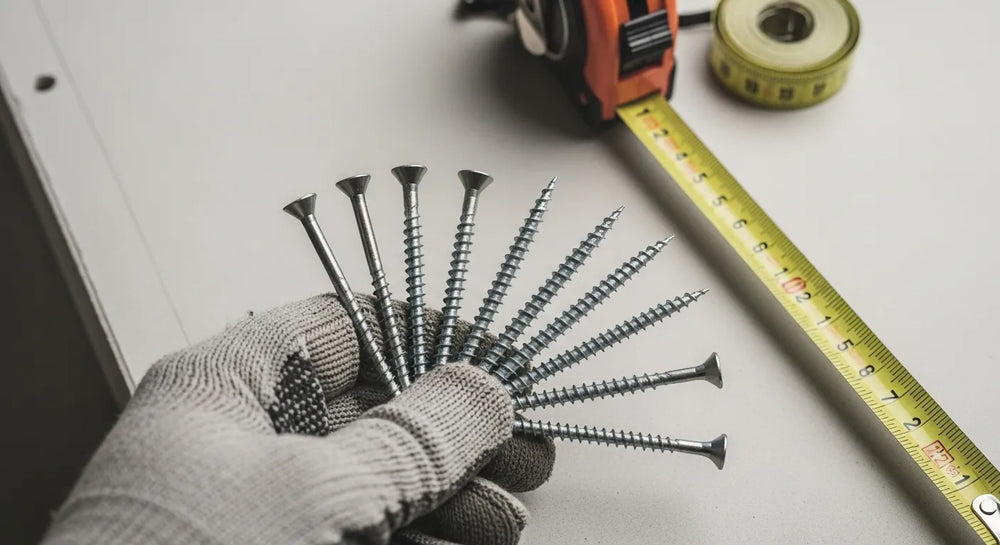
How Deep Should Wood Screws Go? Mastering Fastener Depth for Superior Structural Integrity
Table of Contents
- The Criticality of Proper Wood Screw Depth: Beyond the Surface
- Understanding Wood Types and Their Impact on Screw Depth
- The Anatomy of a Wood Screw and Its Role in Grip
- Calculating Optimal Screw Depth: Formulas and Practical Guidelines
- Pilot Holes: The Unsung Hero of Wood Fastening
- Best Practices for Ensuring Proper Screw Depth and Performance
- Common Mistakes and How to Avoid Them
- The Maden.co Advantage: Sourcing American-Made Fasteners for Industrial Excellence
- Conclusion
- Frequently Asked Questions (FAQ)
Imagine completing a complex industrial assembly, only for a critical connection to fail prematurely due to insufficient fastener engagement. Or perhaps a design engineer discovers material splitting during a prototype test, realizing that the wood screws used were driven too deep, compromising the very structure they were meant to secure. These scenarios highlight a fundamental truth in manufacturing and MRO: the seemingly simple act of fastening with a wood screw is fraught with nuances, none more critical than determining the optimal depth. Understanding precisely how deep wood screws should go is not merely a matter of mechanical assembly; it's a direct determinant of structural integrity, product longevity, and ultimately, your project's Total Cost of Ownership (TCO).
This comprehensive guide delves into the science and best practices behind wood screw depth. We will explore the critical factors influencing proper screw engagement, from the inherent properties of various wood types to the intricate anatomy of the screws themselves. We’ll break down practical guidelines, demystify the role of pilot holes, and arm you with the knowledge to avoid common, costly mistakes. By mastering these principles, procurement managers, MRO buyers, and design engineers can ensure that every fastener contributes optimally to the robustness and reliability of their American-made products and repairs.
The Criticality of Proper Wood Screw Depth: Beyond the Surface
The depth to which a wood screw penetrates the receiving material profoundly impacts its performance, governing its pull-out resistance, shear strength, and the overall integrity of the joint. Insufficient depth leads to weak connections prone to loosening, rattling, or outright failure under stress. Conversely, excessive depth or incorrect technique can cause the wood to split, especially near edges or in dense hardwoods, thereby destroying the material and undermining the joint's strength.
Beyond immediate structural concerns, improper screw depth carries significant hidden costs. Rework due to failed connections wastes valuable labor and materials, derailing project timelines and inflating expenses. For manufacturers, this can translate into warranty claims, reputational damage, and lost customer trust. For MRO teams, a failed repair means extended downtime, reduced operational efficiency, and increased maintenance budgets. Therefore, a precise understanding of "how deep should wood screws go" is not just about technical accuracy; it's about safeguarding investments, ensuring operational continuity, and upholding the quality standards synonymous with American manufacturing.
Why Depth Matters for Structural Integrity
The primary function of a wood screw is to create a strong, durable mechanical connection by threading into wood fibers. This engagement generates friction and compression, providing resistance against forces attempting to separate the joined components.
- Pull-out Resistance: This is the screw's ability to resist being pulled straight out of the wood. It’s directly proportional to the amount of thread engaged within the receiving material. More engagement generally means higher pull-out resistance, up to a point.
- Shear Strength: This refers to the screw's ability to resist forces applied perpendicular to its shaft, attempting to cut or bend it. While primarily determined by the screw's diameter and material, adequate depth ensures that the screw itself is fully supported by the wood, preventing it from pivoting or bending prematurely at the surface.
- Preventing Splitting: When a screw is driven too deep, especially without a pilot hole or with an oversized screw, the wedging action can exert excessive pressure on the wood fibers, causing them to split. This is particularly prevalent in hardwoods or when fastening close to the edge of a board. Proper depth, combined with correct pilot hole sizing, minimizes this risk.
- Aesthetics and Finish: For applications where appearance matters, such as furniture, cabinetry, or visible assemblies, proper screw depth ensures that screw heads are flush, countersunk, or counterbored as intended, contributing to a clean, professional finish.
Understanding Wood Types and Their Impact on Screw Depth
The diverse world of wood materials—from softwoods to hardwoods and various engineered products—exhibits a wide range of densities, grain structures, and fastening characteristics. These properties are paramount in determining the optimal depth, diameter, and type of wood screw to use, as well as the necessity and size of pilot holes.
Hardwoods vs. Softwoods: A Density-Driven Distinction
The distinction between hardwoods and softwoods is not about actual hardness but primarily about the tree type (deciduous vs. coniferous) and, consequently, their density and cellular structure.
-
Hardwoods (e.g., Oak, Maple, Cherry, Walnut):
- Density: Generally denser and stronger than softwoods. This density contributes to excellent holding power but also makes them more prone to splitting if a screw is driven without an adequately sized pilot hole.
- Grain Structure: Often tighter and less porous.
- Implications for Depth: While hardwoods offer superior grip, the risk of splitting means that pilot hole accuracy is critical. Screws generally need to penetrate sufficiently to engage maximum thread, but overdriving can be particularly damaging. The dense fibers resist deformation, meaning the screw thread largely cuts its way in rather than displacing wood as much as in softer woods. For durable connections in hardwoods, you might consider fasteners like our Round Slot Drive Brass Wood Screw, which offer both aesthetic appeal and robust material properties.
-
Softwoods (e.g., Pine, Cedar, Fir, Spruce):
- Density: Less dense and softer, making them easier to work with but also more susceptible to stripping if screws are over-driven.
- Grain Structure: Generally looser and more porous.
- Implications for Depth: Softwoods offer good initial holding power but are more prone to compression and stripping. While pilot holes are still beneficial, especially for larger screws or near edges, they might not always be strictly necessary for smaller screws in the field of the board. The screw essentially displaces and compresses the wood fibers around its threads. Because the wood is softer, it can lose its grip more easily if the screw is over-tightened. Adequate depth ensures enough thread engagement to compensate for the lower density.
Engineered Wood Products: Different Fibers, Different Challenges
Engineered wood products are manufactured by binding wood fibers, veneers, or particles with adhesives, creating materials with distinct properties from natural lumber.
-
Plywood: Composed of thin wood veneers glued in alternating grain directions.
- Implications for Depth: Plywood is strong and dimensionally stable. Screws can achieve good holding power, but care must be taken to avoid delamination if screws are driven too aggressively or too close to an edge. Depth should ensure engagement through multiple plies.
-
MDF (Medium-Density Fiberboard): Made from wood fibers compressed with resin.
- Implications for Depth: MDF is very uniform but lacks the strong, continuous grain of natural wood. It holds screws well on the face but poorly on edges, which are prone to crumbling. Screws can strip easily if over-driven. Optimal depth requires careful pilot hole sizing and avoiding over-torque. Specific screws with coarse threads are often recommended.
-
Particleboard/Chipboard: Made from wood particles (chips) bound with resin.
- Implications for Depth: Similar to MDF, particleboard has poor edge holding and can strip easily. It's generally weaker than MDF. Screw depth needs to be sufficient for engagement without causing the particles to break apart.
-
OSB (Oriented Strand Board): Made from strands of wood arranged in layers and bonded with adhesive.
- Implications for Depth: OSB offers better structural performance than particleboard or MDF but can still be prone to crumbling or splitting, especially if screws are driven into the edges or without pilot holes. Depth should ensure full thread engagement without compromising the structural integrity of the strands.
When specifying fasteners for any of these materials, ensuring consistent quality and compliance with industry standards like DIN or NPT is crucial. At Maden.co, our mission is to democratize access to American manufacturing, connecting industrial buyers with over 2.5 million U.S.-made products from our network of 800+ verified manufacturers, simplifying the sourcing of high-quality components for these diverse applications.
The Anatomy of a Wood Screw and Its Role in Grip
Understanding the components of a wood screw is fundamental to comprehending how it interacts with wood and, consequently, how deep it should penetrate for optimal performance. Each part of the screw plays a role in its ability to secure a joint.
Thread Engagement: The Science of Fiber Bite
The threads are the most critical part of a wood screw for holding power. They are designed to cut into or displace wood fibers, creating a mechanical interlock that resists withdrawal.
- Thread Length: Not all screws are fully threaded. Some have a smooth shank near the head. For maximum holding power, the threads must fully engage the receiving material, while the smooth shank should ideally pass through the fastened material (the top piece) to allow it to be pulled tightly against the receiving material. If threads extend into the fastened piece, they can prevent a tight pull-down.
- Thread Pitch and Depth: Coarse threads (wider spacing, deeper grooves) are generally better for softer woods, allowing more wood fibers to be captured and displaced. Finer threads might be preferred for hardwoods, as they reduce the wedging action that can cause splitting.
Screw Length and Diameter (Gauge): The Foundational Dimensions
The length and diameter (gauge) of a wood screw are primary determinants of its load-bearing capacity and penetration depth.
- Screw Length: The most commonly cited guideline for wood screw depth is that the screw should penetrate the receiving material by at least two-thirds (2/3) of its total length. Another common rule suggests the screw should penetrate at least 3/4 of its total length into the receiving piece. For instance, if you are fastening a 1-inch thick board to another 2-inch thick board, and you use a 2-inch long screw, 1 inch will pass through the first board, leaving 1 inch to penetrate the receiving board. This 1 inch represents half of the screw's total length (not 2/3 or 3/4), suggesting this screw might be too short for optimal holding power in this specific configuration. A better choice might be a 2.5-inch or 3-inch screw to achieve the 2/3 to 3/4 penetration rule into the receiving material, while still ensuring the screw doesn't protrude.
- Screw Diameter (Gauge): A larger diameter screw generally provides greater pull-out resistance and shear strength because it engages more wood fibers and has a greater cross-sectional area. However, larger diameters also increase the risk of splitting the wood, necessitating careful pilot hole sizing. A good rule of thumb for penetration into the receiving material is to aim for a depth that is at least three times the screw's diameter. So, a #8 screw (approximately 0.164 inches in diameter) should penetrate at least 0.492 inches (or roughly 1/2 inch) into the receiving material, in addition to passing through the fastened material.
Head Types: Flushness, Bearing Surface, and Aesthetics
The design of the screw head influences how the screw sits in the material and its aesthetic finish.
- Flat Head (Countersunk): Designed to sit flush with or slightly below the surface of the wood. This requires a countersink recess to be drilled into the fastened material. A flat head provides a clean, unobtrusive finish. For applications requiring a flush and secure fastening, our Flat Slot Drive Brass Wood Screw offers excellent performance and corrosion resistance.
- Round Head: Sits proud of the surface, providing a decorative look or a larger bearing surface for applications where maximum clamping force on the top material is desired without sinking the head. These don't require countersinking. Our Round Slot Drive Brass Wood Screw is a classic example, often chosen for its traditional appearance and reliable hold.
- Oval Head: A hybrid of flat and round heads, with a rounded top and a countersunk underside. This allows for a partially recessed, yet decorative finish. They are often used with finish washers. For a blend of strength and elegant finish, consider our Oval Slot Drive Silicon Bronze Wood Screw, which offers superior corrosion resistance for demanding environments.
- Pan Head/Hex Head: Typically used in applications where a higher torque can be applied, and a flush finish is not required. They offer a large bearing surface.
Drive Types: Torque Transfer and Stripping Prevention
The drive type refers to the recess in the screw head that accepts a screwdriver or power tool bit.
- Slotted: Traditional, but prone to cam-out (the driver slipping out), especially with power tools. Requires more careful alignment.
- Phillips: More common, offers better torque transfer than slotted but can still cam-out.
- Torx (Star Drive): Excellent torque transfer, virtually no cam-out, preferred for demanding applications.
- Square (Robertson): Excellent positive engagement, widely popular in woodworking.
Choosing the right drive type minimizes the risk of stripping the screw head, which can prevent the screw from reaching its intended depth or from being removed later.
Calculating Optimal Screw Depth: Formulas and Practical Guidelines
While experience plays a significant role, understanding the quantitative aspects of screw depth provides a robust foundation for effective fastening. There are general rules of thumb that serve as excellent starting points, which should then be adjusted based on specific material properties and application requirements.
The 2/3 Rule (or 75% Rule): A General Benchmark
A widely accepted guideline is that the screw should penetrate the receiving material by at least 2/3 to 3/4 (or 67% to 75%) of its total length. This rule ensures sufficient thread engagement to develop strong pull-out resistance without unnecessarily long screws that might protrude or weaken the overall structure.
-
Example: If you are joining a 1/2-inch thick piece of wood (the "fastened" material) to a 1-inch thick piece of wood (the "receiving" material):
- The screw must first pass through the 1/2-inch fastened piece.
- If you choose a 1 1/2-inch long screw, 1/2 inch goes through the first piece, leaving 1 inch to penetrate the receiving material.
- Is 1 inch "2/3 to 3/4" of the total 1 1/2-inch screw length?
- 1 1/2 inches * (2/3) = 1 inch.
- 1 1/2 inches * (3/4) = 1 1/8 inches.
- In this case, 1 inch of penetration precisely meets the 2/3 rule and is close to the 3/4 rule. This screw length would be considered appropriate.
Minimum Engagement Length: A Safety Factor
Beyond the percentage rule, it's often wise to ensure a minimum absolute engagement length, especially in critical applications. A common recommendation is that the screw should penetrate the receiving material by at least 1 inch (25mm), regardless of the overall length, to ensure robust holding power. This provides a safety margin, particularly for smaller projects or where vibration might be a concern.
Considering Material Thickness: Avoiding Protrusion and Splitting
While maximizing thread engagement is crucial, you must also ensure the screw does not exit the back of the receiving material. This is not only unsightly but can also create hazards or interfere with other components. Always measure the total thickness of the receiving material and select a screw length that allows for optimal penetration (2/3 to 3/4 of its length) without protruding. Leave a margin, typically at least 1/8 to 1/4 inch, from the opposing surface.
Conversely, ensure that the screw's penetration does not come so close to an edge or end grain that it causes splitting. For this, proper pilot hole drilling is paramount.
Shear vs. Pull-out Resistance: Prioritizing Strength
In some applications, shear strength (resistance to forces parallel to the joint) is more critical, while in others, pull-out resistance (resistance to forces perpendicular to the joint) dominates.
- Shear-dominant applications: Framing, structural connections where loads primarily try to slide the joined pieces past each other. Here, screw diameter is crucial, and adequate depth ensures the full strength of the screw shank is utilized without bending at the surface.
- Pull-out-dominant applications: Attaching cabinet backs, securing trim, holding objects against a wall. Here, thread engagement depth is paramount.
For a design engineer needing specific material certifications for a new prototype, or an MRO buyer facing an unexpected equipment breakdown, the ability to quickly find and procure high-quality, U.S.-made fasteners that meet precise depth and strength requirements is a game-changer. Our commitment at Maden.co is to streamline this process, ensuring you have access to industrial excellence, supporting projects that demand the utmost reliability.
Factors Affecting Holding Power
Several other factors interact with depth to influence the overall holding power of a wood screw:
- Wood Species and Density: As discussed, denser woods offer better grip but are more prone to splitting. Softer woods are less prone to splitting but offer less grip.
- Moisture Content: Wood expands and contracts with changes in moisture. Screwing into wet wood that later dries can lead to loosening as the wood shrinks. Conversely, screwing into very dry wood increases the risk of splitting. Aim for fastening wood at its in-service moisture content.
- Grain Direction: Screws driven perpendicular to the grain (across the width of the board) offer significantly greater holding power than those driven into the end grain. End-grain connections are notoriously weak and should be avoided if possible, or supplemented with other joinery methods.
- Screw Diameter: Larger diameter screws typically provide greater holding power but require larger pilot holes and increase splitting risk.
- Pilot Hole Size: The most critical factor besides screw length in preventing splitting and ensuring optimal thread engagement.
Pilot Holes: The Unsung Hero of Wood Fastening
Many fastening failures—from split wood to stripped screws—can be traced back to the omission or incorrect sizing of a pilot hole. A pilot hole is a pre-drilled hole that guides the screw and creates space for its shank and core, allowing the threads to properly engage without undue stress on the wood.
Why Pilot Holes Are Essential
- Preventing Splitting: This is the primary reason. As a screw enters wood, its tapered tip and threads act as a wedge. In dense woods, near edges, or in thinner stock, this wedging action can easily force the wood fibers apart, causing a split. A pilot hole provides a path that alleviates this pressure.
- Guiding the Screw: A pilot hole ensures the screw starts straight and follows the desired path, preventing it from wandering and creating a misaligned joint or poking out at an unexpected angle.
- Reducing Driving Torque: By creating space for the screw, a pilot hole significantly reduces the force required to drive it. This is particularly important when working with hand tools or preventing over-stressing power tools.
- Ensuring Proper Thread Engagement: A correctly sized pilot hole allows the screw's threads to cut into the wood fibers effectively without stripping the hole (if too large) or damaging the threads (if too small).
Selecting the Correct Pilot Hole Size
Choosing the right pilot hole size is a delicate balance. It must be large enough to prevent splitting but small enough to allow the screw threads to bite firmly into the wood. The general principle involves two diameters:
- Shank Diameter (Clearance Hole for the Fastened Material): In the piece of wood being fastened (the top piece), the hole should be the same diameter as the shank (the unthreaded part) of the screw. This allows the screw to pass freely through, ensuring that the screw head pulls the two pieces of wood tightly together without the threads binding in the top piece. If the hole in the top piece is too small, the threads will engage both pieces, preventing a tight joint.
- Thread Root Diameter (Pilot Hole for the Receiving Material): In the receiving material (the bottom piece), the hole should be slightly smaller than the root diameter (the solid core) of the screw's threads. This allows the threads to cut into the wood fibers, creating a strong grip. If this hole is too large, the threads won't have enough material to grip, leading to a weak connection. If it's too small, the screw will be very difficult to drive, and the wood is highly likely to split.
Practical Tip: A simple way to determine the approximate pilot hole size for the receiving material is to hold the screw up to a drill bit. The drill bit should be just slightly smaller than the screw's core (the part without threads), such that the threads are visible on either side of the drill bit when held against it. For hardwoods, err on the side of a slightly larger pilot hole; for softwoods, a slightly smaller one. Always test on a scrap piece of the same material first.
Counterboring and Countersinking: Achieving a Flush Finish
- Countersinking: This involves drilling a conical recess at the surface of the pilot hole, allowing the head of a flat-head or oval-head screw to sit flush with or slightly below the surface. This is essential for a smooth finish and prevents snagging.
- Counterboring: This involves drilling a wider, flat-bottomed hole deeper into the surface, allowing the entire screw head (including round heads or hex heads) to sit below the surface. A plug can then be inserted to conceal the screw, often for aesthetic purposes or to protect the fastener.
Best Practices for Ensuring Proper Screw Depth and Performance
Achieving optimal wood screw performance extends beyond merely selecting the right screw and drilling a pilot hole. A meticulous approach to the fastening process itself contributes significantly to the durability and reliability of any assembly.
Pre-Drilling: A Non-Negotiable Step in Many Cases
While sometimes overlooked in softwoods, pre-drilling is almost always a necessity in hardwoods, near edges, or when using larger diameter screws. It effectively eliminates the primary cause of splitting and ensures a straight, consistent screw path. Even in softwoods, pre-drilling for screws larger than #6 can prevent issues.
Lubrication: Easing the Drive
For particularly stubborn hardwoods or very long screws, applying a small amount of lubricant to the screw threads can dramatically ease driving and reduce the risk of splitting. Options include:
- Wax: Paraffin wax, beeswax, or even candle wax can be rubbed onto the threads.
- Soap: Bar soap can be used similarly.
- Specialty Screw Lubricants: Available for professional applications.
The lubrication reduces friction between the screw and the wood, allowing it to turn more easily and reach its intended depth without excessive force that could damage the wood or strip the screw head.
Torque Control: Preventing Over-driving and Stripping
Modern power drills and impact drivers come equipped with clutch settings or torque control mechanisms. Learning to use these effectively is crucial:
- Clutch Settings: These allow you to set a maximum torque output. Once the resistance reaches this setting, the clutch disengages, preventing the screw from being over-driven. Start with a lower setting and gradually increase it until the screw is flush and snug without stripping.
- Impact Drivers: While powerful, impact drivers require more finesse when fastening wood. Their hammering action can quickly strip screws or damage wood if not used carefully, especially as the screw approaches its final depth. Use them for initial driving, then finish with a drill on a lower torque setting or by hand for critical connections.
Over-driving a screw can strip the threads in the wood, effectively reducing its holding power to zero. It can also cause the screw head to break or strip, making removal difficult. Under-driving leaves a loose connection, equally compromising structural integrity.
Grain Direction: Maximizing Holding Power
The orientation of the wood grain relative to the screw's path significantly influences holding power:
- Perpendicular to the Grain (Face or Edge Grain): This provides the strongest connection. When a screw is driven across the grain, its threads engage numerous strong, continuous wood fibers. This is the ideal scenario for maximum pull-out resistance and shear strength.
- Parallel to the Grain (End Grain): Screwing into end grain is generally very weak. The screw runs parallel to the wood fibers, essentially pushing them apart rather than engaging them across their width. This offers minimal resistance to pull-out and is highly prone to splitting. Avoid end-grain fastening wherever possible; if unavoidable, use very long screws with deep penetration, larger diameters, and always pre-drill.
Environmental Factors: Considering Moisture and Temperature
Wood is a hygroscopic material, meaning it absorbs and releases moisture, causing it to swell and shrink.
- Moisture Content: Fastening "green" (wet) wood can lead to connections that loosen as the wood dries and shrinks. Conversely, fastening bone-dry wood that later absorbs moisture can create stress that leads to splitting or warping. Ensure the wood has acclimatized to its expected in-service environment before permanent fastening.
- Temperature Fluctuations: While less critical than moisture for wood screws, extreme temperature swings can also cause slight expansion and contraction, which can, over very long periods, contribute to joint fatigue.
By meticulously adhering to these best practices, procurement managers can confidently specify fastener requirements, and MRO buyers can ensure repairs are executed with the utmost reliability. For those demanding precision and adherence to critical industry standards, Maden.co stands as America's premier B2B marketplace for U.S.-manufactured products, ensuring every component you source contributes to industrial excellence. Our entire business model is built on this principle; you can learn more about our mission to champion American manufacturing here: About Us.
Common Mistakes and How to Avoid Them
Even with the best intentions, errors in wood screw application can occur. Recognizing these common pitfalls is the first step toward avoiding them, saving time, material, and frustration.
-
Under-driving: Leaving a screw proud of the surface when it should be flush, or simply not driving it deep enough into the receiving material.
- Consequence: Insufficient thread engagement leads to weak connections, poor pull-out resistance, and potential joint failure. Visually, it can be unprofessional, and functionally, it can snag or interfere with other components.
- Avoidance: Always ensure screws are driven to their full intended depth, whether flush, countersunk, or counterbored. Use appropriate screw lengths according to the 2/3 or 3/4 rule.
-
Over-driving: Applying too much torque, causing the screw head to strip, the wood threads to strip, or the screw head to break off.
- Consequence: Stripped wood threads mean no holding power. A stripped screw head makes removal impossible without specialized tools. A broken screw renders the fastener useless. It also causes material compression or damage around the screw head.
- Avoidance: Utilize clutch settings on power drills. Practice on scrap material. Know the limits of the wood and the screw. Finish tightening by hand if precision is critical.
-
Incorrect Pilot Hole Size: Using a pilot hole that is too small or too large.
- Consequence (Too Small): Wood splitting, difficulty driving the screw, screw head stripping, or breaking.
- Consequence (Too Large): Reduced thread engagement, weak connection, poor pull-out resistance, stripped threads.
- Avoidance: Always test pilot hole sizes on scrap material. Match the pilot hole to the screw's root diameter (for receiving material) and shank diameter (for clearance in fastened material).
-
Ignoring Material Properties: Using a standard wood screw in MDF, particleboard, or very dense hardwoods without special considerations.
- Consequence: Material crumbling (in engineered wood), severe splitting (in hardwoods), or rapid stripping due to inadequate grip.
- Avoidance: Understand the specific fastening characteristics of each wood type. Use coarse-threaded screws for engineered wood, always pre-drill hardwoods, and consider specialized fasteners if necessary.
-
Lack of Pre-planning: Rushing into a fastening job without measuring, marking, or selecting the right tools and fasteners.
- Consequence: Misaligned screws, unsightly results, weakened joints, damaged materials, and wasted time and resources.
- Avoidance: Take the time to plan each fastening. Measure carefully, mark pilot hole locations, choose the appropriate screw length and diameter, and select the correct drill bits and drive tools.
The Maden.co Advantage: Sourcing American-Made Fasteners for Industrial Excellence
In the demanding world of industrial procurement, where every component contributes to the reliability and safety of a final product or system, the quality and accessibility of fasteners are non-negotiable. This is where Maden.co distinguishes itself, offering a strategic partnership for businesses committed to American manufacturing pride and operational excellence. Our vision is to become the definitive platform that proves American-made components are as accessible and convenient as any global alternative, driving the manufacturing revival with our tagline: "America's manufacturing revival is here."
At Maden.co, our mission is to democratize access to American manufacturing. We achieve this by connecting industrial buyers—procurement managers, MRO buyers, and design engineers—with an unparalleled network of over 2.5 million U.S.-manufactured products from over 800+ verified U.S. manufacturers. This vast catalog ensures that whether you're sourcing high-strength structural fasteners, precision machine screws, or specific wood screws for a delicate assembly, you can find the exact U.S.-made component you need with confidence.
Our core values underpin every aspect of our platform:
- American Manufacturing Pride: We celebrate and champion the ingenuity and quality of U.S. producers. Every product on our marketplace proudly bears the "Made in USA" distinction.
- Digital Innovation: We leverage cutting-edge technology to simplify complex procurement processes, making it easier than ever to find, compare, and purchase industrial components.
- Supply Chain Transparency: We provide clear, verifiable information about our manufacturers and products, fostering trust and reducing risk.
- Industrial Excellence: We are committed to offering products that meet the highest standards of quality, compliance, and performance.
- Customer Empowerment: We equip our customers with the tools and resources they need to make informed purchasing decisions and optimize their operations.
For a procurement manager under pressure to source a specific DIN 931 compliant hex cap screw, a design engineer needing specific material certifications for a new prototype, or an MRO buyer facing an unexpected equipment breakdown, the ability to quickly find and finance a verified, U.S.-made part is a game-changer. Our platform significantly improves your Total Cost of Ownership (TCO) by:
- Enhancing Supply Chain Resilience: Sourcing domestically reduces reliance on volatile global supply chains, mitigating risks associated with geopolitical events, shipping delays, and fluctuating international regulations.
- Ensuring Compliance: Easily find products that meet critical industry standards (e.g., DIN, NPT, ANSI), supported by transparent documentation from verified U.S. manufacturers.
- Reducing Procurement Friction: Our intuitive search and filtering tools, combined with a streamlined purchasing process, minimize the time and effort traditionally associated with sourcing industrial components.
- Partnering with Verified U.S. Manufacturers: Gain peace of mind knowing you're acquiring products from reputable American companies adhering to stringent quality controls.
From the moment you arrive on our platform at Maden.co, you're stepping into a world where quality meets convenience, designed to support the backbone of American industry.
Are you a U.S. manufacturer looking to expand your reach and contribute to the nation's industrial strength? Register as a vendor and join the American manufacturing revival, connecting your products with a vast network of dedicated industrial buyers.
Streamlining Your Procurement with Maden.co's Instant Financing
We understand that large-volume purchases or critical project needs often require flexible financial solutions. That's why a key differentiator at Maden.co is our Instant Financing option. This isn't just a payment method; it's a strategic tool designed to empower businesses to manage cash flow effectively and make larger-volume purchases without tying up immediate capital.
Instant Financing allows procurement managers and business owners to:
- Optimize Cash Flow: Preserve working capital for other operational needs while securing necessary components.
- Facilitate Larger Projects: Make significant purchases, such as bulk orders of specialized fasteners or extensive MRO parts, without immediate upfront payment.
- Enhance Agility: Quickly respond to urgent needs or seize advantageous purchasing opportunities.
You can apply for Instant Financing directly at checkout, simplifying the process and integrating it seamlessly into your existing procurement workflow. This feature, combined with our vast selection of high-quality U.S.-made products, makes Maden.co a truly strategic partner in building a more reliable and efficient procurement process. If you have specific sourcing questions about project financing or finding the right fasteners, our team is ready to help through our Contact Us page.
Conclusion
Mastering the art and science of wood screw depth is a testament to the meticulous attention to detail that defines industrial excellence. From selecting the appropriate screw length and diameter to understanding the nuances of wood types and the crucial role of pilot holes, every decision impacts the structural integrity and longevity of your assemblies. By applying the principles discussed—adhering to the 2/3 to 3/4 penetration rule, recognizing the importance of specific screw head and drive types, and implementing best practices like proper torque control—you ensure that every fastener performs optimally, preventing costly failures and upholding the quality of your U.S.-made products.
For American businesses, the commitment to precision in fastening directly translates into enhanced product reliability, reduced warranty claims, and optimized operational efficiency. It contributes to a stronger, more resilient domestic supply chain, allowing for greater control over material quality and faster response times.
Are you ready to elevate your procurement strategy and build with unparalleled confidence? Explore the extensive catalog of American-made fasteners and industrial components available on Maden.co. Discover a vast selection of high-quality, U.S.-manufactured products, from the robust Round Slot Drive Brass Wood Screw to the versatile Flat Slot Drive Brass Wood Screw and the corrosion-resistant Oval Slot Drive Silicon Bronze Wood Screw, all designed to meet the rigorous demands of industrial applications. Leverage our Instant Financing option at checkout to streamline your capital-intensive projects and ensure your business always has access to the best American-made components. America's manufacturing revival is here, and Maden.co is your definitive partner in building its future.
Frequently Asked Questions (FAQ)
Q1: What is the general rule of thumb for wood screw depth?
A1: The most common rule of thumb is that a wood screw should penetrate the receiving (bottom) material by at least two-thirds (2/3) to three-quarters (3/4) of its total length. For example, if you're using a 1.5-inch screw, it should penetrate the receiving material by at least 1 inch to 1.125 inches after passing through the fastened (top) material. This ensures sufficient thread engagement for optimal holding power.
Q2: Why are pilot holes so important for wood screws?
A2: Pilot holes are crucial for several reasons: they prevent the wood from splitting, especially in hardwoods or near edges; they guide the screw, ensuring it drives straight and true; and they reduce the torque required to drive the screw, minimizing the risk of stripping the screw head or over-stressing the material. Correct pilot hole sizing ensures strong thread engagement without damaging the wood.
Q3: Can a wood screw be too deep?
A3: Yes, a wood screw can be too deep in several contexts. If it's too long, it can protrude through the back of the receiving material, creating a hazard or an unsightly finish. If driven too aggressively or without an appropriate pilot hole, excessive depth can cause the wood to split, especially near edges or in dense materials, thereby compromising the joint's integrity. Over-driving can also strip the wood fibers, leading to a loose connection.
Q4: How does the type of wood affect screw depth requirements?
A4: The density and grain structure of the wood significantly affect screw depth requirements. Hardwoods are denser, offering better holding power but are more prone to splitting, necessitating precise pilot hole sizing. Softwoods are less dense, easier to drive screws into, but are more susceptible to stripping if over-driven, requiring careful torque control and often benefiting from slightly longer screws for increased thread engagement. Engineered wood products like MDF or particleboard have different fiber structures, often requiring coarse-threaded screws and meticulous pilot hole preparation to prevent crumbling or stripping at the edges.


