
How to Anchor Something Heavy to Drywall Securely
Table of Contents
- Introduction
- Understanding the Challenge: Why Drywall Fails
- The First Rule of Mounting: Always Prioritize a Stud
- Choosing the Right Anchor: A Procurement Manager's Guide
- Step-by-Step Installation: Ensuring Industrial-Grade Security
- Beyond the Anchor: Strategic Sourcing for Supply Chain Resilience
- Managing Costs and Cash Flow with Strategic Procurement
- Conclusion
- Frequently Asked Questions
Introduction
Imagine this scenario: a critical piece of safety equipment, a new server rack, or heavy-duty industrial shelving needs to be installed on a facility wall. The project timeline is tight, the location is non-negotiable, but a stud finder reveals nothing but hollow space behind the gypsum board. For a facilities manager or MRO buyer, this common problem can quickly escalate from a minor inconvenience into a significant project delay, a safety hazard, or a costly mistake. The structural integrity of your mounted assets is not just a matter of convenience; it's a foundational element of operational safety and efficiency. Simply driving a screw into drywall is a recipe for failure, but understanding the engineering behind proper anchoring techniques transforms this challenge into a solvable, secure task.
This article provides a definitive guide for industrial and commercial professionals on how to anchor heavy items to drywall. We will move beyond simple DIY tips to explore the physics of load-bearing, the technical specifications of different anchor types, and the critical importance of proper installation methodology. More importantly, we will connect these practical steps to the larger strategic goals of every procurement professional: ensuring compliance, enhancing supply chain resilience, and reducing the Total Cost of Ownership (TCO) for every component sourced. The ultimate takeaway is that selecting the right, high-quality, American-made anchor and installing it correctly is an investment in safety, reliability, and operational excellence.
Understanding the Challenge: Why Drywall Fails
Before selecting an anchor, it’s essential to understand the material you're working with. Drywall, or gypsum board, is essentially a layer of hardened gypsum plaster pressed between two thick sheets of paper. While it offers excellent fire resistance and a smooth finish for walls, its core is inherently brittle and has very low structural strength on its own. It's designed to be a surface, not a support structure.
When you attempt to hang a heavy object from a simple screw embedded only in the gypsum, you are concentrating the entire load onto a small, weak area. This creates two primary types of stress that lead to failure:
- Shear Force: This is the downward force that acts parallel to the wall's surface. A heavy object's weight pulls the screw downwards, attempting to tear a vertical path through the soft gypsum core.
- Tensile (or Pull-Out) Force: This is the force that acts perpendicular to the wall, pulling directly away from it. If an object is bumped or has depth (like a shelf), it creates a lever effect that exerts a powerful tensile force on the fastener, trying to rip it straight out of the wall.
Drywall has exceptionally poor resistance to both forces. A standard screw might only hold 10 pounds before the gypsum around it pulverizes and gives way. For any application in a commercial, industrial, or professional setting—from mounting heavy-duty monitors and commercial displays to securing wall-mounted tool chests or safety stations—relying on the drywall itself is not an option. The solution lies in using an anchor that bypasses the weakness of the gypsum by distributing the load over a much larger surface area, typically on the backside of the drywall.
The First Rule of Mounting: Always Prioritize a Stud
The safest and most secure method for mounting anything heavy is to fasten it directly into a wall stud. Studs are the vertical framing members of the wall, typically made of wood (2x4s or 2x6s) or steel, and are connected to the building's primary structure. Driving a long screw or lag bolt into a stud means you are anchoring into a solid piece of structural material, not the cosmetic drywall surface.
How to Reliably Locate a Wall Stud
Before you even consider using a drywall anchor, a thorough search for a stud is a mandatory first step.
- Electronic Stud Finders: This is the most reliable modern method. These devices detect changes in density behind the wall. High-quality models can identify the edges and center of a stud and even alert you to the presence of live AC wiring.
- Magnetic Stud Finders: A simpler, less expensive option, these tools use a powerful magnet to locate the metal screws or nails that attach the drywall to the studs. Where there’s a fastener, there’s a stud.
- Visual Inspection and Measurement: Studs are typically spaced 16 inches or 24 inches on-center. You can often measure from a corner or a known stud location (like next to an electrical outlet or light switch) to find the next one. Look for small dimples or imperfections in the drywall finish where fasteners were spackled over.
- The "Knock Test": This is the least precise method but can be used as a last resort. Tapping on the wall will produce a hollow sound between studs and a more solid, dull thud when you are over a stud.
However, operational requirements don't always align with building construction. The optimal placement for a piece of equipment may be squarely between two studs. In these unavoidable situations, selecting the correct heavy-duty drywall anchor is not a compromise; it is the engineered solution.
Choosing the Right Anchor: A Procurement Manager's Guide
The fastener market is vast, but for professional applications, choices must be driven by load capacity, material integrity, and sourcing reliability. At Maden.co, we are committed to simplifying this process by providing direct access to a comprehensive catalog of U.S.-made industrial components. Our mission is to democratize access to American manufacturing, ensuring that engineers and buyers can source verified, high-quality parts with confidence.
Here’s a breakdown of common anchor types, moving from lighter-duty to heavy-duty solutions suitable for commercial use.
Light to Medium-Duty Anchors
While not intended for truly "heavy" loads, it's important to understand these common anchors to know their limitations.
Ribbed Plastic Anchors
These are perhaps the most common type of anchor. A plastic sleeve is inserted into a pilot hole, and as you drive a screw into it, the sleeve expands, pressing against the inside of the drywall.
- Best For: Lightweight signage, small control panels, thermostats, and other items under 15-20 pounds.
- Procurement Insight: For standardized, light-duty applications across a facility, sourcing a reliable, consistently manufactured anchor is key. A product like this American-made Ribbed Plastic Anchor ensures you are getting a component that meets stated specifications, avoiding the inconsistencies often found in bulk, unverified hardware.
Self-Drilling Anchors (Zip-It Style)
These anchors feature a sharp, threaded design that allows them to be screwed directly into the drywall without a pre-drilled pilot hole, saving significant installation time.
- Best For: Medium-weight items like smoke detectors, conduit clamps, or lightweight shelving, typically in the 25-50 pound range.
- Procurement Insight: In MRO environments where speed and efficiency are critical, self-drilling anchors are invaluable. For tasks requiring rapid installation, a U.S.-made fastener like the Medium Duty Nylon Wall Anchor #6 Self-Drilling Drywall Zip-It® can reduce labor costs and project time. The quality of the nylon and the precision of the threads are critical for ensuring a secure grip, reinforcing the importance of sourcing from verified manufacturers.
Heavy-Duty Drywall Anchors
When the load exceeds 50 pounds or safety is paramount, you must move to a more robust class of anchors.
Toggle Bolts
Toggle bolts are one of the strongest types of drywall anchors. They consist of a screw and a spring-loaded, wing-like toggle. You drill a hole large enough for the collapsed toggle to pass through. Once inside the wall cavity, the wings spring open. As you tighten the screw, the wings are pulled tight against the back of the drywall, distributing the load over a very wide area.
- Best For: Heavy shelving, wall-mounted cabinets, grab bars, and ceiling applications (like projectors). They excel against tensile/pull-out force.
- Weight Capacity: Can often support 100 pounds or more, depending on the bolt size and drywall thickness.
- Installation Note: The primary drawback is the large pilot hole required. Also, the bolt must be passed through the item you are mounting before inserting it into the wall. If you remove the bolt, the toggle will fall down inside the wall cavity.
Molly Bolts (Sleeve-Type Anchors)
Molly bolts, or "mollies," are metal sleeve anchors that provide a permanent, threaded fixture in the wall. The anchor's sleeve is inserted into a pilot hole. As you tighten the included screw, the sleeve compresses and expands, forming metal legs that grip the backside of the drywall.
- Best For: Heavy mirrors, television mounts, and any fixture where you might need to remove and re-fasten the object. Once set, the screw can be removed without the anchor falling into the wall.
- Weight Capacity: Typically supports loads in the 50-75 pound range.
- Installation Note: It's critical not to overtighten a molly bolt, as this can damage the drywall. Some versions come with a specialized setting tool for perfect installation.
Sleeve-Type Nylon Anchors
These are a modern evolution of the plastic anchor, engineered for higher performance. They function through a combination of expansion, compression, and gripping action.
- Best For: A wide range of medium-duty commercial applications, offering a balance of strength, ease of installation, and vibration resistance.
- Procurement Insight: For general-purpose MRO and installation kits, a versatile and high-quality nylon anchor is a smart choice. Sourcing a dependable product like the Medium Duty Nylon Wall Anchor #8 for Drywall provides a go-to solution for many common tasks. Its U.S.-made quality ensures the nylon polymer won't become brittle and that the design provides maximum holding power as specified.
Step-by-Step Installation: Ensuring Industrial-Grade Security
Choosing the right anchor is only half the battle. Flawless installation is essential to achieve the manufacturer's rated holding strength.
Step 1: Pre-Installation Checks and Tool Assembly
- Confirm Location: Use a stud finder one last time to be certain you are working with hollow drywall. Use an AC detection feature or a separate tool to check for hidden wiring. Be aware of plumbing locations, especially in kitchens and bathrooms.
- Gather Your Tools: You will need a power drill, a set of drill bits, a level, a measuring tape, a pencil, and a screwdriver (or driver bit for your drill).
- Check the Anchor's Specifications: The packaging or product data sheet will specify the required pilot hole size and the maximum weight capacity. Never exceed the stated limits.
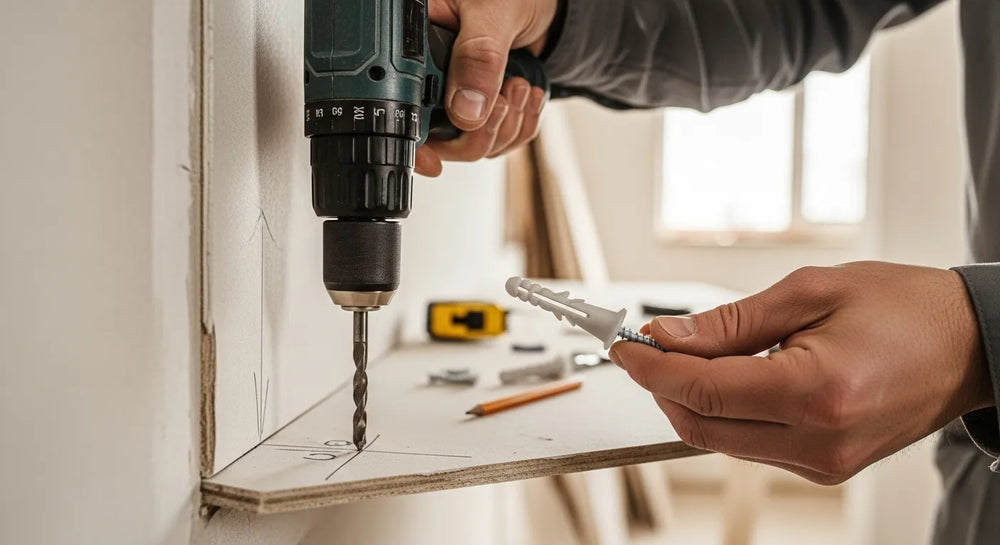
Step 2: Marking and Drilling the Pilot Hole
- Measure and Mark: Use your measuring tape and pencil to mark the precise location for your anchor. If mounting an object with multiple holes, use a level to ensure your marks are perfectly aligned horizontally or vertically.
- Select the Correct Drill Bit: This is a critical step. A hole that is too small will make it difficult to insert the anchor and may damage it. A hole that is too large will prevent the anchor from gripping properly, rendering it useless. Use the exact bit size recommended by the anchor manufacturer.
- Drill the Hole: Keep the drill perpendicular to the wall and drill straight through the drywall. Apply steady, gentle pressure.
Step 3: Installing the Anchor
The installation process varies by anchor type.
- For a Ribbed Plastic or Nylon Sleeve Anchor: Gently tap the anchor with a hammer until its head is flush with the wall's surface.
- For a Toggle Bolt: Pinch the spring-loaded wings together and push them, along with the bolt, through the pilot hole. You will hear and feel the wings spring open on the other side.
- For a Molly Bolt: Insert the entire anchor assembly into the hole until the head is flush. You may need to tap it gently. Then, turn the screw clockwise. You will feel resistance as the sleeve begins to expand. Stop when it feels snug; do not overtighten.
Step 4: Mounting the Object
- Position the Item: Align the mounting hole on your object with the installed anchor.
- Insert and Tighten the Screw: For most anchors, you will now drive the screw through your object and into the anchor. For a toggle bolt, you will be tightening the screw that is already in place.
- Final Check: Tighten the screw until the object is secure against the wall. The fastener should be snug, but again, avoid over-tightening. Use your level one last time to confirm the object is correctly positioned.
Beyond the Anchor: Strategic Sourcing for Supply Chain Resilience
In a professional setting, the process doesn't end with a securely mounted object. For the procurement manager, design engineer, or business owner, the source of the anchor is as important as its technical specifications. The frustration of project delays caused by backordered components or the significant risk of using a non-compliant part from an unverified overseas supplier are all too common.
This is where a fundamental shift in procurement strategy offers a competitive advantage. Our entire business model is built on the principle of strengthening domestic supply chains; you can learn more about our mission to champion American manufacturing here. By connecting industrial buyers with over 2.5 million American-made products from our network of 800+ verified U.S. manufacturers, we empower businesses to build more resilient and reliable operations.
Sourcing fasteners and other MRO components through a dedicated U.S. marketplace provides tangible benefits:
Supply Chain Transparency: Know exactly where your components are coming from, ensuring traceability and quality control from the factory floor to your job site.
Enhanced Compliance: Easily source parts that meet critical industry standards (e.g., DIN, NPT, ANSI), reducing the risk of non-compliance in regulated environments.
Reduced Procurement Friction: Our platform is designed for the industrial buyer, saving time and resources spent vetting suppliers and searching for hard-to-find, spec-compliant parts.
This commitment to a robust domestic industrial base is why we continuously expand our network. Are you a U.S. manufacturer? Register as a vendor and join the American manufacturing revival.
Managing Costs and Cash Flow with Strategic Procurement
The true cost of a component is never just its price tag. The Total Cost of Ownership (TCO) includes the risks of failure, downtime, and project delays. The cost of a failed anchor—potential damage to expensive equipment, safety incidents, and the labor required for repairs—vastly exceeds the price difference between a commodity fastener and a high-quality, verified component.
We understand that managing budgets and cash flow is a constant priority. For a procurement manager overseeing a large facility fit-out or an MRO buyer needing to place a bulk order for essential components, balancing immediate needs with financial constraints is critical. That's why we offer a powerful tool to streamline these purchases. At Maden.co, you can apply for Instant Financing at checkout to streamline your capital-intensive projects. This feature acts as a strategic lever, allowing you to secure the necessary U.S.-made parts now to keep your projects on schedule without disrupting your operational budget.
Conclusion
Anchoring a heavy object to drywall is a task that demands precision, technical knowledge, and the right components. For professionals, the stakes are too high for guesswork. By understanding the limitations of drywall, prioritizing studs whenever possible, and selecting the appropriate heavy-duty anchor for the job, you can ensure a safe and durable installation.
More profoundly, this simple task highlights a larger opportunity for American businesses. By choosing to source components from a dedicated marketplace for U.S.-made products, you are doing more than just buying a fastener; you are investing in a more resilient supply chain, guaranteeing quality and compliance, and becoming a part of America's manufacturing revival.
Don't let procurement friction or supply chain uncertainty delay your next project. Explore our extensive catalog of American-made anchors and fasteners today. Secure the components you need with confidence, and leverage our Instant Financing options at checkout to empower your purchasing strategy. If you have specific sourcing questions or need help finding a particular component, our team is ready to help.
Frequently Asked Questions
1. What is the absolute maximum weight you can hang on drywall with anchors? The maximum weight depends entirely on the specific anchor type, the thickness and condition of the drywall (e.g., 1/2" vs. 5/8"), and the number of anchor points used to distribute the load. High-quality, heavy-duty toggle bolts can hold over 100 pounds in ideal conditions. However, you should always consult the manufacturer's specifications for the anchor you are using and apply a safety factor by not loading it to its absolute maximum limit.
2. Can I reuse a drywall anchor hole? Generally, it is not recommended to reuse a drywall anchor hole. The process of installing and then removing an anchor, especially an expansion-type anchor, compromises the integrity of the surrounding gypsum. The material becomes crushed and weakened, and a new anchor installed in the same spot will not achieve its full rated holding power. It is always safer to install a new anchor in a fresh location at least a few inches away from the old hole.
3. How do I choose between a toggle bolt and a molly bolt for a heavy item? Toggle bolts typically offer superior weight ratings, especially against tensile (pull-out) force, making them the preferred choice for very heavy items like cabinets or for ceiling mounts. Molly bolts are an excellent choice for heavy items where you might need to remove the object periodically, as the anchor body remains in the wall, allowing you to re-insert the screw. For a 70-pound mirror, a molly bolt is suitable; for a 120-pound wall cabinet, a series of toggle bolts would be the more appropriate and safer solution.
4. Why is sourcing U.S.-made fasteners important for my business? Sourcing U.S.-made fasteners from a verified marketplace like Maden.co provides critical business advantages that go beyond the component itself. It ensures complete supply chain transparency, drastically reduces lead times compared to global sourcing, and guarantees that parts meet stringent domestic quality and safety standards. For any business, this translates to reduced operational risk, higher quality assurance for projects, and a more resilient, reliable supply chain that is not vulnerable to international disruptions.


