
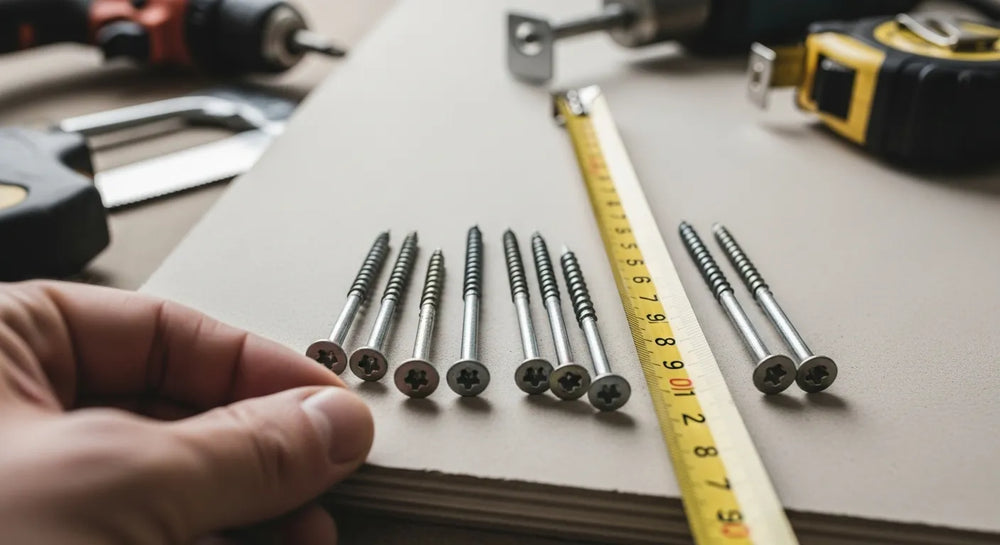
Optimal Drywall Screw Spacing: Precision for Project Integrity
Table of Contents
- The Critical Role of Drywall Fastening in Construction Excellence
- The Science of Screw Placement: How Close Should Drywall Screws Be?
- Beyond Spacing: Key Factors Influencing Drywall Screw Performance
- Common Drywall Fastening Mistakes and How to Avoid Them
- Enhancing Project Efficiency and Durability: A Strategic Procurement Approach
- Streamlining Your Procurement: Maden.co's Digital Innovation
- The Long-Term Value of American Manufacturing in Drywall Projects
- Conclusion
- Frequently Asked Questions (FAQ)
A seemingly minor detail, the precise spacing of drywall screws can dramatically influence the structural integrity, aesthetic finish, and long-term durability of a construction project. Imagine completing a significant build, only to discover hairline cracks emerging along seams or fasteners popping through the finish within months – issues often traceable back to improper screw placement. These aren't just cosmetic flaws; they represent potential structural weaknesses, costly rework, and a direct impact on project timelines and budgets. For procurement managers, MRO buyers, and design engineers, understanding the science behind optimal drywall fastening is not merely about construction best practices; it's about safeguarding investments, ensuring compliance, and delivering lasting quality.
This comprehensive guide delves into the critical question: how close should drywall screws be for optimal performance? We will explore the technical specifications, application nuances, and strategic procurement considerations that elevate a drywall installation from adequate to exemplary. From the foundational principles of screw placement to the role of advanced fastening technologies and the undeniable value of sourcing high-quality, American-made components, we aim to equip you with the knowledge to drive industrial excellence. Our mission at Maden.co is to democratize access to American manufacturing, connecting industrial buyers with over 2.5 million U.S.-made products. We believe that informed procurement decisions, backed by reliable, quality components, are the bedrock of the American manufacturing revival.
The Critical Role of Drywall Fastening in Construction Excellence
Drywall, often referred to as plasterboard or gypsum board, forms the essential interior surface of nearly every modern building, from commercial complexes to industrial facilities and residential structures. Its ubiquity, however, belies the critical importance of its installation. The integrity of a drywall system hinges not just on the quality of the panels themselves, but profoundly on the fastening schedule – specifically, the type, size, and most importantly, the spacing of the screws used to secure it to the framing.
Improper fastening can lead to a cascade of costly issues:
- Cracking and Warping: Inconsistent spacing, screws driven too close to edges, or insufficient fasteners can cause the drywall panels to flex and crack under normal building movement or environmental changes.
- Screw Pops: This common problem occurs when screws are either over-driven, breaking the paper face, or under-driven and not properly seated. It also happens when framing members move, causing the screw heads to protrude through the finished surface, requiring extensive repair.
- Reduced Fire Resistance: Drywall is a key component in a building's fire-rating assembly. Gaps or loose panels due to poor fastening can compromise this critical safety feature, potentially failing to meet stringent fire codes.
- Aesthetic Degradation: Visible flaws due to poor fastening undermine the professional finish, reflecting poorly on the quality of construction and demanding costly corrective measures.
- Structural Instability: While drywall is not typically a structural load-bearing component in the same way lumber or steel is, its secure attachment to the framing contributes to the overall rigidity and shear resistance of a wall assembly, especially in resisting racking forces.
For procurement managers overseeing large-scale projects, understanding these risks translates directly into managing project costs, timelines, and reputation. Sourcing fasteners that meet precise specifications, coupled with rigorous adherence to installation standards, becomes a non-negotiable aspect of delivering a high-quality, durable structure. This is where our commitment at Maden.co to Industrial Excellence becomes paramount, ensuring that every component sourced through our platform meets the rigorous demands of modern construction.
Understanding Drywall and Its Fastening Requirements
Drywall panels consist of a gypsum plaster core sandwiched between two sheets of heavy paper. Gypsum is naturally fire-resistant and stable, but the paper facing provides the tensile strength and a smooth surface for finishing. Different types of drywall are designed for specific applications, each with unique fastening considerations:
- Standard Drywall: The most common type, typically 1/2-inch or 5/8-inch thick.
- Moisture-Resistant (Green Board/Blue Board): Designed for high-humidity areas like bathrooms and kitchens, requiring corrosion-resistant fasteners.
- Fire-Rated (Type X): Thicker (usually 5/8-inch) with additives in the gypsum core for enhanced fire resistance. Fastening here is critical for maintaining fire ratings.
- Sound-Reducing Drywall: Features a higher-density core or laminated layers for improved sound attenuation, often requiring specific fastening patterns to maintain acoustic properties.
The choice of drywall type, thickness, and its intended application directly influences the necessary screw length, gauge, and, crucially, the optimal spacing to ensure robust attachment and performance.
The Science of Screw Placement: How Close Should Drywall Screws Be?
The question of "how close should drywall screws be" is foundational to proper installation, balancing the need for secure attachment with the avoidance of over-fastening, which can weaken the panel or framing. Building codes and industry standards provide clear guidelines based on extensive testing and real-world performance.
General Spacing Guidelines
The general rule of thumb for drywall screw spacing depends primarily on whether you are fastening to walls or ceilings, and the orientation of the drywall panels.
Wall Applications:
- Field of the Panel: For typical 1/2-inch or 5/8-inch drywall on walls, screws should be spaced no more than 16 inches on center along studs. This spacing ensures adequate support across the panel, preventing bowing or movement.
- Edge and Butt Joints: At the edges of the drywall panel (where panels meet along their tapered or untapered edges), screws should be spaced no more than 7 inches on center. This closer spacing provides stronger reinforcement where two panels meet, crucial for tape and compound adhesion, and minimizing edge lifting or cracking. Screws should be offset from the edge by 3/8 to 1/2 inch to prevent blowouts.
- Corners: Similar to edges, closer spacing (7 inches on center) is recommended along inside and outside corners to provide robust support where the drywall meets adjacent walls or ceilings.
Ceiling Applications:
- Increased Stress: Drywall on ceilings is under greater gravitational stress than on walls. Therefore, closer spacing is generally required. Screws should be spaced no more than 12 inches on center across the field of the panel when fastened to ceiling joists.
- Edge and Butt Joints: At the perimeter of the ceiling drywall and where panels meet, screws should be spaced no more than 7 inches on center, maintaining the same edge distance as walls.
Double Layer Drywall Applications:
- When installing a second layer of drywall (common for enhanced fire rating or soundproofing), the spacing for the outer layer can be slightly more generous, typically 12 inches on center for both walls and ceilings. However, the screws for the second layer must be long enough to penetrate through the first layer and into the framing by at least 1 inch for wood studs and 3/8 inch for metal studs. The screws for the second layer should also be offset from the screws in the first layer to avoid hitting them.
The Importance of Consistency:
Regardless of the specific spacing, consistency is key. Using a chalk line or a laser guide can help maintain even screw spacing, which contributes significantly to a flat, stable surface ready for finishing. Inconsistent spacing can lead to uneven stress distribution, increasing the likelihood of screw pops or cracking.
Specific Fastener Types and Their Impact on Spacing
While the general spacing guidelines hold true, the specific type of drywall screw also plays a role in overall system integrity. Maden.co offers a wide array of U.S.-manufactured fasteners, designed for superior performance and compliance with industrial standards.
-
Coarse Thread Drywall Screws: These are the most common type for fastening drywall to wood studs. The coarser threads provide excellent grip in the wood fibers, minimizing stripping and ensuring a strong pull-through resistance. For demanding applications where superior hold is critical, consider options like our 6 x 1-1/4 coarse thread drywall screws, engineered for maximum engagement and durability in wood framing. The robust design of these U.S.-made screws ensures consistent performance, reducing the likelihood of callbacks and enhancing overall project longevity.
-
Fine Thread Drywall Screws: Designed for use with metal studs (typically 20-25 gauge steel). The finer threads are ideal for tapping into thin gauge metal without stripping. When working with light-gauge metal framing, a reliable fastener like the 6 x 1 fine thread drywall screw from our extensive catalog is indispensable. This precision-engineered screw ensures a secure, flush fit into metal studs, preventing rotation and providing a stable base for drywall panels. The consistent quality of American-made fine thread screws minimizes installation issues, contributing to a smoother, more efficient workflow.
-
Self-Tapping/Self-Drilling Screws: For heavier gauge metal studs or specialized applications, self-tapping or self-drilling screws may be used, which create their own hole and threads. While primarily used for structural connections within metal framing, some specialized drywall applications might leverage these for greater pull-out resistance, especially in high-traffic or impact-prone areas.
-
Longer/Heavier Gauge Screws: For thicker drywall, multiple layers, or applications requiring exceptional pull-out resistance, longer and sometimes heavier gauge screws (e.g., #8 gauge instead of #6 gauge) are specified. For projects requiring robust fastening for thicker drywall or specific load-bearing requirements, the 8 x 4 drywall screw offers superior strength and engagement. Sourced from verified U.S. manufacturers on Maden.co, these screws are designed to meet stringent performance demands, contributing to the long-term stability and safety of your construction. Our platform connects you directly with the American manufacturers producing these high-performance fasteners, ensuring you receive quality components that comply with relevant industry standards.
Understanding these distinctions and selecting the appropriate fastener for the job is a cornerstone of professional construction, directly impacting the integrity of the fastening schedule and the overall quality of the finished wall or ceiling.
Beyond Spacing: Key Factors Influencing Drywall Screw Performance
While screw spacing is paramount, it is just one piece of the puzzle. Numerous other factors collectively determine the success and longevity of a drywall installation. Procurement managers must consider these variables when specifying fasteners to ensure maximum performance and compliance.
Screw Length and Gauge
- Length: The screw must be long enough to penetrate through the drywall panel(s) and into the framing member by at least 5/8 to 3/4 inch for wood studs, and 3/8 inch for metal studs. Insufficient penetration leads to weak attachment and screw pops. Excessive length can unnecessarily protrude through the back of the stud, potentially interfering with wiring or plumbing.
- Gauge: The screw's gauge (diameter) relates to its strength. Common drywall screws are typically #6 gauge. Heavier #8 gauge screws offer increased shear strength and pull-out resistance, often used for thicker drywall or in areas prone to impact.
Screw Type: Coarse vs. Fine Thread
As previously discussed, coarse threads are optimized for wood, biting aggressively into the fibers. Fine threads are designed for metal studs, creating a clean tap without stripping the thin gauge steel. Using the wrong type significantly compromises holding power and can damage the framing or the screw itself.
Driving Depth and Technique
- Dimpling: The ideal screw depth is achieved when the screw head is recessed just below the drywall paper surface, creating a slight "dimple" without breaking the paper. This dimple provides a cavity for joint compound, allowing for a smooth finish.
- Over-driving: Breaking the paper face of the drywall significantly reduces the screw's holding power, as the paper is what primarily secures the screw to the gypsum core. This is a common cause of screw pops.
- Under-driving: If the screw head is left flush with or proud of the surface, it will interfere with finishing and be visible through the paint.
- Driving Tools: Using a drywall screw gun with an adjustable clutch or depth-sensing nose cone is highly recommended to achieve consistent, proper dimpling.
Substrate Material: Wood vs. Metal Studs
The framing material dictates the screw type and can slightly influence optimal spacing, especially in how the screw interacts with the substrate. Wood provides a more forgiving substrate, while metal studs require precise thread engagement to prevent stripping. Understanding the material composition of your project's framing is crucial for specifying the correct fasteners.
Adhesive Use (Construction Adhesive)
In certain high-performance applications, such as ceilings, fire-rated assemblies, or areas requiring enhanced rigidity, construction adhesive is used in conjunction with screws. Adhesives can sometimes allow for slightly wider screw spacing (e.g., 16 inches on center on ceilings instead of 12 inches), as the adhesive provides continuous bond strength. However, screws are still essential to hold the panel in place while the adhesive cures and to provide long-term mechanical fastening.
Environmental Factors
High humidity, significant temperature fluctuations, or exposure to moisture can impact drywall and fasteners. In such conditions, moisture-resistant drywall and corrosion-resistant fasteners (e.g., phosphate-coated or galvanized) become critical. Environmental stress can exacerbate issues arising from improper fastening, leading to premature failure.
Building Codes and Standards
Adherence to local building codes (e.g., International Residential Code - IRC, International Building Code - IBC) and industry standards (e.g., ASTM C1396 for drywall, ASTM C1002 for screws) is not optional. These codes specify minimum fastener requirements, spacing, and installation methods to ensure safety, structural integrity, and fire resistance. Failing to comply can result in project delays, costly rework, and potential legal liabilities. Our commitment at Maden.co to Supply Chain Transparency ensures that our verified U.S. manufacturers produce components that meet these critical standards, giving procurement managers peace of mind.
Common Drywall Fastening Mistakes and How to Avoid Them
Even experienced installers can make mistakes, but understanding the most common pitfalls can help procurement managers and project leads implement better quality control.
-
Over-driving/Under-driving Screws:
- Mistake: Screw heads either tear through the paper face or protrude beyond the surface.
- Avoidance: Use a clutch-equipped screw gun or a depth-sensing bit. Train installers on proper dimpling technique. Inspect completed sections for proper depth before finishing.
-
Incorrect Spacing:
- Mistake: Screws are too far apart, leading to bowing or movement, or too close together, weakening the panel.
- Avoidance: Clearly communicate spacing requirements. Use chalk lines, laser guides, or measuring tapes to ensure consistent 16-inch (walls) or 12-inch (ceilings) on-center spacing, and 7-inch spacing at edges and corners.
-
Using the Wrong Screw Type:
- Mistake: Coarse thread screws in metal studs, or fine thread screws in wood studs.
- Avoidance: Verify framing material (wood or metal) before ordering screws. Ensure distinct screw types are used for each application. Maden.co simplifies this by offering precise specifications for products like our 6 x 1-1/4 coarse thread drywall screws for wood and 6 x 1 fine thread drywall screw for metal, ensuring you always select the right fastener.
-
Damaging the Drywall Paper:
- Mistake: Screws driven too close to the edge, causing blowouts or tears.
- Avoidance: Maintain a minimum 3/8 to 1/2 inch edge distance. Emphasize careful handling of panels to avoid pre-damaging edges.
-
Inadequate Stud Locating:
- Mistake: Screws miss the stud entirely, leaving the drywall unsecured.
- Avoidance: Use stud finders, chalk lines, or laser levels to accurately mark stud locations. Ensure panels are aligned correctly with framing members.
By proactively addressing these common mistakes through proper training, precise specification, and rigorous quality control, construction projects can significantly reduce rework and enhance the overall quality of the drywall installation.
Enhancing Project Efficiency and Durability: A Strategic Procurement Approach
In the complex landscape of industrial construction and MRO, the journey from raw material to finished installation is fraught with potential friction points. For procurement managers, sourcing fasteners for a large-scale drywall project goes beyond simply buying screws; it involves mitigating risk, ensuring compliance, and optimizing Total Cost of Ownership (TCO). This is where a strategic procurement approach, focused on quality, reliability, and domestic sourcing, truly shines.
The Supply Chain Challenge for Drywall Fasteners
The global supply chain often presents unpredictable challenges:
- Volatile Pricing: Fluctuations in international markets can lead to sudden cost increases.
- Extended Lead Times: Geopolitical events, shipping delays, or production bottlenecks can stretch delivery schedules, impacting project timelines.
- Quality Inconsistency: Sourcing from unverified international suppliers can introduce risks of inconsistent quality, non-compliance with standards, and product failures.
- Lack of Transparency: Obscure supply chains make it difficult to verify manufacturing origins, material specifications, and ethical production practices.
These challenges directly impact a procurement manager's ability to maintain project schedules, control budgets, and guarantee the integrity of their builds.
The Maden.co Advantage: Sourcing Verified U.S.-Made Components
At Maden.co, our mission is to redefine industrial procurement by offering a solution to these challenges. We are democratizing access to American manufacturing, providing a seamless bridge between industrial buyers and a vast network of verified U.S. manufacturers. Our platform empowers you to build a more resilient and efficient procurement process.
- Connecting with U.S. Manufacturers: We proudly feature over 2.5 million U.S.-made products from more than 800 verified American manufacturers. This direct connection ensures that when you specify a product, you're getting it from a trusted domestic source committed to quality. For instance, whether you need our 8 x 4 drywall screw for heavy-duty applications or standard coarse and fine thread screws, you can be confident they are manufactured to exacting American standards.
- Quality Assurance and Compliance: Every product listed on Maden.co is sourced from a U.S. manufacturer who adheres to rigorous quality controls and industry standards. This eliminates the uncertainty often associated with international sourcing and ensures that your drywall fasteners, from our 6 x 1-1/4 coarse thread drywall screws to our 6 x 1 fine thread drywall screw, meet or exceed the performance specifications required by U.S. building codes and engineering designs. You can learn more about our commitment to quality and our mission to champion American manufacturing by visiting our About Us page.
- Improving TCO and Supply Chain Resilience: By sourcing domestically through Maden.co, you reduce reliance on complex global logistics, shortening lead times and minimizing the risk of supply chain disruptions. This translates into tangible cost savings by avoiding delays, reducing inventory holding costs, and mitigating the financial impact of rework due to substandard components. A reliable, transparent, and domestic supply chain is a cornerstone of improved TCO and enhanced operational resilience.
- Reducing Procurement Friction: Our platform is designed with the industrial buyer in mind. We streamline the search, comparison, and purchasing process, making it as convenient to source specialized American-made components as it is to find any other alternative. Our vision is to become the definitive platform that proves American-made components are as accessible and convenient as any global alternative, driving the manufacturing revival with our tagline: "America's manufacturing revival is here." To explore the breadth of products and begin your journey towards optimized procurement, visit the Maden.co homepage.
Streamlining Your Procurement: Maden.co's Digital Innovation
Maden.co isn't just a marketplace; it's a strategic partner built on the principles of Digital Innovation and Customer Empowerment. We leverage technology to simplify complex industrial procurement, making it easier than ever to secure the high-quality, U.S.-made components your projects demand.
Simplified Search and Discovery
Our intuitive platform allows procurement managers, MRO buyers, and design engineers to quickly navigate a vast catalog of industrial products. Robust search filters enable you to specify material, dimension, compliance standards (e.g., DIN, NPT), and other critical attributes, ensuring you find the exact drywall screws or other fasteners required for your project without sifting through irrelevant options. This precision saves invaluable time and reduces the common frustrations of sourcing hard-to-find components.
Instant Financing as a Strategic Tool
We understand that large-volume purchases, especially for essential components like drywall screws for major construction projects, can impact cash flow. That's why we offer Instant Financing during the checkout process. This isn't merely a payment option; it's a strategic tool designed to empower your business:
- Optimize Cash Flow: Secure the components you need today without immediately tying up working capital.
- Facilitate Larger Orders: Make bulk purchases to leverage economies of scale and ensure consistent supply without budgetary constraints.
- Maintain Project Momentum: Avoid delays caused by waiting for capital allocation, keeping your projects on track and on budget.
You can apply for Instant Financing at checkout to streamline your capital-intensive projects, providing the flexibility required to manage procurement effectively and efficiently.
Customer Empowerment and Support
Our commitment to Customer Empowerment extends beyond a user-friendly interface. We provide robust support channels to assist you at every step of your procurement journey. Whether you have questions about product specifications, need assistance with an order, or require guidance on finding a particular U.S.-made component, our expert team is ready to help. If you have specific sourcing questions or need personalized assistance, our team is ready to help; simply Contact Us.
Furthermore, we are continuously expanding our network of verified U.S. manufacturers. If you are a U.S. manufacturer producing high-quality industrial components and wish to reach a broader market of industrial buyers, we invite you to partner with us. Register as a vendor and join the American manufacturing revival to connect your products with businesses seeking domestic excellence.
The Long-Term Value of American Manufacturing in Drywall Projects
Choosing American-made drywall fasteners, like those found on Maden.co, is more than a preference; it’s a strategic investment in durability, reliability, and the economic strength of our nation.
Durability and Reliability
U.S. manufacturing adheres to some of the most stringent quality control standards in the world. This commitment to Industrial Excellence translates directly into fasteners that perform consistently, resisting failure and contributing to the longevity of your construction. When you specify U.S.-made screws for your drywall projects, you are investing in components that stand up to the test of time, reducing maintenance costs and enhancing the reputation of your finished build. This is a testament to American Manufacturing Pride.
Supporting Local Economies
Every purchase of a U.S.-made product through Maden.co supports American jobs, fosters innovation, and strengthens domestic supply chains. It’s a direct contribution to the economic vitality of communities across the country, reinforcing the resilience of our industrial base. This alignment of procurement strategy with economic impact creates a positive feedback loop, driving the very manufacturing revival that Maden.co champions.
Maden.co's Commitment to Industrial Excellence
Our platform is built on the bedrock of these values. We meticulously verify every manufacturer in our network, ensuring that the products they offer meet the high standards expected by industrial buyers. This dedication to quality, coupled with our innovative digital tools, ensures that sourcing through Maden.co is not just a transaction, but a partnership in building a better, stronger America. We are confident that American-made components are not only superior in quality but, with Maden.co, are also the most convenient and accessible option for your industrial procurement needs.
Conclusion
The precise placement and selection of drywall screws are far from trivial details; they are foundational elements dictating the long-term integrity, safety, and aesthetic quality of any building project. Understanding "how close should drywall screws be," along with the critical factors of screw type, length, driving technique, and compliance, empowers procurement managers and project teams to make informed decisions that prevent costly errors and ensure lasting durability.
Embracing a strategic procurement approach, particularly one that prioritizes high-quality, verified U.S.-made components, is paramount. By choosing American manufacturing, you not only secure superior products but also fortify your supply chain, enhance project resilience, and contribute to the economic strength of our nation.
Maden.co stands as your definitive partner in this endeavor. We simplify access to an unparalleled catalog of U.S.-manufactured industrial components, from precision drywall screws to complex machinery parts, all backed by our commitment to American Manufacturing Pride, Digital Innovation, Supply Chain Transparency, Industrial Excellence, and Customer Empowerment. Don't compromise on the integrity of your next project. Explore our extensive catalog today to find the exact U.S.-made fasteners you need, and leverage our Instant Financing option at checkout to streamline your capital-intensive projects and maintain optimal cash flow.
Frequently Asked Questions (FAQ)
Q1: What happens if drywall screws are spaced too far apart?
A1: If drywall screws are spaced too far apart, the panels may not be adequately secured to the framing. This can lead to issues such as bowing, sagging, or warping of the drywall sheets. Over time, this can cause cracks to appear along seams or screw heads to "pop" as the panels shift, requiring costly repairs and compromising the overall aesthetic and structural integrity of the wall or ceiling.
Q2: Is there a difference in screw spacing for walls versus ceilings?
A2: Yes, there is a crucial difference. Drywall on ceilings is subject to greater gravitational forces than on walls, requiring more secure fastening. Generally, screws for ceiling drywall should be spaced closer, typically no more than 12 inches on center. For walls, a spacing of no more than 16 inches on center is common. At panel edges and butt joints, a tighter spacing of 7 inches on center is recommended for both walls and ceilings.
Q3: How close to the edge of a drywall panel should screws be placed?
A3: To prevent the drywall paper from tearing or "blowing out," screws should be placed a minimum of 3/8 inch to 1/2 inch from the edge of the panel. This provides sufficient gypsum backing behind the screw head to ensure a strong hold without compromising the integrity of the panel's edge.
Q4: Does the type of framing (wood vs. metal studs) affect screw spacing or selection?
A4: The type of framing primarily affects the type of screw selected, rather than the general spacing guidelines. For wood studs, coarse thread drywall screws are used for their superior grip in wood fibers. For metal studs (typically light-gauge steel), fine thread drywall screws are used, designed to tap into the metal without stripping. While the overall spacing on center (e.g., 16 inches for walls, 12 inches for ceilings) remains consistent, ensuring the correct screw type for the substrate is critical for achieving optimal holding power.


