
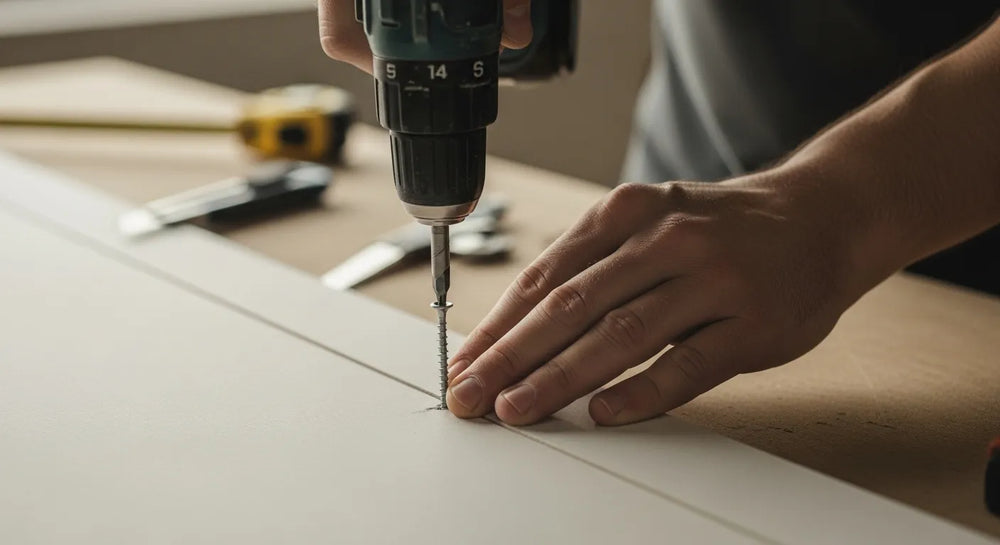
Selecting the Right Screws for a Concrete Wall
Table of Contents
- Introduction
- Understanding the Fundamentals: Why Concrete Requires Specialized Fasteners
- Types of Concrete Screws: A Detailed Breakdown
- Critical Selection Criteria for Your Application
- The Proper Installation Process: A Step-by-Step Guide for Success
- The Maden.co Advantage: Championing American Manufacturing for a Resilient Supply Chain
- Conclusion
- Frequently Asked Questions (FAQ)
Introduction
A project manager stands on a bustling job site, the air thick with the smell of curing concrete and the hum of machinery. The schedule is tight, and every hour counts. Suddenly, work grinds to a halt. The fasteners specified for mounting critical electrical conduit to a new concrete wall are failing, pulling out under a fraction of their expected load. The delay will now cascade, pushing back electricians, then inspectors, costing the project thousands of dollars and jeopardizing its deadline. This scenario, all too common, stems from a seemingly small detail: choosing the wrong screw for a concrete wall.
Selecting the correct fastener for concrete is not merely a hardware choice; it's a foundational decision that impacts structural integrity, project efficiency, and long-term safety. Unlike wood, which is fibrous and forgiving, concrete is a dense, brittle, and non-elastic substrate that demands a specialized engineering approach. Using the wrong screw can lead to catastrophic failure, project delays, and significant rework—risks that procurement managers, MRO buyers, and design engineers cannot afford to take.
This article provides a definitive resource for understanding the complexities of fastening into concrete walls. We will dissect the different types of concrete screws, explore the critical criteria for selecting the right one for your specific application, and detail the correct installation process that ensures maximum holding power. Furthermore, we will illustrate how partnering with a trusted American manufacturing marketplace like Maden.co not only provides access to superior, compliant products but also fortifies your supply chain against the volatility of global markets. Our aim is to empower you with the knowledge to make informed decisions that enhance safety, reduce total cost of ownership, and contribute to the success of your projects.
Understanding the Fundamentals: Why Concrete Requires Specialized Fasteners
To appreciate why specialized screws are necessary, one must first understand the nature of concrete itself. Concrete is exceptionally strong under compression (squeezing forces) but relatively weak under tension (pulling forces). It is a composite material made of aggregate (sand, gravel) and a binder (cement paste), resulting in a dense but porous and brittle structure.
When you drive a standard wood screw into a concrete wall, several problems arise:
- No Fiber to Grip: Wood screws rely on displacing and gripping wood fibers. Concrete has no fibers; it has aggregate and cured cement. The threads of a wood screw will simply grind against the material, creating dust and failing to achieve a secure purchase.
- Brittle Fracture: The wedging action of a standard screw can create immense localized pressure, causing the concrete around the hole to fracture or "spall," especially near an edge.
- Vibration and Loosening: Without proper thread engagement, vibrations can easily cause a standard screw to loosen and back out over time.
Concrete screws are engineered to overcome these challenges. They don't rely on displacing material but on a principle of mechanical interlock. By cutting precise threads into the walls of a pre-drilled pilot hole, they create a tight, continuous connection with the dense base material. This method generates high friction and holding power, allowing the fastener to resist both shear (sideways) and tensile (pull-out) forces effectively.
Types of Concrete Screws: A Detailed Breakdown
While the term "concrete screw" is often used broadly, several variations exist, each designed for specific applications, load requirements, and environmental conditions. The most common and versatile type is the self-tapping screw, often known by various brand names but sharing a common design principle.
Self-Tapping Concrete Screws
These are the workhorses of light to medium-duty fastening in concrete, brick, and block. Their defining feature is a specialized thread design that allows them to cut their own mating threads into a pre-drilled hole, eliminating the need for a separate anchor or insert.
Key Characteristics:
- Thread Design: They typically feature a high-low or serrated thread pattern. This design helps to cut into the concrete while efficiently clearing away dust and debris, preventing the screw from binding during installation.
-
Materials:
- Case-Hardened Carbon Steel: The most common material, offering high tensile strength for general-purpose applications. The surface is hardened to cut threads, while the core remains more ductile to resist snapping under torque.
- Stainless Steel: Used in applications where corrosion resistance is paramount, such as outdoor installations, chemical plants, or marine environments.
-
Protective Coatings: Because carbon steel is susceptible to rust, these screws are almost always coated. The quality and type of coating are critical for the fastener's longevity.
- Blue Ceramic Coating (Ruspert): This is a high-performance finish consisting of multiple layers, including a metallic zinc layer and a chemical-resistant ceramic topcoat. It provides excellent protection against corrosion, abrasion, and chemicals, making it ideal for outdoor or demanding indoor use. For projects requiring superior durability and a flush finish, a product like the Steel Blue Ruspert Ceramic Coating Flat Phillips® Drive Concrete Screw is an exemplary choice, offering both performance and a clean aesthetic.
- Zinc Plating: A standard, cost-effective coating suitable for dry, indoor environments where moisture is not a concern.
-
Head Styles: The head style determines how the screw sits on the surface of the fixture and what tool is used to drive it.
- Hex Head: This is the most common style, offering a large bearing surface and allowing for high installation torque using a standard socket or nut driver. It is ideal for mounting machinery, brackets, and structural supports. Products like these U.S.-Made Hex Head Concrete Screws are perfect for applications where maximum clamping force and ease of installation are priorities.
- Flat Head (Countersunk): Designed to sit flush with or below the surface of the material being fastened, providing a smooth, snag-free finish. This is essential for applications like installing door frames, window sills, or finished wall panels.
- Round Head (Pan Head): Features a low-profile dome and a flat bearing surface, suitable for attaching thin materials like electrical boxes or signage where a flush finish isn't required but a low profile is desirable.
Critical Selection Criteria for Your Application
Choosing the right screw goes beyond simply picking a type. A procurement professional or design engineer must evaluate several factors to ensure the fastener meets the project's specific demands. This methodical approach minimizes risk and maximizes performance.
1. Load Requirements: Understanding the Forces at Play
The single most important factor is the load the fastener will be subjected to. Loads are generally categorized into two types:
- Tensile Load (Pull-Out Force): This is the force trying to pull the screw straight out of the wall. Examples include hanging suspended ceilings, heavy shelving, or overhead pipes.
- Shear Load (Shear Force): This is the force acting parallel to the wall surface, trying to slice the screw in half. Examples include mounting a heavy television bracket, handrails, or wall-mounted equipment.
Many applications involve a combination of both. Always consult the manufacturer's technical data sheets, which provide performance metrics for different screw diameters and embedment depths in various strengths of concrete. Always apply a safety factor, typically 4:1, meaning the fastener's ultimate load capacity should be at least four times the expected working load.
2. Base Material: Not All Concrete Is Created Equal
The type and condition of the concrete wall will dramatically affect a screw's holding power.
- Poured Concrete: Generally offers the highest and most consistent density, providing the best base for secure anchoring.
- Concrete Block (CMU): Can be hollow or solid. Fastening into the solid sections or webs is crucial. Fastening into the hollow cores significantly reduces holding power and is not recommended for anything other than very light loads.
- Brick: The density and quality of brick can vary widely. It is essential to use a screw designed for masonry and to drill into the solid part of the brick, not the mortar joints, which are much weaker.
- Concrete Age: Freshly poured ("green") concrete has not reached its full compressive strength. Fasteners should only be installed in fully cured concrete, typically after 28 days.
3. Environmental Conditions and Corrosion Resistance
The environment where the fastener will be installed dictates the necessary level of corrosion protection. A fastener that rusts will not only lose its own structural integrity but can also expand and crack the surrounding concrete, leading to a complete failure of the connection.
- Dry, Indoor Environments: Standard zinc-plated carbon steel screws are generally sufficient.
- Damp or Humid Indoor Environments: (e.g., basements, warehouses) A higher-grade coating, such as a blue ceramic finish, is highly recommended to prevent premature rusting.
- Outdoor and High-Moisture Environments: For exterior walls, coastal areas, or industrial settings with chemical exposure, a high-performance coating is non-negotiable. The multi-layer protection of a Steel Blue Ruspert Ceramic Coating Flat Phillips® Drive Concrete Screw provides the necessary barrier against the elements, ensuring long-term reliability.
- Corrosive or Marine Environments: For the harshest conditions, such as wastewater treatment plants or applications exposed to salt spray, stainless steel concrete screws are the only suitable choice.
4. Embedment Depth and Spacing
These two geometric factors are critical for achieving the manufacturer's specified load values.
- Embedment Depth: This is the length of the screw embedded into the base material. Deeper embedment engages more concrete, creating a larger "cone of influence" and significantly increasing pull-out resistance. A screw's holding power is directly proportional to its embedment depth. Always follow the manufacturer's minimum and maximum recommended depths.
- Edge and Corner Distance: Installing a screw too close to an edge or corner of a concrete slab can cause a "blowout," where the pressure from the screw fractures and breaks off a chunk of concrete. A general rule of thumb is to maintain a minimum distance of ten anchor diameters from any unsupported edge.
- Spacing Between Fasteners: Placing screws too close to each other can cause their cones of influence to overlap, reducing the holding power of each fastener. Again, consult the manufacturer's data for minimum spacing requirements, which are often between ten and twenty anchor diameters.
The Proper Installation Process: A Step-by-Step Guide for Success
Even the highest quality screw will fail if installed incorrectly. The installation process requires precision and attention to detail. Skipping any of these steps compromises the integrity of the connection.
Step 1: Select the Right Tools You will need a hammer drill (not a standard drill), a proper-sized ANSI-compliant carbide-tipped drill bit, eye and ear protection, a wire brush, and a compressed air source or blow-out bulb.
Step 2: Drill the Pilot Hole The pilot hole is the foundation of the connection.
- Correct Diameter: Use the exact drill bit diameter specified by the screw manufacturer. A bit that is too small will make the screw impossible to drive, and one that is too large will result in no thread engagement.
- Correct Depth: Drill the hole at least 1/2" deeper than the intended screw embedment. This extra space allows room for any remaining dust to collect without preventing the screw from reaching its full depth.
- Perpendicular Drilling: Hold the drill perpendicular to the wall surface to ensure the screw is installed straight, preventing uneven stress.
Step 3: Clean the Hole Thoroughly This is the most frequently skipped and most critical step. Concrete dust left in the hole acts as a lubricant and barrier, preventing the screw's threads from making full contact with the base material. This can reduce the fastener's holding power by over 50%.
- Use a wire brush to scrub the inside of the hole, loosening any packed dust.
- Use a blow-out bulb or oil-free compressed air to completely clear all debris from the hole. Repeat this brush-and-blow process at least twice.
Step 4: Drive the Screw
- Using the correct driver bit (e.g., Phillips, hex driver), insert the tip of the screw into the clean pilot hole.
- Drive the screw steadily until the head is seated firmly against the fixture. For an MRO buyer needing to securely mount new safety railings, a product like the 1/4" x 2-3/4" Flat Head Concrete Screws ensures a robust and reliable installation when these steps are followed precisely.
- Do Not Over-Torque: Over-tightening the screw can strip the threads it has just cut in the concrete or, in the worst case, snap the screw itself. Use a torque wrench if precise values are required, or develop a feel for when the screw is snug.
The Maden.co Advantage: Championing American Manufacturing for a Resilient Supply Chain
In an era of unpredictable global logistics, the strategic value of a reliable domestic supply chain cannot be overstated. At Maden.co, our entire business model is built on the principle of strengthening American industry. Our mission is to democratize access to U.S. manufacturing, proving that American-made components are as accessible and convenient as any global alternative. You can learn more about our commitment to this mission and our core values of Industrial Excellence and Supply Chain Transparency by visiting our About Us page.
For a procurement manager, sourcing fasteners through our platform offers distinct advantages that go far beyond the product itself:
- Supply Chain Resilience: Our network of over 800 verified U.S. manufacturers provides a buffer against international shipping delays, port closures, and geopolitical instability. You get shorter lead times and greater predictability, keeping your projects on track.
- Uncompromising Quality and Compliance: American manufacturers are known for their adherence to rigorous quality control standards. When you source fasteners from our platform, you gain confidence that they meet or exceed industry specifications (e.g., ANSI, ASTM), ensuring material traceability and consistent performance. This is critical for engineers who cannot compromise on safety and reliability.
- Reduced Total Cost of Ownership (TCO): While a foreign-made screw might have a lower initial price, the TCO is often much higher. This hidden cost includes expenses from project delays due to shipping, rework caused by inferior quality products, and the administrative burden of managing complex international supply chains. Sourcing verified, American-made products minimizes these risks, leading to a lower overall project cost.
- Customer Empowerment through Digital Innovation: We've built a platform that removes the friction from industrial procurement. Instead of spending hours tracking down a specific type of concrete screw, you can search our catalog of over 2.5 million products and find exactly what you need in minutes. If you have specific sourcing questions or need help navigating our extensive catalog, our team is ready to help.
And for the bedrock of our nation's industry—are you a U.S. manufacturer? Register as a vendor and join the American manufacturing revival. We are building the definitive platform to connect your products with businesses across the country.
Streamlining Your Procurement with Instant Financing
We understand that managing cash flow is critical for businesses of all sizes. For large-scale projects or capital-intensive equipment purchases, waiting on traditional financing can cause unnecessary delays. That's why we offer a powerful tool directly within our platform. You can apply for Instant Financing at checkout to streamline your capital-intensive projects, allowing you to acquire the materials you need now and manage your payments in a way that suits your budget. This isn't just a payment option; it's a strategic advantage that keeps your operations moving forward.
Conclusion
The question of "what screws for concrete wall" does not have a one-size-fits-all answer. The correct choice is a calculated decision based on a thorough analysis of load requirements, base material, environmental exposure, and proper installation geometry. By understanding these principles, you can transform a potential point of failure into a source of strength and reliability for your projects.
More than just a technical exercise, your procurement strategy is an opportunity to build a more robust and resilient business. By choosing to source high-quality, American-made fasteners from Maden.co, you are not only ensuring the integrity of your work but also investing in a stronger domestic supply chain. You gain access to verified products, reduce your exposure to global disruptions, and benefit from a streamlined purchasing process designed for the modern industrial buyer.
Don't let a small component create a major project roadblock. Explore our extensive catalog of U.S.-made concrete screws and other industrial components today. Build with confidence, secure your supply chain, and leverage strategic tools like Instant Financing at checkout to power your success. America's manufacturing revival is here, and we are proud to be your partner in it.
Frequently Asked Questions (FAQ)
1. Can I reuse concrete screws? It is strongly advised not to reuse concrete screws. The process of driving the screw cuts threads into the concrete, but it also causes wear on the screw's own hardened threads. When removed and reinstalled, the screw's ability to cut clean, new threads is diminished, and its holding power can be significantly reduced, creating an unsafe connection.
2. What is the main difference between a concrete screw and a wedge anchor? The primary difference lies in their application and function. A concrete screw is a self-tapping fastener ideal for light to medium-duty applications and is generally removable. A wedge anchor is a heavy-duty, expansion-style anchor that is permanent. It is installed by hammering it into a pre-drilled hole and then tightening a nut, which pulls a cone into an expansion clip, wedging it firmly against the concrete walls. Wedge anchors are used for structural connections and mounting very heavy equipment.
3. How do I know what size pilot hole to drill for my concrete screw? The manufacturer's technical data sheet is the only reliable source for this information. The required pilot hole diameter is specific to the screw's brand, diameter, and even the type of base material. As a general rule, the ANSI-standard carbide bit will be slightly smaller than the nominal diameter of the screw (e.g., a 1/4" screw often requires a 3/16" bit), but you must always verify the exact specification to ensure proper installation and performance.
4. Why is cleaning the hole so important before installing a concrete screw? Cleaning the hole is arguably the most critical step for achieving maximum holding power. The dust and debris created during drilling act as a barrier between the screw's threads and the solid concrete. If left in the hole, this dust prevents the threads from fully engaging and locking into the base material. This can reduce the screw's ultimate pull-out and shear strength by 50% or more, compromising the safety and integrity of the fixture.


